 Image 1 of 4
 Image 2 of 4
 Image 3 of 4
 Image 4 of 4
Digital Interactive Lesson with Narrative Modeling & Reaction Identification Practice.
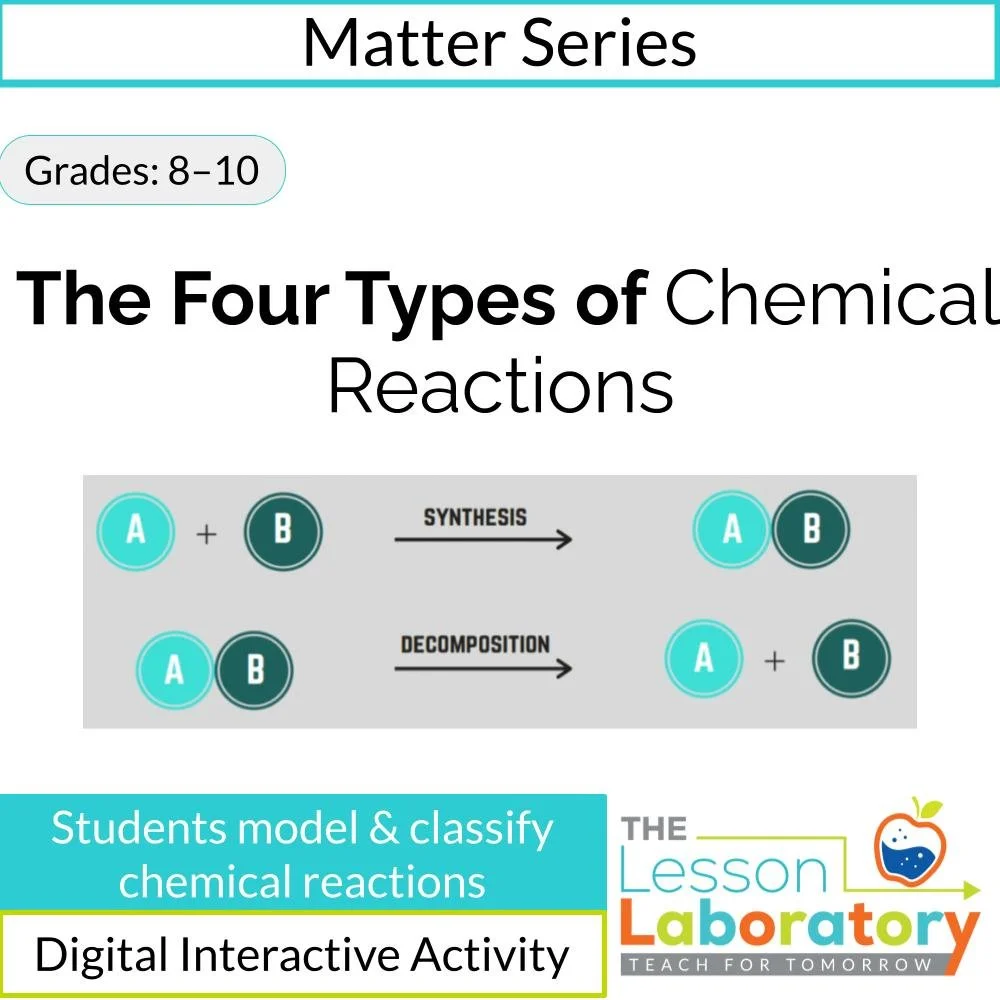
This structured digital lesson introduces the four primary reaction types through guided instruction, conceptual modeling, and applied practice.
Students begin with a focused warm-up before moving into direct instruction on synthesis, decomposition, single replacement, and double replacement reactions. Visual diagrams and scaffolded examples help students recognize patterns in how reactants rearrange to form products.
The central modeling activity invites students to write structured “reaction stories” that anthropomorphize chemical changes. This narrative approach is not used for novelty, but as a tool for reinforcing particle-level rearrangement and symbolic interpretation. By translating reaction patterns into story form, students deepen their understanding of how atoms reorganize during chemical change.
The lesson concludes with reaction identification practice and a concise exit ticket to assess mastery within a single class period.
Classifying reaction types
Interpreting symbolic chemical equations
Modeling reactant-to-product rearrangements
Connecting particle-level changes to equation form
Reinforcing reaction identification skills
Warm-up activity
Direct instruction slides with diagrams
Structured reaction modeling activity
Scaffolded reaction identification practice
Exit ticket for formative assessment
Fully editable Google Slides
Teacher key and pacing guidance
Middle school physical science
Introductory high school chemistry
Early-year chemistry foundations units
Review of reaction types in biology-aligned courses
This lesson strengthens foundational chemical literacy while providing a structured, memorable approach to reaction classification.
To see a preview of this lesson, click here.
NGSS Alignment (High School):
HS-PS1-2
NGSS Alignment (Middle School):
MS-PS1-2
Science & Engineering Practices (SEPs):
Developing and Using Models
Analyzing and Interpreting Data
Constructing Explanations
Crosscutting Concepts (CCCs):
Cause and Effect
Energy and Matter
Patterns
Common Core (Literacy in Science):
RST.6-8.7 / RST.9-10.7; WHST.6-8.2 / WHST.9-10.2
Digital Interactive Lesson with Narrative Modeling & Reaction Identification Practice.
This structured digital lesson introduces the four primary reaction types through guided instruction, conceptual modeling, and applied practice.
Students begin with a focused warm-up before moving into direct instruction on synthesis, decomposition, single replacement, and double replacement reactions. Visual diagrams and scaffolded examples help students recognize patterns in how reactants rearrange to form products.
The central modeling activity invites students to write structured “reaction stories” that anthropomorphize chemical changes. This narrative approach is not used for novelty, but as a tool for reinforcing particle-level rearrangement and symbolic interpretation. By translating reaction patterns into story form, students deepen their understanding of how atoms reorganize during chemical change.
The lesson concludes with reaction identification practice and a concise exit ticket to assess mastery within a single class period.
Classifying reaction types
Interpreting symbolic chemical equations
Modeling reactant-to-product rearrangements
Connecting particle-level changes to equation form
Reinforcing reaction identification skills
Warm-up activity
Direct instruction slides with diagrams
Structured reaction modeling activity
Scaffolded reaction identification practice
Exit ticket for formative assessment
Fully editable Google Slides
Teacher key and pacing guidance
Middle school physical science
Introductory high school chemistry
Early-year chemistry foundations units
Review of reaction types in biology-aligned courses
This lesson strengthens foundational chemical literacy while providing a structured, memorable approach to reaction classification.
To see a preview of this lesson, click here.
NGSS Alignment (High School):
HS-PS1-2
NGSS Alignment (Middle School):
MS-PS1-2
Science & Engineering Practices (SEPs):
Developing and Using Models
Analyzing and Interpreting Data
Constructing Explanations
Crosscutting Concepts (CCCs):
Cause and Effect
Energy and Matter
Patterns
Common Core (Literacy in Science):
RST.6-8.7 / RST.9-10.7; WHST.6-8.2 / WHST.9-10.2