 Image 1 of 4
 Image 2 of 4
 Image 3 of 4
 Image 4 of 4
A Digital Biology Lesson on Male Competition, Female Choice, Fitness, and Environmental Pressures.
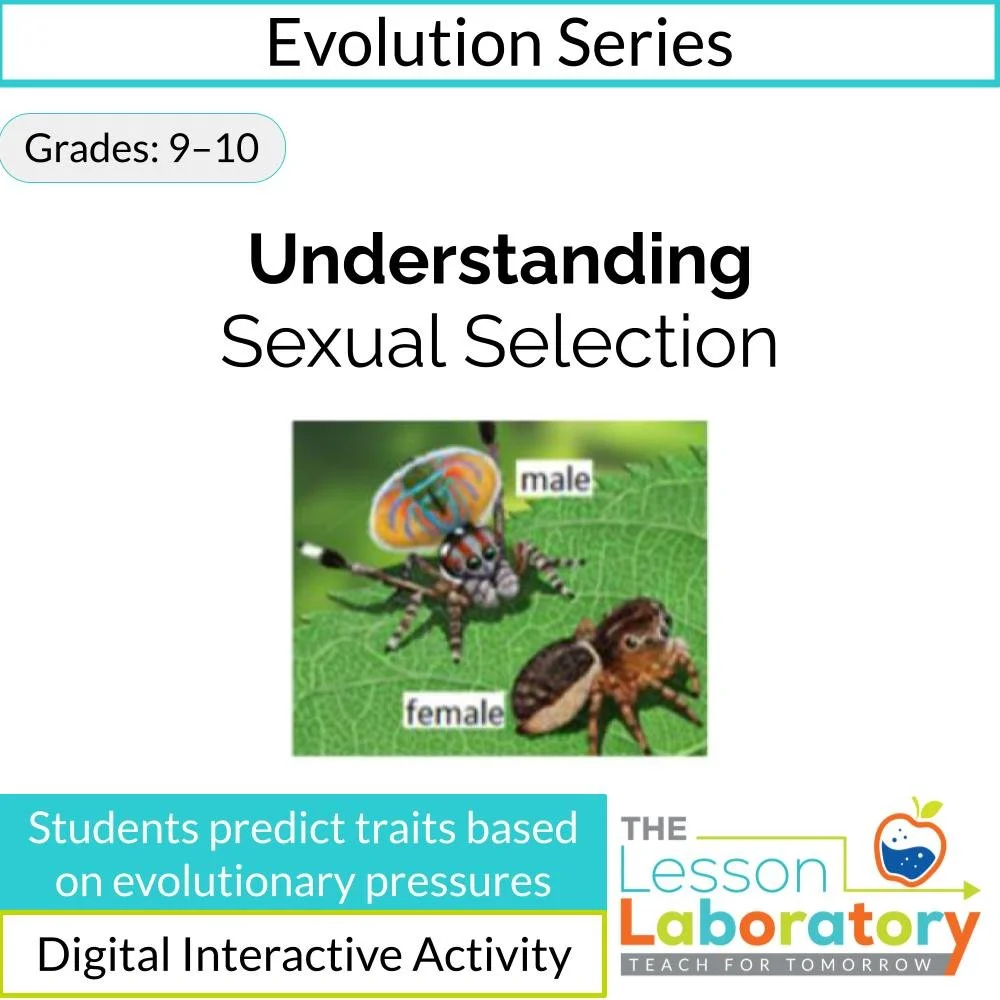
This digital lesson helps students distinguish natural selection from sexual selection and analyze the environmental conditions that favor each mechanism.
Rather than memorizing definitions, students work through structured comparisons of male competition and female choice. They examine real organisms across multiple taxa and identify how ornamentation, body size, and behavioral traits evolve under different ecological pressures.
Students analyze classic experimental studies, including John Endler’s guppy research and Malte Andersson’s long-tailed widowbird experiment, to evaluate how predator presence and mate choice influence trait development. Throughout the lesson, students respond to reasoning prompts, complete comparison organizers, and apply selection logic to new scenarios.
The lesson concludes with a creative application task in which students design male and female phenotypes for organisms living under distinct environmental pressures. This activity requires students to justify trait development using evolutionary mechanisms rather than simple description.
This resource supports instruction on natural vs. sexual selection, reinforces core evolution mechanisms, and strengthens students’ ability to connect environmental conditions to trait outcomes.
Digital slide lesson with editable student tasks
Structured comparison of natural and sexual selection
Male competition vs. female choice analysis framework
Real organism case studies (lizards, arthropods, mammals, fish)
Endler’s guppy predator study analysis
Andersson’s widowbird tail experiment
Environmental pressure synthesis table
Creative phenotype design application
Printable exit ticket
Complete teacher key
Clarifies the distinction between survival advantage and mating success
Connects environmental conditions to evolutionary outcomes
Integrates authentic experimental evidence
Promotes predictive and evidence-based reasoning
Ready-to-use digital format with structured progression
This lesson moves beyond definitions and helps students understand how and why sexual selection operates within broader evolutionary systems.
To see a preview of this lesson, click here.
NGSS Alignment (High School):
HS-LS4-2; HS-LS4-3; HS-LS4-4
Science & Engineering Practices (SEPs):
Developing and Using Models
Analyzing and Interpreting Data
Constructing Explanations
Engaging in Argument from Evidence
Crosscutting Concepts (CCCs):
Cause and Effect
Systems and System Models
Stability and Change
Common Core (Literacy in Science):
CCSS.ELA-LITERACY.RST.9-10.3; CCSS.ELA-LITERACY.WHST.9-12.2
Bundle Upgrade Policy
This lesson is included in one or more bundles. To support flexible purchasing and long-term use of our curriculum, Lesson Laboratory offers a bundle upgrade policy.
If you purchase this lesson and decide at a later date that you would like to upgrade to a bundle, you may request a store credit equal to the total amount paid for duplicate items.
To request an upgrade credit, please email thelessonlaboratory@gmail.com and include:
Your username
The order numbers for both the original purchase(s) and the bundle
The names of the duplicate resources
Requests must be submitted within 30 days of the bundle purchase. Credits are issued as store credit for future Lesson Laboratory purchases and are not provided as cash refunds.
This policy applies only to purchases of resources that are later included in a Lesson Laboratory bundle and is limited to one adjustment per upgrade pathway.
A Digital Biology Lesson on Male Competition, Female Choice, Fitness, and Environmental Pressures.
This digital lesson helps students distinguish natural selection from sexual selection and analyze the environmental conditions that favor each mechanism.
Rather than memorizing definitions, students work through structured comparisons of male competition and female choice. They examine real organisms across multiple taxa and identify how ornamentation, body size, and behavioral traits evolve under different ecological pressures.
Students analyze classic experimental studies, including John Endler’s guppy research and Malte Andersson’s long-tailed widowbird experiment, to evaluate how predator presence and mate choice influence trait development. Throughout the lesson, students respond to reasoning prompts, complete comparison organizers, and apply selection logic to new scenarios.
The lesson concludes with a creative application task in which students design male and female phenotypes for organisms living under distinct environmental pressures. This activity requires students to justify trait development using evolutionary mechanisms rather than simple description.
This resource supports instruction on natural vs. sexual selection, reinforces core evolution mechanisms, and strengthens students’ ability to connect environmental conditions to trait outcomes.
Digital slide lesson with editable student tasks
Structured comparison of natural and sexual selection
Male competition vs. female choice analysis framework
Real organism case studies (lizards, arthropods, mammals, fish)
Endler’s guppy predator study analysis
Andersson’s widowbird tail experiment
Environmental pressure synthesis table
Creative phenotype design application
Printable exit ticket
Complete teacher key
Clarifies the distinction between survival advantage and mating success
Connects environmental conditions to evolutionary outcomes
Integrates authentic experimental evidence
Promotes predictive and evidence-based reasoning
Ready-to-use digital format with structured progression
This lesson moves beyond definitions and helps students understand how and why sexual selection operates within broader evolutionary systems.
To see a preview of this lesson, click here.
NGSS Alignment (High School):
HS-LS4-2; HS-LS4-3; HS-LS4-4
Science & Engineering Practices (SEPs):
Developing and Using Models
Analyzing and Interpreting Data
Constructing Explanations
Engaging in Argument from Evidence
Crosscutting Concepts (CCCs):
Cause and Effect
Systems and System Models
Stability and Change
Common Core (Literacy in Science):
CCSS.ELA-LITERACY.RST.9-10.3; CCSS.ELA-LITERACY.WHST.9-12.2
Bundle Upgrade Policy
This lesson is included in one or more bundles. To support flexible purchasing and long-term use of our curriculum, Lesson Laboratory offers a bundle upgrade policy.
If you purchase this lesson and decide at a later date that you would like to upgrade to a bundle, you may request a store credit equal to the total amount paid for duplicate items.
To request an upgrade credit, please email thelessonlaboratory@gmail.com and include:
Your username
The order numbers for both the original purchase(s) and the bundle
The names of the duplicate resources
Requests must be submitted within 30 days of the bundle purchase. Credits are issued as store credit for future Lesson Laboratory purchases and are not provided as cash refunds.
This policy applies only to purchases of resources that are later included in a Lesson Laboratory bundle and is limited to one adjustment per upgrade pathway.