 Image 1 of 4
 Image 2 of 4
 Image 3 of 4
 Image 4 of 4
Student-Centered Biology Lesson on Natural Selection, Genetic Drift, and Gene Flow.
Most students can describe natural selection. Far fewer can explain what evolution actually means at the population level.
This lesson is designed to close that gap.
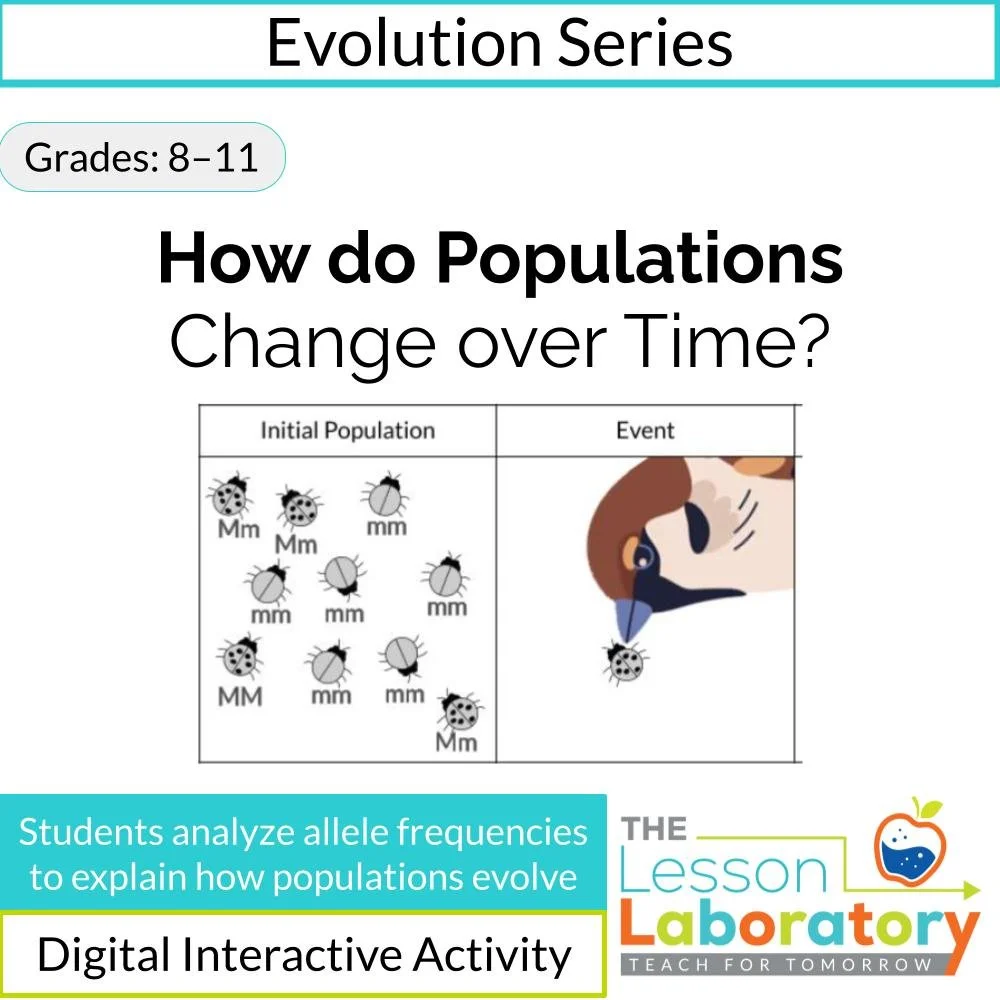
Students build a clear, working understanding of evolution by focusing on its most accurate definition: a change in allele frequency over time. Rather than memorizing terms or completing isolated calculations, students analyze populations, track changes across generations, and explain why those changes occur.
What Makes This Lesson Different
Population-level evolution is one of the most commonly taught—and most commonly misunderstood—topics in biology. Many lessons rely on formulas or disconnected examples that fail to build a coherent model.
This lesson takes a different approach.
Students begin by examining simple populations and identifying what it actually means for a population to evolve. They then calculate and interpret allele frequencies, observe what happens when a population remains stable, and analyze multiple scenarios that disrupt that stability.
Through this progression, students construct a complete understanding of how evolution works at the genetic level.
What Students Do
Define evolution using allele frequency and apply it to real scenarios
Calculate and interpret allele frequencies in populations
Analyze how natural selection, genetic drift, gene flow, mutation, and sexual selection affect populations
Distinguish between changes caused by advantage and chance
Apply concepts to real-world examples of population change
Construct written explanations using scientific reasoning
Instructional Design
This lesson is built around a consistent model: students learn by identifying patterns and explaining change.
Each scenario follows a repeated reasoning structure, allowing students to:
determine whether evolution has occurred
identify which allele has changed in frequency
explain why that change occurred
This structure reduces cognitive overload while maintaining high expectations for reasoning and explanation.
The lesson concludes with a synthesis task in which students define evolution precisely and apply that definition to a real example, ensuring that understanding is both accurate and transferable.
What’s Included
Student-facing Google Slides lesson
Guided introduction to alleles and allele frequency
Multiple structured evolution scenarios
Real-world application examples
Final synthesis analysis task
Exit ticket
Teacher key
Grade Range
Grades 8–11 (General Biology / Life Science)
Why Teachers Use This Lesson
Clarifies one of the most misunderstood concepts in biology
Moves beyond formulas to conceptual understanding
Builds strong reasoning through repeated structure
Produces clear, defensible written student responses
Requires no prep and is ready to teach
Value
This lesson provides a complete, student-centered approach to population-level evolution. It helps students move from recognizing evolutionary patterns to explaining them accurately, making it an essential component of any evolution unit.
To see a preview of this lesson, click here.
NGSS Alignment (High School):
HS-LS4-2; HS-LS4-3; HS-LS4-4
NGSS Alignment (Middle School):
MS-LS4-4; MS-LS4-6
Science & Engineering Practices (SEPs):
Analyzing and Interpreting Data
Using Mathematics and Computational Thinking
Constructing Explanations
Engaging in Argument from Evidence
Crosscutting Concepts (CCCs):
Cause and Effect
Stability and Change
Common Core (Literacy in Science):
RST.6-8.1 / RST.9-10.1
RST.6-8.7 / RST.9-10.7
WHST.6-8.2 / WHST.9-10.2
Bundle Upgrade Policy
This lesson is included in one or more bundles. To support flexible purchasing and long-term use of our curriculum, Lesson Laboratory offers a bundle upgrade policy.
If you purchase this lesson and decide at a later date that you would like to upgrade to a bundle, you may request a store credit equal to the total amount paid for duplicate items.
To request an upgrade credit, please email thelessonlaboratory@gmail.com and include:
Your username
The order numbers for both the original purchase(s) and the bundle
The names of the duplicate resources
Requests must be submitted within 30 days of the bundle purchase. Credits are issued as store credit for future Lesson Laboratory purchases and are not provided as cash refunds.
This policy applies only to purchases of resources that are later included in a Lesson Laboratory bundle and is limited to one adjustment per upgrade pathway.
Student-Centered Biology Lesson on Natural Selection, Genetic Drift, and Gene Flow.
Most students can describe natural selection. Far fewer can explain what evolution actually means at the population level.
This lesson is designed to close that gap.
Students build a clear, working understanding of evolution by focusing on its most accurate definition: a change in allele frequency over time. Rather than memorizing terms or completing isolated calculations, students analyze populations, track changes across generations, and explain why those changes occur.
What Makes This Lesson Different
Population-level evolution is one of the most commonly taught—and most commonly misunderstood—topics in biology. Many lessons rely on formulas or disconnected examples that fail to build a coherent model.
This lesson takes a different approach.
Students begin by examining simple populations and identifying what it actually means for a population to evolve. They then calculate and interpret allele frequencies, observe what happens when a population remains stable, and analyze multiple scenarios that disrupt that stability.
Through this progression, students construct a complete understanding of how evolution works at the genetic level.
What Students Do
Define evolution using allele frequency and apply it to real scenarios
Calculate and interpret allele frequencies in populations
Analyze how natural selection, genetic drift, gene flow, mutation, and sexual selection affect populations
Distinguish between changes caused by advantage and chance
Apply concepts to real-world examples of population change
Construct written explanations using scientific reasoning
Instructional Design
This lesson is built around a consistent model: students learn by identifying patterns and explaining change.
Each scenario follows a repeated reasoning structure, allowing students to:
determine whether evolution has occurred
identify which allele has changed in frequency
explain why that change occurred
This structure reduces cognitive overload while maintaining high expectations for reasoning and explanation.
The lesson concludes with a synthesis task in which students define evolution precisely and apply that definition to a real example, ensuring that understanding is both accurate and transferable.
What’s Included
Student-facing Google Slides lesson
Guided introduction to alleles and allele frequency
Multiple structured evolution scenarios
Real-world application examples
Final synthesis analysis task
Exit ticket
Teacher key
Grade Range
Grades 8–11 (General Biology / Life Science)
Why Teachers Use This Lesson
Clarifies one of the most misunderstood concepts in biology
Moves beyond formulas to conceptual understanding
Builds strong reasoning through repeated structure
Produces clear, defensible written student responses
Requires no prep and is ready to teach
Value
This lesson provides a complete, student-centered approach to population-level evolution. It helps students move from recognizing evolutionary patterns to explaining them accurately, making it an essential component of any evolution unit.
To see a preview of this lesson, click here.
NGSS Alignment (High School):
HS-LS4-2; HS-LS4-3; HS-LS4-4
NGSS Alignment (Middle School):
MS-LS4-4; MS-LS4-6
Science & Engineering Practices (SEPs):
Analyzing and Interpreting Data
Using Mathematics and Computational Thinking
Constructing Explanations
Engaging in Argument from Evidence
Crosscutting Concepts (CCCs):
Cause and Effect
Stability and Change
Common Core (Literacy in Science):
RST.6-8.1 / RST.9-10.1
RST.6-8.7 / RST.9-10.7
WHST.6-8.2 / WHST.9-10.2
Bundle Upgrade Policy
This lesson is included in one or more bundles. To support flexible purchasing and long-term use of our curriculum, Lesson Laboratory offers a bundle upgrade policy.
If you purchase this lesson and decide at a later date that you would like to upgrade to a bundle, you may request a store credit equal to the total amount paid for duplicate items.
To request an upgrade credit, please email thelessonlaboratory@gmail.com and include:
Your username
The order numbers for both the original purchase(s) and the bundle
The names of the duplicate resources
Requests must be submitted within 30 days of the bundle purchase. Credits are issued as store credit for future Lesson Laboratory purchases and are not provided as cash refunds.
This policy applies only to purchases of resources that are later included in a Lesson Laboratory bundle and is limited to one adjustment per upgrade pathway.