Anatomical Terminology Digital Lab & Escape Room – Relative Position, Body Regions & Doctor Simulation

$6.50

A Fully Digital Anatomy Lesson with Interactive Practice, Medical Case Tasks & a Google Forms Mini Escape Room.

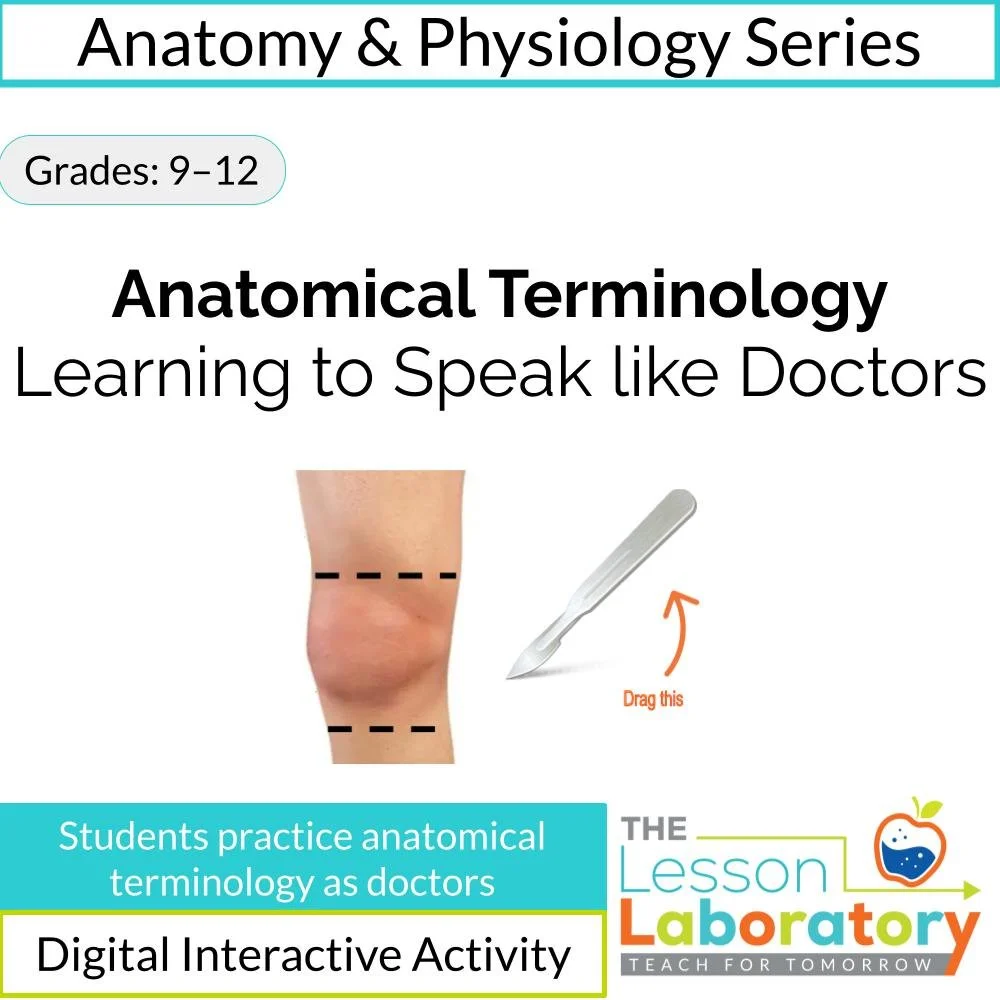
Help your students finally master the most confusing part of early anatomy: anatomical terminology. This fully digital, highly engaging lesson guides students through relative position, body regions, and directional terminology using a scaffolded sequence of review, interactives, a miniature Google Forms escape room, and a hands-on Doctor Simulation Challenge.

Perfect for Anatomy & Physiology, Biomedical Science, Health Science, Sports Medicine, or any course that introduces body orientation vocabulary.

What’s Included

✔ Google Slides Interactive Lesson

Students progress through:

  • Levels of structural organization review

  • Anatomical reference diagrams for visual orientation

  • An external online interactive activity with screenshot upload

  • “Act as a Doctor” clickable case tasks requiring correct anatomical terminology application

✔ Google Forms Mini Escape Room

In Escape the Mad Doctor’s Office, students must:

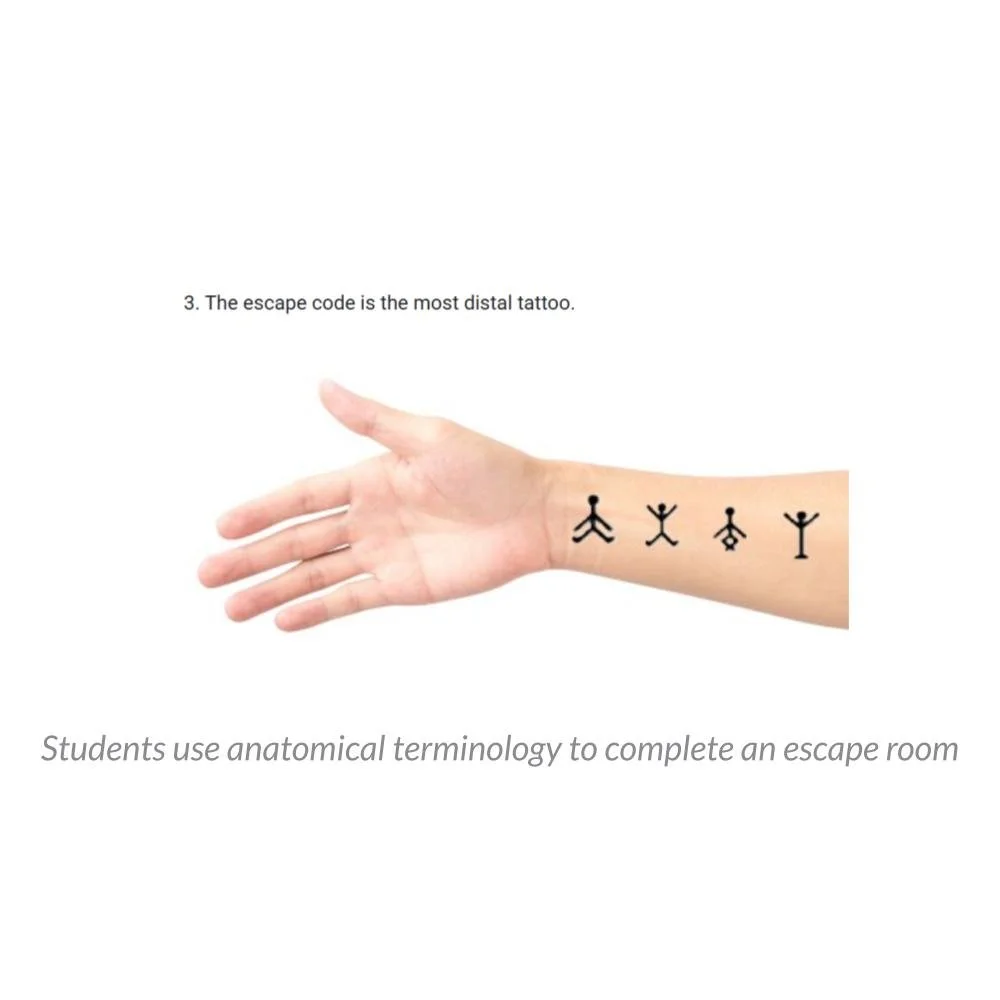
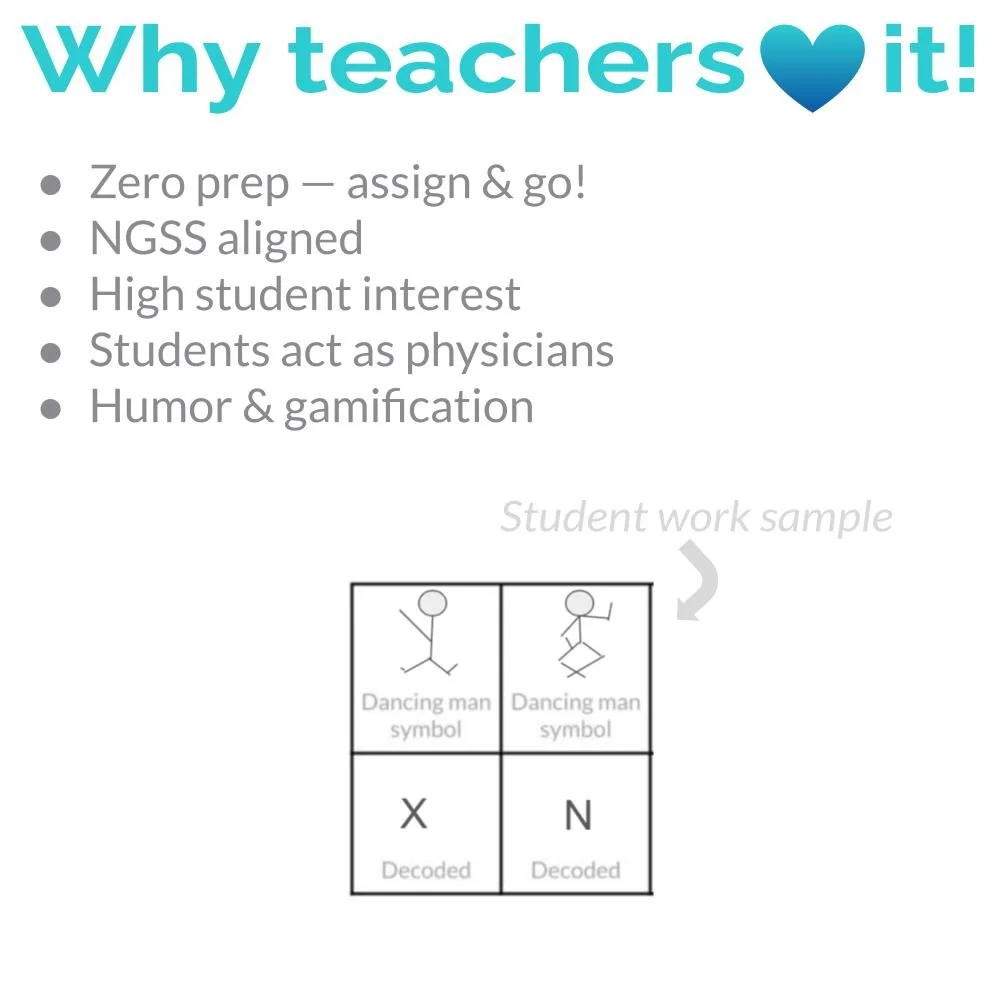
  • Interpret wacky dancing-man tattoos on patients

  • Identify positions such as superior, proximal, distal, ventral, medial

  • Solve five anatomical-location puzzles to decode a secret phrase

This escape room format transforms vocabulary practice into a memorable, low-stress challenge.

✔ Built-In Assessment Tools

  • Self-scoring doctor performance tasks

  • A printable/literacy-based exit ticket

  • Teacher key included for all tasks and puzzles

Why Teachers Love It

  • Zero prep — everything is digital and ready to assign

  • Multiple modalities: visual diagrams, clickable tasks, puzzle decoding, and a simulation

  • High student buy-in thanks to gamification and humor

  • Perfect early-unit assessment for anatomy terminology

  • Scaffolded from review → guided practice → independent application

  • Works great for one-to-one classrooms, sub plans, or absent-student make-up work

Grade & Course Recommendations

Best Fit Grades

Grades 9–12

Ideal Courses

  • Anatomy & Physiology

  • Biology (anatomy unit)

  • Health Science Foundations / CTE pathways

  • Biomedical Science

  • Sports Medicine

  • Forensics (orientation vocabulary)

Rationale

Students must interpret positional terminology using real anatomical images (Pages 8–12) and apply those terms to precise medical actions — a skill aligned to high school-level anatomy and health science competencies.

Cross-Curricular Connections & Extensions

ELA / Technical Reading

  • Students decode anatomical instructions (“Amputate proximal to the knee”) which requires precise reading comprehension.

  • Extension: write their own “doctor orders” using anatomical terminology.

Career & Technical Education (CTE)

  • Reinforces skills used in medical assisting, sports medicine, and nursing programs.

  • Extension: students create a patient chart documenting injuries using correct terminology.

Problem-Solving / Logic

The escape room puzzles (Google Forms file) require deductive reasoning and spatial logic tied to anatomical vocabulary.

Daily slide + literacy - based exit ticket included with purchase

Join the Lesson Laboratory and Teach for Tomorrow!

NGSS Alignment

This lesson strongly aligns to NGSS Science & Engineering Practices and Crosscutting Concepts, with lighter alignment to DCIs because anatomical terminology is foundational vocabulary.

Disciplinary Core Ideas (DCIs)

HS-LS1-2 — Structure and Function
Students analyze body structures to determine correct anatomical positions (Pages 4, 8–12).

Anatomical Terminology_ Learnin…

HS-LS1-1 / LS1.A — Body Organization
Levels of structural organization review (Page 3) reinforces hierarchical structure.

Anatomical Terminology_ Learnin…

HS-LS1-3 — Homeostasis & Systems
Doctor simulation tasks require interpreting patient conditions using anatomical orientation.

Science & Engineering Practices (SEPs)

Analyzing & Interpreting Data
Students interpret anatomical images, tattoos, and spatial orientation clues.

Obtaining, Evaluating & Communicating Information
Students follow precise physician-style directions to produce correct actions.

Using Models
Human-body diagrams serve as models for determining orientation.

Crosscutting Concepts (CCCs)

Structure & Function
Anatomical terminology is used to describe structural relationships.

Systems & System Models
Understanding body regions and positions supports systems-level thinking.

Scale, Proportion & Quantity
Several tasks reference scale and relative location (superior/inferior, proximal/distal).

Common Core ELA Standards

Although this is a science lesson, students engage in technical reading and direction-following.

CCSS.ELA-LITERACY.RST.9-10.3/RST.11-12.3
Follow precisely a multistep procedure when carrying out experiments or tasks.

CCSS.ELA-LITERACY.RST.9-10.4/RST.11-12.4
Determine the meaning of domain-specific anatomical terminology.

CCSS.ELA-LITERACY.RST.9-10.7/RST.11-12.7
Translate visual anatomical information into text-based conclusions.

A Fully Digital Anatomy Lesson with Interactive Practice, Medical Case Tasks & a Google Forms Mini Escape Room.

Help your students finally master the most confusing part of early anatomy: anatomical terminology. This fully digital, highly engaging lesson guides students through relative position, body regions, and directional terminology using a scaffolded sequence of review, interactives, a miniature Google Forms escape room, and a hands-on Doctor Simulation Challenge.

Perfect for Anatomy & Physiology, Biomedical Science, Health Science, Sports Medicine, or any course that introduces body orientation vocabulary.

What’s Included

✔ Google Slides Interactive Lesson

Students progress through:

  • Levels of structural organization review

  • Anatomical reference diagrams for visual orientation

  • An external online interactive activity with screenshot upload

  • “Act as a Doctor” clickable case tasks requiring correct anatomical terminology application

✔ Google Forms Mini Escape Room

In Escape the Mad Doctor’s Office, students must:

  • Interpret wacky dancing-man tattoos on patients

  • Identify positions such as superior, proximal, distal, ventral, medial

  • Solve five anatomical-location puzzles to decode a secret phrase

This escape room format transforms vocabulary practice into a memorable, low-stress challenge.

✔ Built-In Assessment Tools

  • Self-scoring doctor performance tasks

  • A printable/literacy-based exit ticket

  • Teacher key included for all tasks and puzzles

Why Teachers Love It

  • Zero prep — everything is digital and ready to assign

  • Multiple modalities: visual diagrams, clickable tasks, puzzle decoding, and a simulation

  • High student buy-in thanks to gamification and humor

  • Perfect early-unit assessment for anatomy terminology

  • Scaffolded from review → guided practice → independent application

  • Works great for one-to-one classrooms, sub plans, or absent-student make-up work

Grade & Course Recommendations

Best Fit Grades

Grades 9–12

Ideal Courses

  • Anatomy & Physiology

  • Biology (anatomy unit)

  • Health Science Foundations / CTE pathways

  • Biomedical Science

  • Sports Medicine

  • Forensics (orientation vocabulary)

Rationale

Students must interpret positional terminology using real anatomical images (Pages 8–12) and apply those terms to precise medical actions — a skill aligned to high school-level anatomy and health science competencies.

Cross-Curricular Connections & Extensions

ELA / Technical Reading

  • Students decode anatomical instructions (“Amputate proximal to the knee”) which requires precise reading comprehension.

  • Extension: write their own “doctor orders” using anatomical terminology.

Career & Technical Education (CTE)

  • Reinforces skills used in medical assisting, sports medicine, and nursing programs.

  • Extension: students create a patient chart documenting injuries using correct terminology.

Problem-Solving / Logic

The escape room puzzles (Google Forms file) require deductive reasoning and spatial logic tied to anatomical vocabulary.

Daily slide + literacy - based exit ticket included with purchase

Join the Lesson Laboratory and Teach for Tomorrow!

NGSS Alignment

This lesson strongly aligns to NGSS Science & Engineering Practices and Crosscutting Concepts, with lighter alignment to DCIs because anatomical terminology is foundational vocabulary.

Disciplinary Core Ideas (DCIs)

HS-LS1-2 — Structure and Function
Students analyze body structures to determine correct anatomical positions (Pages 4, 8–12).

Anatomical Terminology_ Learnin…

HS-LS1-1 / LS1.A — Body Organization
Levels of structural organization review (Page 3) reinforces hierarchical structure.

Anatomical Terminology_ Learnin…

HS-LS1-3 — Homeostasis & Systems
Doctor simulation tasks require interpreting patient conditions using anatomical orientation.

Science & Engineering Practices (SEPs)

Analyzing & Interpreting Data
Students interpret anatomical images, tattoos, and spatial orientation clues.

Obtaining, Evaluating & Communicating Information
Students follow precise physician-style directions to produce correct actions.

Using Models
Human-body diagrams serve as models for determining orientation.

Crosscutting Concepts (CCCs)

Structure & Function
Anatomical terminology is used to describe structural relationships.

Systems & System Models
Understanding body regions and positions supports systems-level thinking.

Scale, Proportion & Quantity
Several tasks reference scale and relative location (superior/inferior, proximal/distal).

Common Core ELA Standards

Although this is a science lesson, students engage in technical reading and direction-following.

CCSS.ELA-LITERACY.RST.9-10.3/RST.11-12.3
Follow precisely a multistep procedure when carrying out experiments or tasks.

CCSS.ELA-LITERACY.RST.9-10.4/RST.11-12.4
Determine the meaning of domain-specific anatomical terminology.

CCSS.ELA-LITERACY.RST.9-10.7/RST.11-12.7
Translate visual anatomical information into text-based conclusions.