 Image 1 of 4
 Image 2 of 4
 Image 3 of 4
 Image 4 of 4
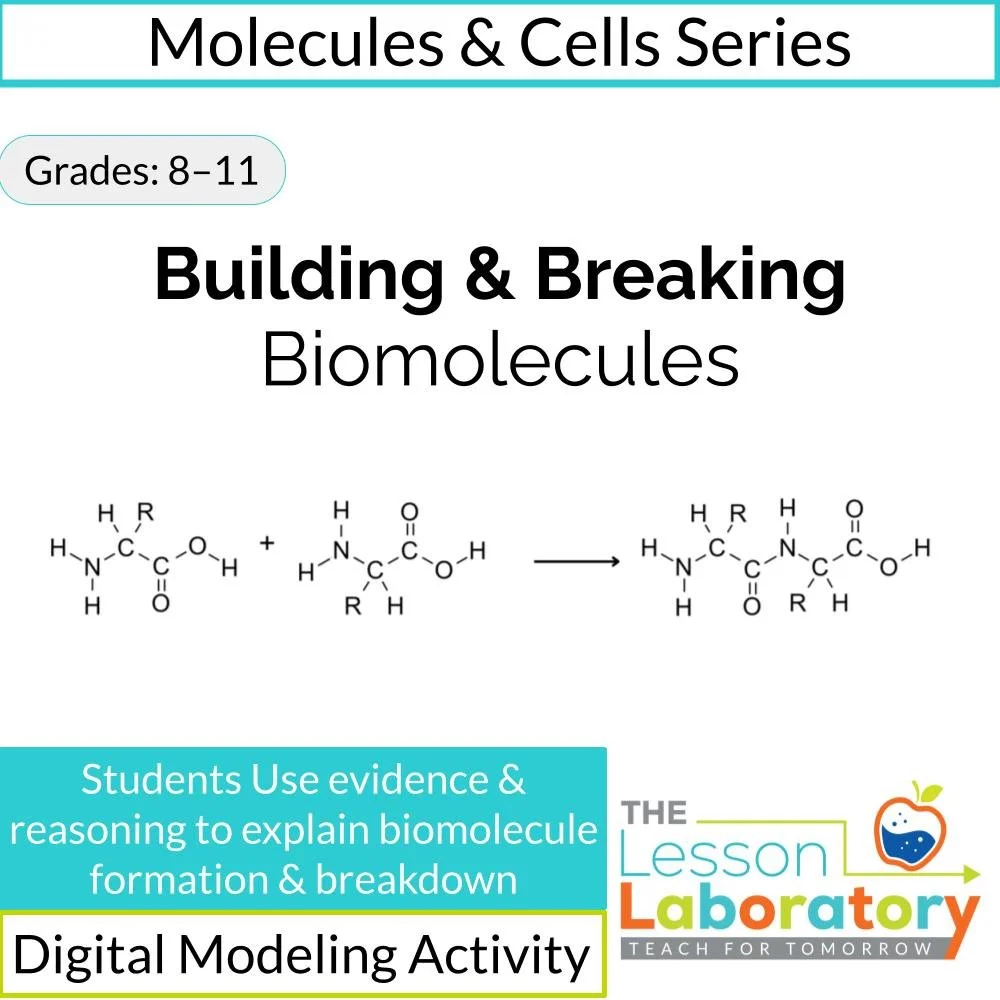
Students analyze molecular models to explain how water drives bond formation and breakdown.
In this lesson, students develop a model to explain how biomolecules are built and broken by analyzing patterns in molecular structure and atom counts. Rather than memorizing definitions, students use evidence to determine how water drives bond formation and breakdown.
Students begin by applying the principle of conservation of matter to molecular models. As they compare reactants and products, they identify a mismatch in atoms and are prompted to determine where those atoms went. Through structured analysis, students recognize that hydrogen and oxygen atoms combine to form water during biomolecule formation.
Students then extend this reasoning to explain hydrolysis, using their model to predict how water must be used to break bonds between monomers. Throughout the lesson, students revise their thinking based on new evidence and build a coherent explanation of both processes.
A final synthesis task requires students to explain why these reactions behave differently from everyday experiences of building and breaking, reinforcing a deep understanding of molecular transformation.
This lesson is designed to function as part of a coherent biomolecules unit. It builds on prior understanding of cell structure and transport and prepares students for more advanced work with macromolecules and enzyme function.
Analyze molecular models to identify changes in atom composition
Identify patterns in biomolecule formation and breakdown
Construct an explanation for dehydration synthesis using evidence
Use models to explain how hydrolysis breaks bonds
Apply conservation of matter to molecular processes
Student-facing Google Slides (full lesson)
Structured modeling and pattern analysis tasks
Scaffolded progression to support student reasoning
Teacher notes and implementation guidance
Printable, literacy-based exit ticket
This lesson uses a modeling-based approach to help students build understanding from evidence. Tasks are sequenced to create productive cognitive tension, prompting students to reconcile unexpected patterns and revise their explanations. The structure supports a wide range of learners while maintaining a high level of rigor.
To see a preview of this lesson, click here.
NGSS Alignment (High School):
HS-LS1-6
NGSS Alignment (Middle School):
MS-LS1-6
Science & Engineering Practices (SEPs):
Developing and Using Models
Analyzing and Interpreting Data
Constructing Explanations
Crosscutting Concepts (CCCs):
Energy and Matter
Structure and Function
Common Core (Literacy in Science):
RST.6-8.1 / RST.9-10.1
RST.6-8.7 / RST.9-10.7
WHST.6-8.2 / WHST.9-10.2
Bundle Upgrade Policy
This lesson is included in one or more bundles. To support flexible purchasing and long-term use of our curriculum, Lesson Laboratory offers a bundle upgrade policy.
If you purchase this lesson and decide at a later date that you would like to upgrade to a bundle, you may request a store credit equal to the total amount paid for duplicate items.
To request an upgrade credit, please email thelessonlaboratory@gmail.com and include:
Your username
The order numbers for both the original purchase(s) and the bundle
The names of the duplicate resources
Requests must be submitted within 30 days of the bundle purchase. Credits are issued as store credit for future Lesson Laboratory purchases and are not provided as cash refunds.
This policy applies only to purchases of resources that are later included in a Lesson Laboratory bundle and is limited to one adjustment per upgrade pathway.
Students analyze molecular models to explain how water drives bond formation and breakdown.
In this lesson, students develop a model to explain how biomolecules are built and broken by analyzing patterns in molecular structure and atom counts. Rather than memorizing definitions, students use evidence to determine how water drives bond formation and breakdown.
Students begin by applying the principle of conservation of matter to molecular models. As they compare reactants and products, they identify a mismatch in atoms and are prompted to determine where those atoms went. Through structured analysis, students recognize that hydrogen and oxygen atoms combine to form water during biomolecule formation.
Students then extend this reasoning to explain hydrolysis, using their model to predict how water must be used to break bonds between monomers. Throughout the lesson, students revise their thinking based on new evidence and build a coherent explanation of both processes.
A final synthesis task requires students to explain why these reactions behave differently from everyday experiences of building and breaking, reinforcing a deep understanding of molecular transformation.
This lesson is designed to function as part of a coherent biomolecules unit. It builds on prior understanding of cell structure and transport and prepares students for more advanced work with macromolecules and enzyme function.
Analyze molecular models to identify changes in atom composition
Identify patterns in biomolecule formation and breakdown
Construct an explanation for dehydration synthesis using evidence
Use models to explain how hydrolysis breaks bonds
Apply conservation of matter to molecular processes
Student-facing Google Slides (full lesson)
Structured modeling and pattern analysis tasks
Scaffolded progression to support student reasoning
Teacher notes and implementation guidance
Printable, literacy-based exit ticket
This lesson uses a modeling-based approach to help students build understanding from evidence. Tasks are sequenced to create productive cognitive tension, prompting students to reconcile unexpected patterns and revise their explanations. The structure supports a wide range of learners while maintaining a high level of rigor.
To see a preview of this lesson, click here.
NGSS Alignment (High School):
HS-LS1-6
NGSS Alignment (Middle School):
MS-LS1-6
Science & Engineering Practices (SEPs):
Developing and Using Models
Analyzing and Interpreting Data
Constructing Explanations
Crosscutting Concepts (CCCs):
Energy and Matter
Structure and Function
Common Core (Literacy in Science):
RST.6-8.1 / RST.9-10.1
RST.6-8.7 / RST.9-10.7
WHST.6-8.2 / WHST.9-10.2
Bundle Upgrade Policy
This lesson is included in one or more bundles. To support flexible purchasing and long-term use of our curriculum, Lesson Laboratory offers a bundle upgrade policy.
If you purchase this lesson and decide at a later date that you would like to upgrade to a bundle, you may request a store credit equal to the total amount paid for duplicate items.
To request an upgrade credit, please email thelessonlaboratory@gmail.com and include:
Your username
The order numbers for both the original purchase(s) and the bundle
The names of the duplicate resources
Requests must be submitted within 30 days of the bundle purchase. Credits are issued as store credit for future Lesson Laboratory purchases and are not provided as cash refunds.
This policy applies only to purchases of resources that are later included in a Lesson Laboratory bundle and is limited to one adjustment per upgrade pathway.