 Image 1 of 4
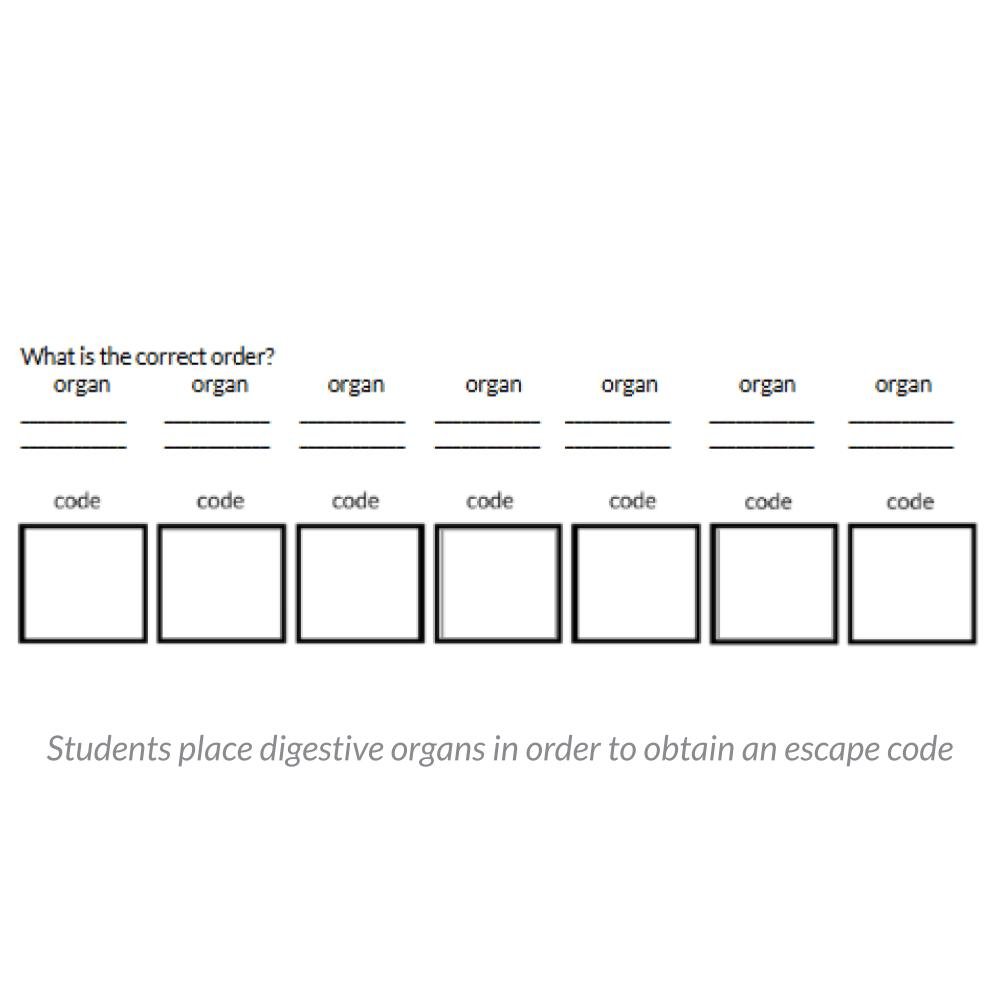 Image 2 of 4
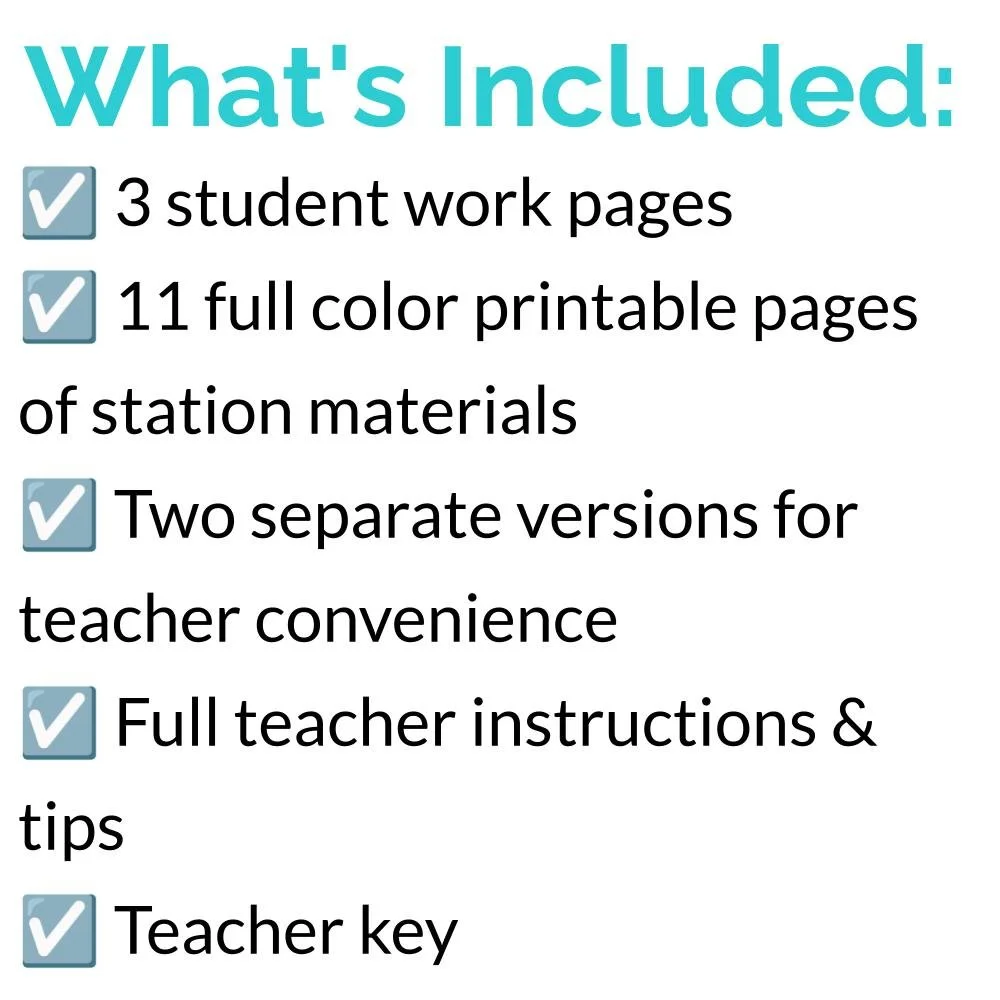 Image 3 of 4
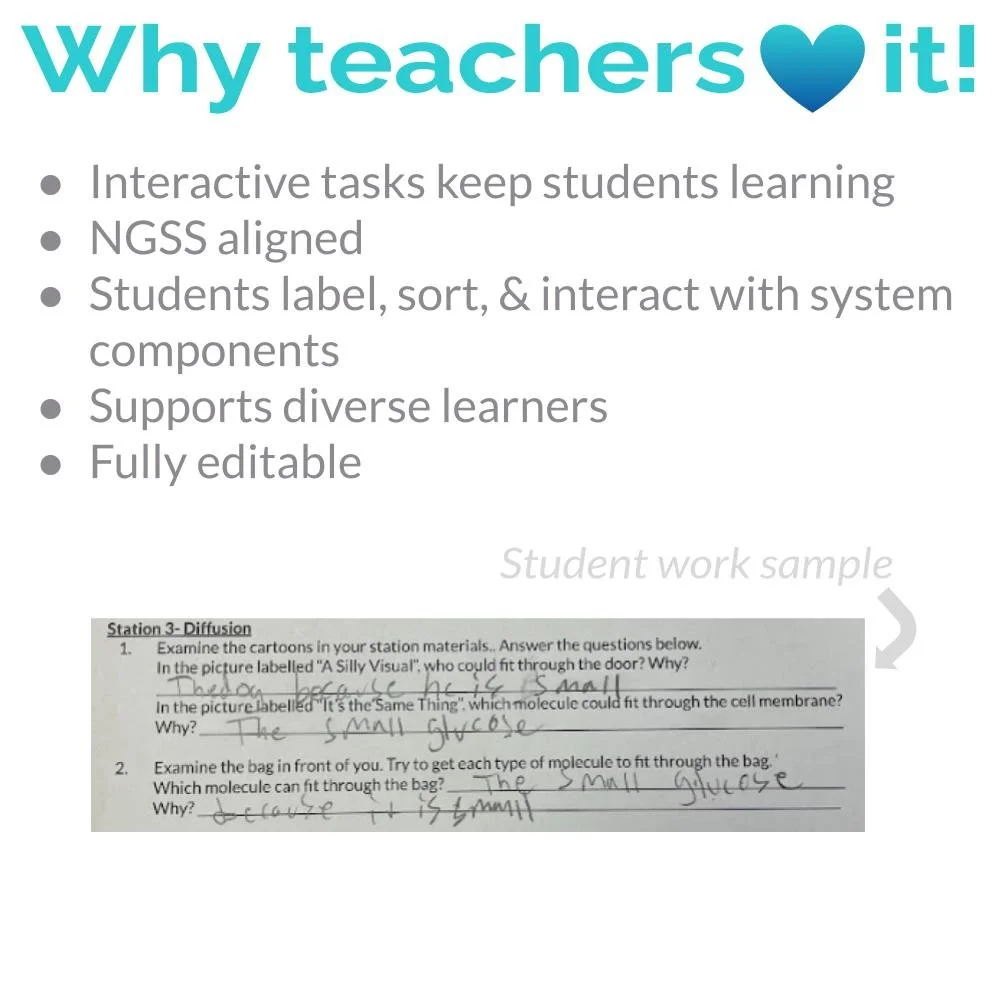 Image 4 of 4
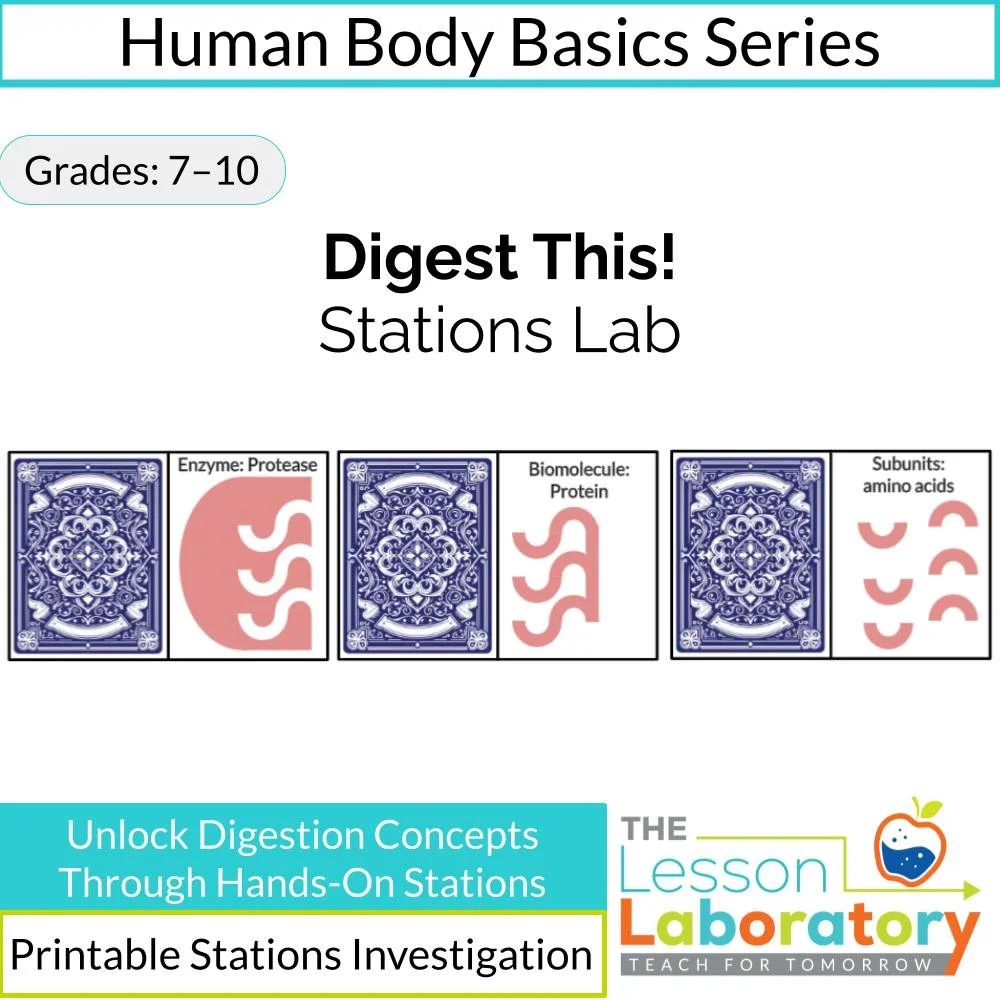
A Hands-On, Multi-Station Lab on Digestion, Nutrient Breakdown, Enzyme Function & Intestinal Surface Area.
This stations-based lab teaches the digestive system through physical models, experiments, and structured analysis. Students rotate through five activities that simulate how food is broken down and absorbed, allowing them to experience digestion as a process rather than memorize steps.
Instead of relying on notes alone, students model mechanical and chemical digestion, enzyme action, diffusion, and surface area to build a functional understanding of how nutrients enter the bloodstream.
Students complete five independent stations:
Station 1 — Digestive Organ Sequence (Escape-Style Challenge)
Students place digestive organs in the correct order to unlock the next task.
Two versions are included:
• Version 1: Unlocks a physical candy container
• Version 2: Unlocks teacher-controlled access
Station 2 — Saliva vs. Water Dissolving Test
Students compare candy dissolving rates in saliva and water, time results, and connect findings to enzyme activity.
Station 3 — Diffusion & Membrane Permeability Model
Students use visual models and manipulatives to represent how digested molecules pass through intestinal membranes.
Station 4 — Enzyme Memory Match
Students match digestive enzymes (amylase, lipase, protease, lactase, pepsin) to their target biomolecules and subunits.
Station 5 — Villi & Surface Area Investigation
Students measure smooth and villi-lined intestine models and calculate how surface area increases absorption efficiency.
• Mechanical vs. chemical digestion
• Enzyme specificity
• Diffusion and absorption
• Surface area and villi
• Digestive organ sequence
• Nutrient breakdown
• Teaches digestion through physical modeling
• High student engagement
• Supports kinesthetic and visual learners
• Works well for stations or lab days
• Reinforces core biology concepts
• Easy to set up and run
• Minimal prep required
This resource is a stations-based lab activity.
Includes:
✔ Five complete station activities
✔ Two versions of Station 1
✔ Student recording sheets
✔ Teacher answer key with explanations
• Middle school life science
• High school biology
• Human body systems units
• Digestion and nutrition lessons
• Lab days
To preview this lesson, click here.
NGSS Alignment (High School):
HS-LS1-2, HS-LS1-7
NGSS Alignment (Middle School):
MS-LS1-7
Science & Engineering Practices (SEPs):
Planning and Carrying Out Investigations; Developing and Using Models; Analyzing and Interpreting Data; Obtaining, Evaluating, and Communicating Information
Crosscutting Concepts (CCCs):
Structure and Function; Cause and Effect; Systems and System Models; Scale, Proportion, and Quantity
Common Core (Literacy in Science):
RST.6-8.3, RST.9-10.3
WHST.6-8.2, WHST.9-10.2
A Hands-On, Multi-Station Lab on Digestion, Nutrient Breakdown, Enzyme Function & Intestinal Surface Area.
This stations-based lab teaches the digestive system through physical models, experiments, and structured analysis. Students rotate through five activities that simulate how food is broken down and absorbed, allowing them to experience digestion as a process rather than memorize steps.
Instead of relying on notes alone, students model mechanical and chemical digestion, enzyme action, diffusion, and surface area to build a functional understanding of how nutrients enter the bloodstream.
Students complete five independent stations:
Station 1 — Digestive Organ Sequence (Escape-Style Challenge)
Students place digestive organs in the correct order to unlock the next task.
Two versions are included:
• Version 1: Unlocks a physical candy container
• Version 2: Unlocks teacher-controlled access
Station 2 — Saliva vs. Water Dissolving Test
Students compare candy dissolving rates in saliva and water, time results, and connect findings to enzyme activity.
Station 3 — Diffusion & Membrane Permeability Model
Students use visual models and manipulatives to represent how digested molecules pass through intestinal membranes.
Station 4 — Enzyme Memory Match
Students match digestive enzymes (amylase, lipase, protease, lactase, pepsin) to their target biomolecules and subunits.
Station 5 — Villi & Surface Area Investigation
Students measure smooth and villi-lined intestine models and calculate how surface area increases absorption efficiency.
• Mechanical vs. chemical digestion
• Enzyme specificity
• Diffusion and absorption
• Surface area and villi
• Digestive organ sequence
• Nutrient breakdown
• Teaches digestion through physical modeling
• High student engagement
• Supports kinesthetic and visual learners
• Works well for stations or lab days
• Reinforces core biology concepts
• Easy to set up and run
• Minimal prep required
This resource is a stations-based lab activity.
Includes:
✔ Five complete station activities
✔ Two versions of Station 1
✔ Student recording sheets
✔ Teacher answer key with explanations
• Middle school life science
• High school biology
• Human body systems units
• Digestion and nutrition lessons
• Lab days
To preview this lesson, click here.
NGSS Alignment (High School):
HS-LS1-2, HS-LS1-7
NGSS Alignment (Middle School):
MS-LS1-7
Science & Engineering Practices (SEPs):
Planning and Carrying Out Investigations; Developing and Using Models; Analyzing and Interpreting Data; Obtaining, Evaluating, and Communicating Information
Crosscutting Concepts (CCCs):
Structure and Function; Cause and Effect; Systems and System Models; Scale, Proportion, and Quantity
Common Core (Literacy in Science):
RST.6-8.3, RST.9-10.3
WHST.6-8.2, WHST.9-10.2