Escape the Covalent Bond! (An Organic Compounds Escape Room Activity)

$5.75

Embark on a Thrilling Organic Compounds Escape Mission!

Buckle up, as students are about to face the challenge of a lifetime! The malevolent Dr. Znorgberg, armed with his Enzymatic Emulsifier, has trapped them inside a covalent bond. The only way out is to harness the organic compounds skills they've mastered in this chapter. Time is of the essence, before a chemical reaction changes everything!

This organic compounds review activity is not only demanding but also a blast! It taps into the excitement of the "escape the room" trend, delivering an online adventure like no other. Ideally placed at the conclusion of your organic compounds unit, this mission requires students to employ their knowledge and skills in:

  1. Defining "organic" in both scientific and grocery store contexts

  2. Identifying the four classes of biomolecules

  3. Conducting food nutrient tests

  4. Understanding acids/bases (pH)

  5. Navigating the world of enzymes

The Heart-Pounding Journey:

Station One: Students embark on a quest involving the word "organic." By deciphering whether digits in an escape code need to be rearranged or entered as is, they inch closer to freedom.

Station Two: A set of images and criteria challenges students to distinguish proteins, lipids, carbohydrates, and nucleic acids. By succeeding, they uncover multiple escape codes. The final question holds the key to ultimate escape.

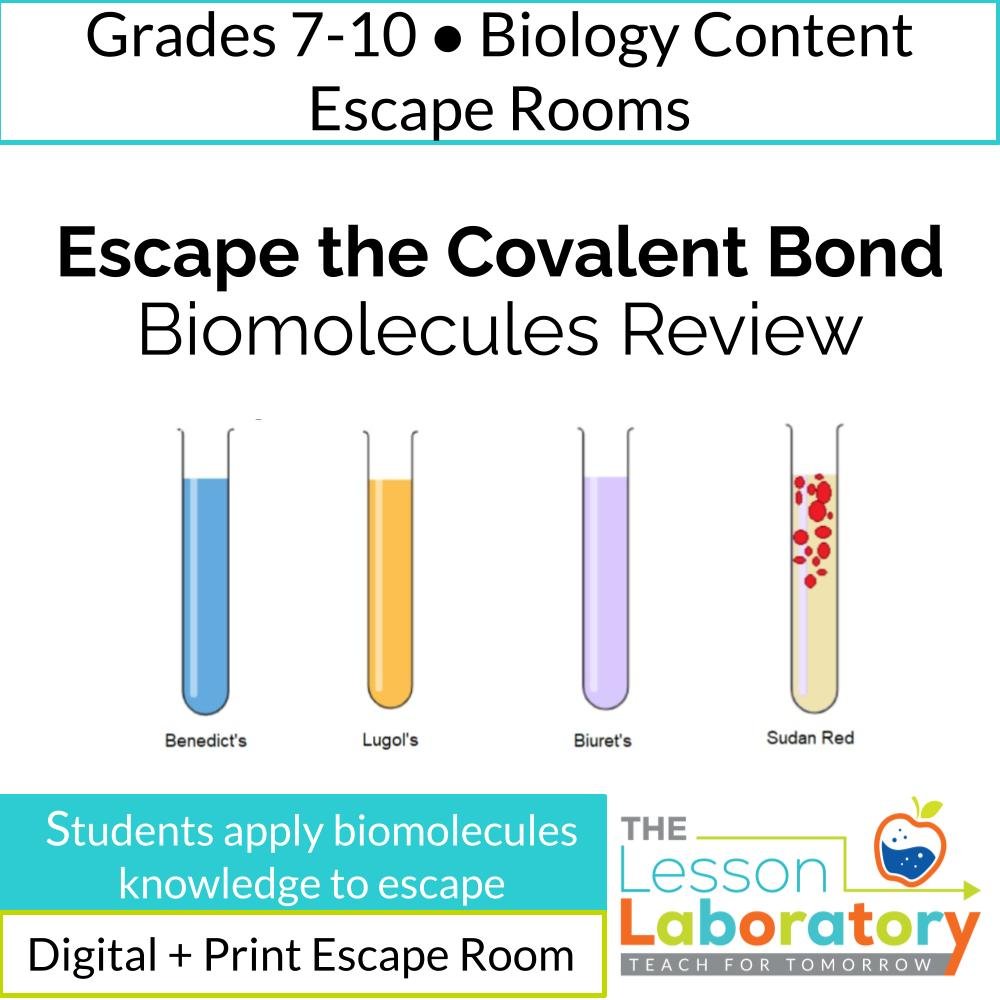
Station Three: Food nutrient test results hold the key to Dr. Znorgberg's lunch box. Through careful analysis, students unveil the escape code that will set them free.

Station Four: Cabbage juice and litmus paper reveal the secrets of substances—acid, neutral, or base. This information paves the way on a map, guiding students to the ultimate escape code.

Station Five: Enzyme-related questions lead students to construct a literal key. When matched with one of six locks, they'll discover the escape code that grants them their long-awaited freedom.

This isn't just a review—it's an adrenaline-pumping adventure that will leave students on the edge of their seats! Will they escape Dr. Znorgberg's clutches in time? Get ready for a journey that blends excitement and education like never before!

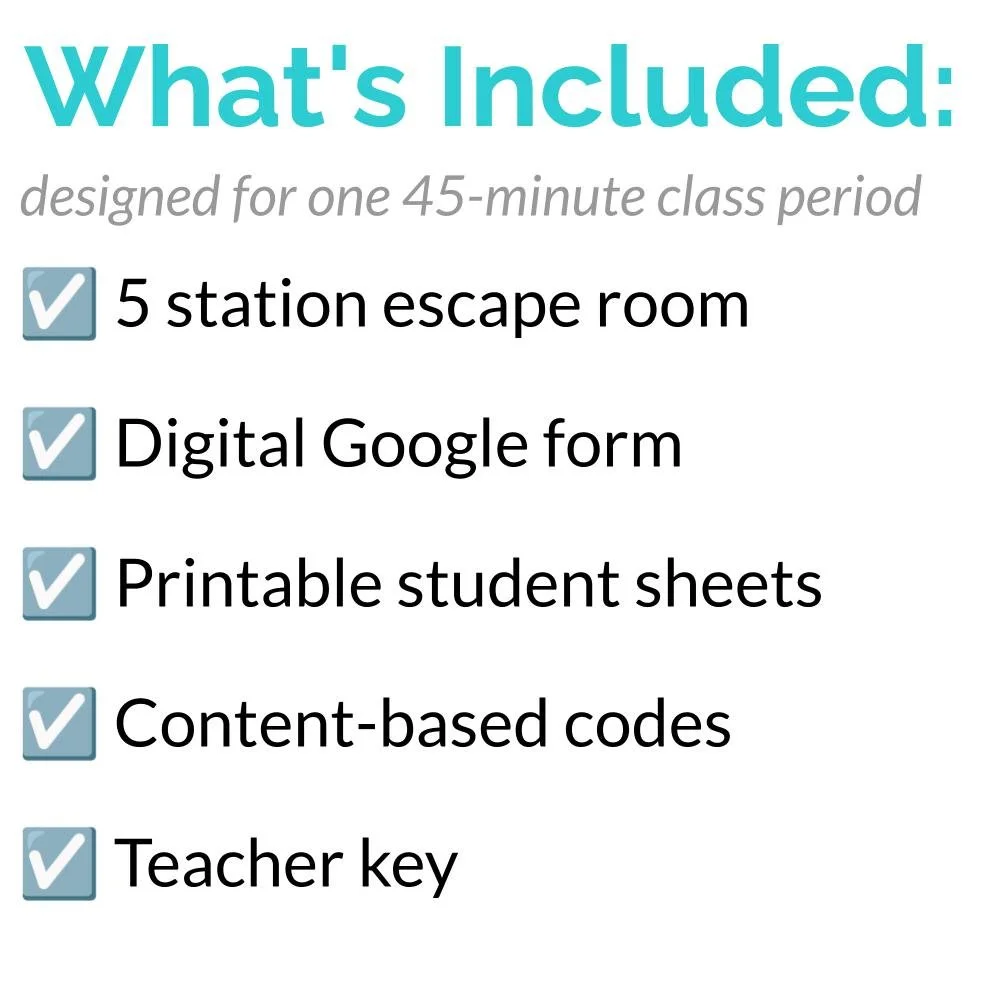
This file includes a teacher key. Please remind your students that their codes will have to be in all capital letters without spaces, or else they won't be able to escape!

Grade Recommendation

  • Middle School: Grades 7–8 (advanced students studying chemistry/biology connections)

  • High School: Grades 9–10, particularly in Living Environment, Biology, or Introductory Chemistry courses.

  • Use Context: Works beautifully as an end-of-unit review, sub-plan, or engagement day activity.

Cross-Curricular Connections and Extensions

  • Mathematics: Logical reasoning and code-breaking reinforce analytical thinking.

  • ELA: Students interpret clues and follow procedural text to complete tasks, promoting reading comprehension and sequencing.

  • Technology Integration: Use of Google Forms promotes digital literacy and self-paced online assessment.

  • Extension Idea: Students could design their own “escape room” challenges explaining other biological processes (e.g., photosynthesis, genetics).

Join the Lesson Laboratory and Teach for Tomorrow!

NGSS Standards (with CCCs and SEPs)

Middle School Performance Expectations

  • MS-LS1-7 – Develop a model to describe how food is rearranged through chemical reactions forming new molecules that support growth or release energy.

  • MS-PS1-2 – Analyze and interpret data on the properties of substances before and after the substances interact to determine if a chemical reaction occurred.

  • MS-LS1-6 – Construct a scientific explanation based on evidence for the role of photosynthesis and biomolecule creation in the cycling of matter.

High School Performance Expectations

  • HS-LS1-6 – Construct and revise an explanation based on evidence for how carbon, hydrogen, and oxygen from sugar molecules may combine with other elements to form amino acids and other large carbon-based molecules.

  • HS-LS1-7 – Use a model to illustrate that cellular respiration is a chemical process whereby bonds are broken and formed to release energy.

  • HS-PS1-6 – Refine the design of a chemical system by specifying a change in conditions that would produce increased amounts of products at equilibrium.

Science & Engineering Practices (SEPs)

  • Analyzing and Interpreting Data: Students analyze food testing results (Benedict’s, Lugol’s, Biuret’s, Sudan Red) to classify organic compounds.

  • Developing and Using Models: Chemical bonding and macromolecule identification act as conceptual models for understanding structure and function.

  • Constructing Explanations: Students use test outcomes to infer macromolecular composition and predict reactions.

  • Engaging in Argument from Evidence: Students justify their reasoning when determining compound classes and pH levels.

Crosscutting Concepts (CCCs)

  • Structure and Function: Students connect molecule structure (carbohydrates, proteins, lipids, nucleic acids) to biological function.

  • Energy and Matter: Exploration of chemical tests reveals how atoms rearrange but are conserved in reactions.

  • Patterns: Recognizing chemical indicators (color changes, reactions) reinforces pattern identification in experimental data.

Common Core Standards

  • CCSS.ELA-LITERACY.RST.9-10.3 – Follow precisely a complex multistep procedure when carrying out experiments or taking measurements.

  • CCSS.ELA-LITERACY.RST.9-10.7 – Translate quantitative or technical information expressed in words into visual form (and vice versa).

Embark on a Thrilling Organic Compounds Escape Mission!

Buckle up, as students are about to face the challenge of a lifetime! The malevolent Dr. Znorgberg, armed with his Enzymatic Emulsifier, has trapped them inside a covalent bond. The only way out is to harness the organic compounds skills they've mastered in this chapter. Time is of the essence, before a chemical reaction changes everything!

This organic compounds review activity is not only demanding but also a blast! It taps into the excitement of the "escape the room" trend, delivering an online adventure like no other. Ideally placed at the conclusion of your organic compounds unit, this mission requires students to employ their knowledge and skills in:

  1. Defining "organic" in both scientific and grocery store contexts

  2. Identifying the four classes of biomolecules

  3. Conducting food nutrient tests

  4. Understanding acids/bases (pH)

  5. Navigating the world of enzymes

The Heart-Pounding Journey:

Station One: Students embark on a quest involving the word "organic." By deciphering whether digits in an escape code need to be rearranged or entered as is, they inch closer to freedom.

Station Two: A set of images and criteria challenges students to distinguish proteins, lipids, carbohydrates, and nucleic acids. By succeeding, they uncover multiple escape codes. The final question holds the key to ultimate escape.

Station Three: Food nutrient test results hold the key to Dr. Znorgberg's lunch box. Through careful analysis, students unveil the escape code that will set them free.

Station Four: Cabbage juice and litmus paper reveal the secrets of substances—acid, neutral, or base. This information paves the way on a map, guiding students to the ultimate escape code.

Station Five: Enzyme-related questions lead students to construct a literal key. When matched with one of six locks, they'll discover the escape code that grants them their long-awaited freedom.

This isn't just a review—it's an adrenaline-pumping adventure that will leave students on the edge of their seats! Will they escape Dr. Znorgberg's clutches in time? Get ready for a journey that blends excitement and education like never before!

This file includes a teacher key. Please remind your students that their codes will have to be in all capital letters without spaces, or else they won't be able to escape!

Grade Recommendation

  • Middle School: Grades 7–8 (advanced students studying chemistry/biology connections)

  • High School: Grades 9–10, particularly in Living Environment, Biology, or Introductory Chemistry courses.

  • Use Context: Works beautifully as an end-of-unit review, sub-plan, or engagement day activity.

Cross-Curricular Connections and Extensions

  • Mathematics: Logical reasoning and code-breaking reinforce analytical thinking.

  • ELA: Students interpret clues and follow procedural text to complete tasks, promoting reading comprehension and sequencing.

  • Technology Integration: Use of Google Forms promotes digital literacy and self-paced online assessment.

  • Extension Idea: Students could design their own “escape room” challenges explaining other biological processes (e.g., photosynthesis, genetics).

Join the Lesson Laboratory and Teach for Tomorrow!

NGSS Standards (with CCCs and SEPs)

Middle School Performance Expectations

  • MS-LS1-7 – Develop a model to describe how food is rearranged through chemical reactions forming new molecules that support growth or release energy.

  • MS-PS1-2 – Analyze and interpret data on the properties of substances before and after the substances interact to determine if a chemical reaction occurred.

  • MS-LS1-6 – Construct a scientific explanation based on evidence for the role of photosynthesis and biomolecule creation in the cycling of matter.

High School Performance Expectations

  • HS-LS1-6 – Construct and revise an explanation based on evidence for how carbon, hydrogen, and oxygen from sugar molecules may combine with other elements to form amino acids and other large carbon-based molecules.

  • HS-LS1-7 – Use a model to illustrate that cellular respiration is a chemical process whereby bonds are broken and formed to release energy.

  • HS-PS1-6 – Refine the design of a chemical system by specifying a change in conditions that would produce increased amounts of products at equilibrium.

Science & Engineering Practices (SEPs)

  • Analyzing and Interpreting Data: Students analyze food testing results (Benedict’s, Lugol’s, Biuret’s, Sudan Red) to classify organic compounds.

  • Developing and Using Models: Chemical bonding and macromolecule identification act as conceptual models for understanding structure and function.

  • Constructing Explanations: Students use test outcomes to infer macromolecular composition and predict reactions.

  • Engaging in Argument from Evidence: Students justify their reasoning when determining compound classes and pH levels.

Crosscutting Concepts (CCCs)

  • Structure and Function: Students connect molecule structure (carbohydrates, proteins, lipids, nucleic acids) to biological function.

  • Energy and Matter: Exploration of chemical tests reveals how atoms rearrange but are conserved in reactions.

  • Patterns: Recognizing chemical indicators (color changes, reactions) reinforces pattern identification in experimental data.

Common Core Standards

  • CCSS.ELA-LITERACY.RST.9-10.3 – Follow precisely a complex multistep procedure when carrying out experiments or taking measurements.

  • CCSS.ELA-LITERACY.RST.9-10.7 – Translate quantitative or technical information expressed in words into visual form (and vice versa).