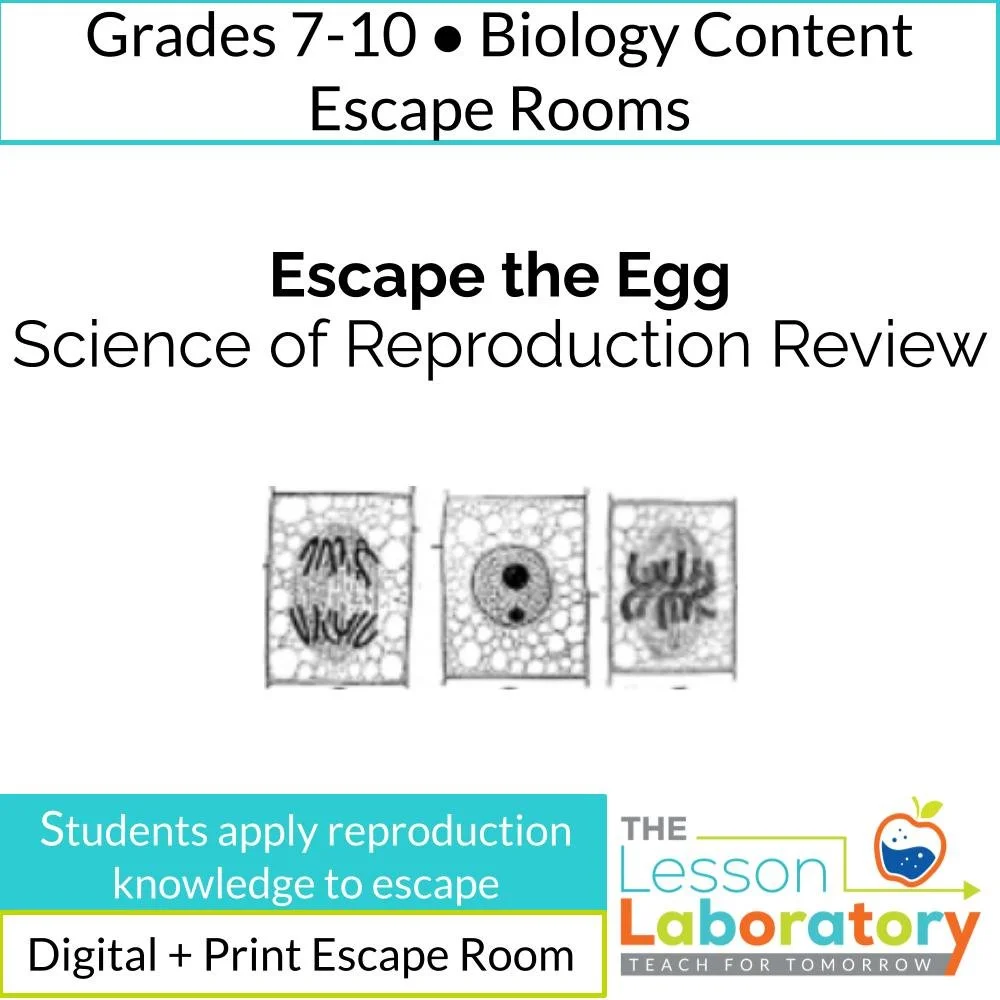
Escape the Egg! (A Science of Reproduction Escape Room Activity)
Embark on an Epic Reproduction Escape Quest!
Prepare for an exhilarating adventure as students find themselves ensnared inside a giant egg, courtesy of the diabolical Dr. Znorgberg and his mind-boggling Oo-oglifier! To break free, they'll need to harness all the science of reproduction skills they've mastered in this chapter. The clock is ticking—brunchtime is approaching!
This science of reproduction review activity is not just challenging; it's a thrill-packed experience! It leverages the excitement of the "escape the room" trend, delivering an online quest like no other. Ideally placed at the conclusion of your reproduction unit, this mission requires students to employ their knowledge and skills in:
Distinguishing asexual and sexual reproduction
Identifying stages of mitosis
Navigating meiosis vocabulary
Understanding internal vs. external fertilization and development
Exploring fetal development
The Pulse-Pounding Journey:
Station One: Students embark on a quest involving example organisms, determining their mode of reproduction—asexual, sexual, or both. Correctly positioning a New Zealand mud snail by a football goal post reveals the escape code.
Station Two: Onion root tip cells meet the world of music as students blacken cells in specific mitotic stages. Their musical notation unlocks chords on a guitar fretboard, providing the escape route!
Station Three: Students are tasked with matching chromosomes or cells, but there's a twist—they match in an unexpected manner! Armed with meiosis vocabulary knowledge, they decode the puzzle to reveal the escape code.
Station Four: Reproductive strategies of various organisms await examination. Students must choose the correct organism corresponding to a specific strategy, leading them to translate ancient runes into modern English for the escape code.
Station Five: Stem cells hold the key to escape, with a long strand of DNA inside. By differentiating the cell and extracting the escape code from the DNA, they'll break free. A clue awaits for those who can place the stages of fetal development in the correct order.
This isn't just a lesson; it's a heart-pounding journey that will leave students on the edge of their seats! Will they escape Dr. Znorgberg's clutches before they're made into a science souffle? Get ready for an adventure that seamlessly combines excitement and education like never before! Don't miss out—unlock the quest today!
This file includes a teacher key. Please remind your students that their codes will have to be in all capital letters without spaces, or else they won't be able to escape!
Grade Recommendation
Middle School: Grades 7–8 (Advanced biology or life science units on cell division and reproduction)
High School: Grades 9–10 (Biology, Living Environment, or Life Science courses)
This escape room effectively bridges both middle and high school levels because it includes accessible conceptual tasks (like identifying asexual vs. sexual reproduction) and more advanced applications (like analyzing fetal development and stem cell differentiation).
Cross-Curricular Connections and/or Extension
Mathematics: Logical reasoning and sequencing (ordering developmental stages, decoding numerical and pattern-based escape codes).
Language Arts: Application of scientific vocabulary and reading comprehension through narrative-based problem solving.
Art/Design: “Musical Mitosis” and “Runic Reproduction” reinforce visual interpretation of abstract biological concepts.
Extension: Students could create their own mini “escape stations” to demonstrate understanding of cell division or developmental stages (project-based extension).
Join the Lesson Laboratory and Teach for Tomorrow!
NGSS Standards
Middle School (MS-LS)
MS-LS1-4: Use argument based on empirical evidence and scientific reasoning to support an explanation for how characteristic animal behaviors and specialized plant structures affect the probability of successful reproduction.
MS-LS1-5: Construct a scientific explanation based on evidence for how environmental and genetic factors influence the growth of organisms.
MS-LS3-2: Develop and use a model to describe why asexual reproduction results in offspring with identical genetic information, while sexual reproduction results in genetic variation.
High School (HS-LS)
HS-LS1-2: Develop and use a model to illustrate the hierarchical organization of interacting systems that provide specific functions within multicellular organisms.
HS-LS3-1: Ask questions to clarify relationships about the role of DNA and chromosomes in coding the instructions for characteristic traits passed from parents to offspring.
HS-LS3-2: Make and defend a claim based on evidence that inheritable genetic variations may result from new genetic combinations through meiosis, viable errors during replication, and/or mutations.
HS-LS1-4: Use a model to illustrate the role of cellular division (mitosis) and differentiation in producing and maintaining complex organisms.
Science and Engineering Practices (SEPs)
Developing and using models (cell division, reproduction, differentiation)
Analyzing and interpreting data (using clues to match biological information to models)
Constructing explanations and designing solutions (synthesizing evidence to solve “escape” puzzles)
Crosscutting Concepts (CCCs)
Structure and Function: Understanding how specialized reproductive and developmental structures influence survival and reproduction.
Patterns: Recognizing patterns in cell division stages and developmental processes.
Cause and Effect: Relating genetic variation and reproductive strategies to survival outcomes.
Systems and System Models: Modeling the relationships between cells, tissues, and organisms in reproductive systems.
Common Core Standards
ELA:
RST.9-10.3: Follow precisely a multistep procedure when carrying out experiments, taking measurements, or performing technical tasks.
RST.9-10.7: Translate quantitative or technical information expressed in words into visual form (e.g., diagrams, models).
WHST.9-10.2: Write informative/explanatory texts to examine and convey complex ideas clearly and accurately.
Math:
MP.2: Reason abstractly and quantitatively (sequencing and code-based tasks require logical and numerical reasoning).
Embark on an Epic Reproduction Escape Quest!
Prepare for an exhilarating adventure as students find themselves ensnared inside a giant egg, courtesy of the diabolical Dr. Znorgberg and his mind-boggling Oo-oglifier! To break free, they'll need to harness all the science of reproduction skills they've mastered in this chapter. The clock is ticking—brunchtime is approaching!
This science of reproduction review activity is not just challenging; it's a thrill-packed experience! It leverages the excitement of the "escape the room" trend, delivering an online quest like no other. Ideally placed at the conclusion of your reproduction unit, this mission requires students to employ their knowledge and skills in:
Distinguishing asexual and sexual reproduction
Identifying stages of mitosis
Navigating meiosis vocabulary
Understanding internal vs. external fertilization and development
Exploring fetal development
The Pulse-Pounding Journey:
Station One: Students embark on a quest involving example organisms, determining their mode of reproduction—asexual, sexual, or both. Correctly positioning a New Zealand mud snail by a football goal post reveals the escape code.
Station Two: Onion root tip cells meet the world of music as students blacken cells in specific mitotic stages. Their musical notation unlocks chords on a guitar fretboard, providing the escape route!
Station Three: Students are tasked with matching chromosomes or cells, but there's a twist—they match in an unexpected manner! Armed with meiosis vocabulary knowledge, they decode the puzzle to reveal the escape code.
Station Four: Reproductive strategies of various organisms await examination. Students must choose the correct organism corresponding to a specific strategy, leading them to translate ancient runes into modern English for the escape code.
Station Five: Stem cells hold the key to escape, with a long strand of DNA inside. By differentiating the cell and extracting the escape code from the DNA, they'll break free. A clue awaits for those who can place the stages of fetal development in the correct order.
This isn't just a lesson; it's a heart-pounding journey that will leave students on the edge of their seats! Will they escape Dr. Znorgberg's clutches before they're made into a science souffle? Get ready for an adventure that seamlessly combines excitement and education like never before! Don't miss out—unlock the quest today!
This file includes a teacher key. Please remind your students that their codes will have to be in all capital letters without spaces, or else they won't be able to escape!
Grade Recommendation
Middle School: Grades 7–8 (Advanced biology or life science units on cell division and reproduction)
High School: Grades 9–10 (Biology, Living Environment, or Life Science courses)
This escape room effectively bridges both middle and high school levels because it includes accessible conceptual tasks (like identifying asexual vs. sexual reproduction) and more advanced applications (like analyzing fetal development and stem cell differentiation).
Cross-Curricular Connections and/or Extension
Mathematics: Logical reasoning and sequencing (ordering developmental stages, decoding numerical and pattern-based escape codes).
Language Arts: Application of scientific vocabulary and reading comprehension through narrative-based problem solving.
Art/Design: “Musical Mitosis” and “Runic Reproduction” reinforce visual interpretation of abstract biological concepts.
Extension: Students could create their own mini “escape stations” to demonstrate understanding of cell division or developmental stages (project-based extension).
Join the Lesson Laboratory and Teach for Tomorrow!
NGSS Standards
Middle School (MS-LS)
MS-LS1-4: Use argument based on empirical evidence and scientific reasoning to support an explanation for how characteristic animal behaviors and specialized plant structures affect the probability of successful reproduction.
MS-LS1-5: Construct a scientific explanation based on evidence for how environmental and genetic factors influence the growth of organisms.
MS-LS3-2: Develop and use a model to describe why asexual reproduction results in offspring with identical genetic information, while sexual reproduction results in genetic variation.
High School (HS-LS)
HS-LS1-2: Develop and use a model to illustrate the hierarchical organization of interacting systems that provide specific functions within multicellular organisms.
HS-LS3-1: Ask questions to clarify relationships about the role of DNA and chromosomes in coding the instructions for characteristic traits passed from parents to offspring.
HS-LS3-2: Make and defend a claim based on evidence that inheritable genetic variations may result from new genetic combinations through meiosis, viable errors during replication, and/or mutations.
HS-LS1-4: Use a model to illustrate the role of cellular division (mitosis) and differentiation in producing and maintaining complex organisms.
Science and Engineering Practices (SEPs)
Developing and using models (cell division, reproduction, differentiation)
Analyzing and interpreting data (using clues to match biological information to models)
Constructing explanations and designing solutions (synthesizing evidence to solve “escape” puzzles)
Crosscutting Concepts (CCCs)
Structure and Function: Understanding how specialized reproductive and developmental structures influence survival and reproduction.
Patterns: Recognizing patterns in cell division stages and developmental processes.
Cause and Effect: Relating genetic variation and reproductive strategies to survival outcomes.
Systems and System Models: Modeling the relationships between cells, tissues, and organisms in reproductive systems.
Common Core Standards
ELA:
RST.9-10.3: Follow precisely a multistep procedure when carrying out experiments, taking measurements, or performing technical tasks.
RST.9-10.7: Translate quantitative or technical information expressed in words into visual form (e.g., diagrams, models).
WHST.9-10.2: Write informative/explanatory texts to examine and convey complex ideas clearly and accurately.
Math:
MP.2: Reason abstractly and quantitatively (sequencing and code-based tasks require logical and numerical reasoning).