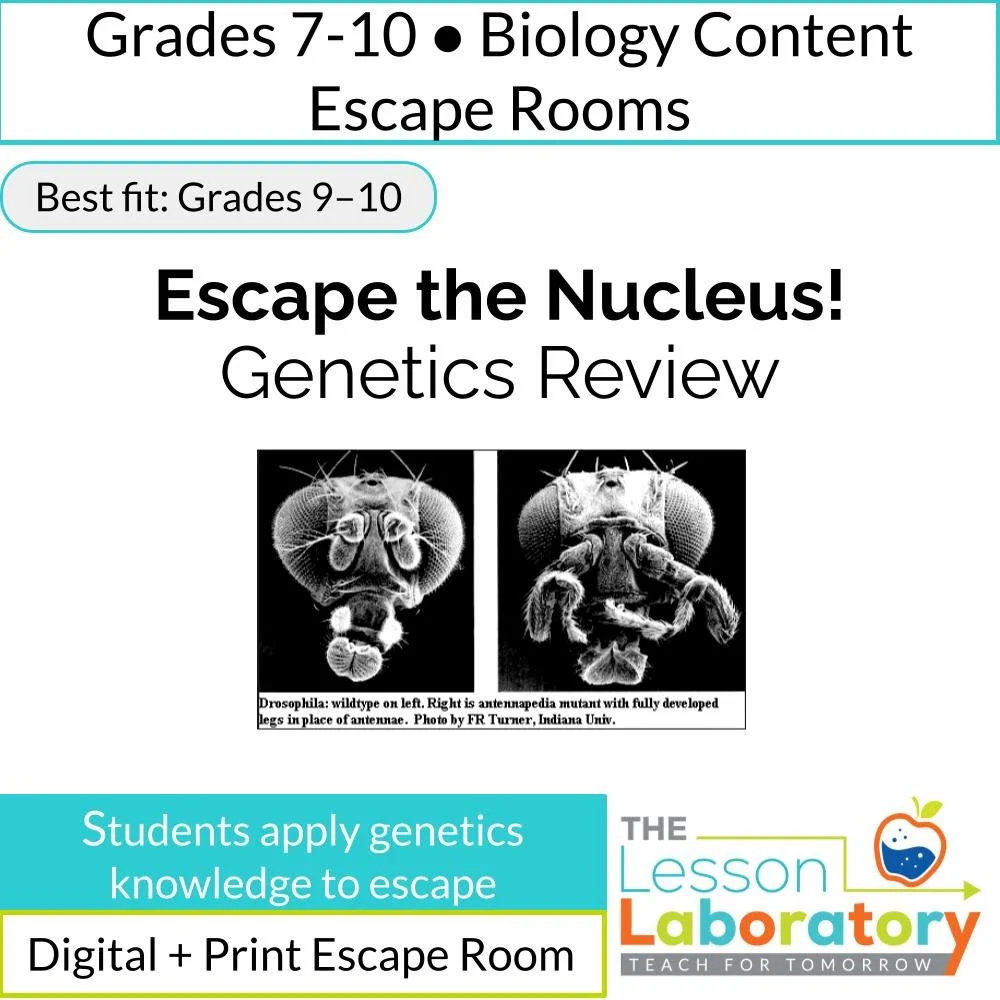
Escape the Nucleus! (A Genetics Escape Room Activity)
Embark on a Microscopic Genetic Adventure Inside the Nucleus!
Prepare for an electrifying mission as students find themselves shrunken down to microscopic size, trapped within the confines of a cell's nucleus, courtesy of the malevolent Dr. Znorgberg and his formidable shrink ray! To break free, they'll need to apply all the genetic investigation skills they've mastered in this chapter. The clock is ticking—can they escape before it's too late?
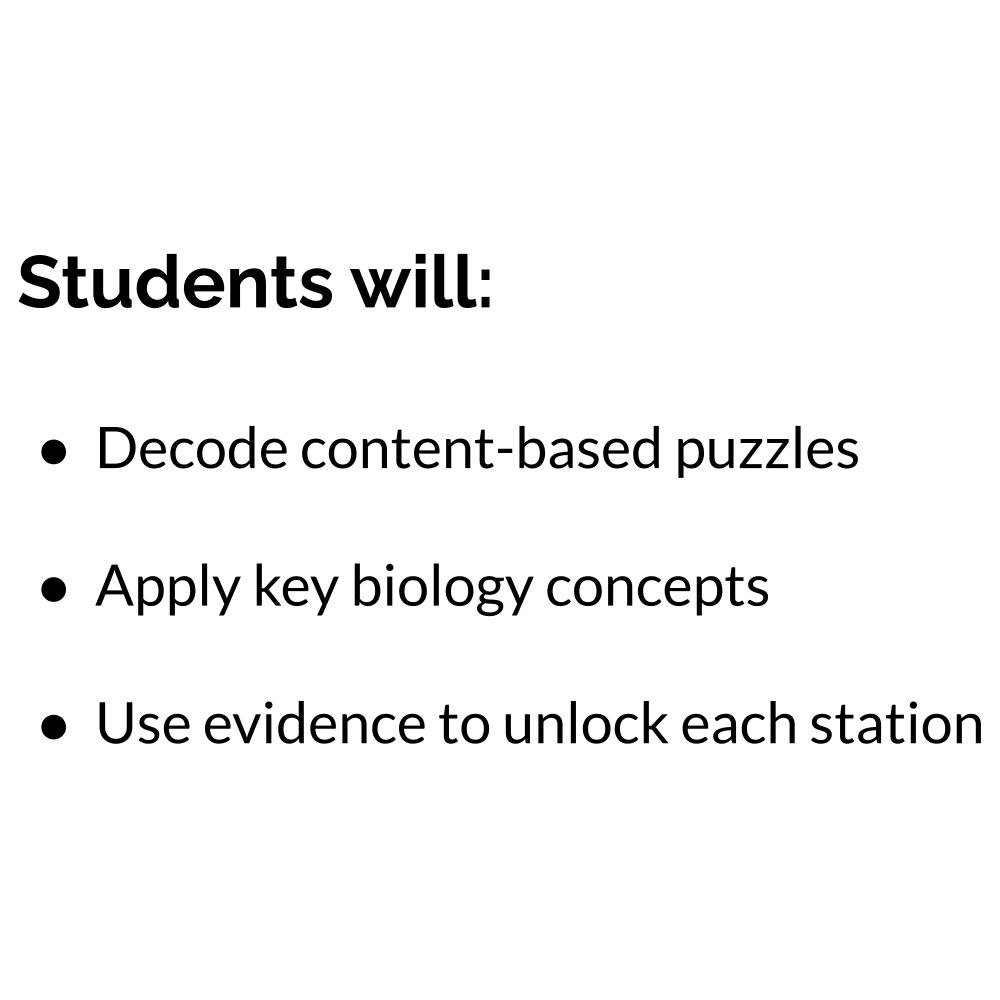
This genetics review activity isn't just challenging—it's a heart-pounding experience! Capitalizing on the thrill of the "escape the room" trend, this online escape promises an adventure like no other. Ideally placed at the conclusion of your genetics unit, this mission calls on students to apply their knowledge and skills in:
Navigating dominant and recessive traits
Mastering Punnett Squares for offspring ratios
Deciphering chromosomal sex determination
Tackling sex-linked recessive traits
Determining genotypes from pedigree charts
Analyzing gel electrophoresis results
Exploring DNA mutations
Engaging in protein synthesis
The Unforgettable Journey:
Station One: Students deploy Punnett Squares to unveil offspring ratios, then translate these ratios into a secret escape code using a decoder. Success leads them forward!
Station Two: Pedigree charts hold the key as students identify carriers, translating their status into Morse Code. Decode it correctly, and the secret escape code is revealed!
Station Three: Gel electrophoresis results provide vital information for a grid map. Students must interpret the data accurately and follow directions carefully to proceed.
Station Four: DNA codons are under mutation! Following directions, students alter the codons, and the mutated sequence itself becomes the secret escape code.
Station Five: The grand finale—students engage in precise protein synthesis to reveal the amino acid code and make their escape from the nucleus!
This isn't just a lesson—it's an adrenaline-fueled adventure that will leave students on the edge of their seats! Will they escape the clutches of Dr. Znorgberg and the nucleus, or will they be stuck in the cell forever? Get ready for an unforgettable blend of excitement and education! Don't wait—dive into the genetic adventure now!
This file includes a teacher key. Please remind your students that their codes will have to be in all capital letters without spaces, or else they won't be able to escape!
Grade Recommendation
Middle School (advanced): Grades 7–8
Appropriate for students completing a full genetics unit.
Requires prior knowledge of Punnett squares, mutations, and basic protein synthesis.
High School: Grades 9–10
Ideal for Biology, Living Environment, and Genetics units.
Strongly matches NY Living Environment exam content (punnett squares, pedigrees, gels, DNA → protein).
Could serve as a full-unit review activity.
Cross-Curricular Connections and/or Extension
Cross-Curricular Connections
ELA:
Students interpret diagrams, read scenario-based questions, and translate information across representations.
Mathematics:
Percent calculations in Punnett squares
Logical sequencing in pedigree analysis
Directional decoding in the electrophoresis grid
Computer Science:
Pattern recognition
Decoding systems (Morse code, directional algorithms)
Forensics:
Gel electrophoresis for crime scene analysis and paternity tests.
Health:
Mutagen exposure (UV, cigarette smoke) and its biological consequences.
Extensions
Students design their own escape-room-style genetics puzzles.
Students research a real-world genetic disorder and construct a sample pedigree.
Classroom wet-lab or simulation extension: paper electrophoresis or protein synthesis card sort.
Join the Lesson Laboratory and Teach for Tomorrow!
NGSS Standards (Including CCCs & SEPs)
Performance Expectations
Middle School
MS-LS3-1: Modeling how genetic mutations may affect proteins (Station 4 mutations).
MS-LS3-2: Using models of inheritance to explain patterns (Punnett squares + pedigrees).
MS-LS4-4: Constructing explanations about how traits affect survival (inherent in trait-based Punnett square stations).
High School
HS-LS1-1: Explaining how DNA structure determines protein structure (Station 5).
HS-LS1-4: Modeling mitosis effects on genetic stability (frameshift mutation questions).
HS-LS3-1: Asking questions about DNA instructions for traits.
HS-LS3-2: Applying Mendelian and non-Mendelian inheritance in Punnett squares.
HS-LS3-3: Using probability to predict trait distributions.
HS-LS4-1: Evaluating evidence of common ancestry (species gel comparison in Station 3).
HS-LS4-2: Constructing explanations based on DNA banding patterns.
Science and Engineering Practices (SEPs)
Analyzing and Interpreting Data:
Interpreting Punnett squares, pedigrees, and electrophoresis results.
Developing and Using Models:
Pedigree charts and DNA → RNA → protein flow.
Constructing Explanations:
Mutation analysis and genotype-to-phenotype reasoning.
Engaging in Argument from Evidence:
Justifying paternity or guilt based on DNA banding patterns.
Using Mathematics and Computational Thinking:
Percent probabilities, Morse code decoding, directional algorithm grid navigation.
Crosscutting Concepts (CCCs)
Patterns:
Inheritance patterns, gel bands, mutation outcomes.
Cause and Effect:
How mutations affect DNA and protein outcomes.
Structure and Function:
How DNA structure changes → differences in proteins.
Systems and System Models:
Viewing genetics as an integrated information-processing system.
Stability and Change:
Mutations altering genetic stability across replication cycles.
Common Core Standards
ELA
RST.9-10.3: Follow multistep genetic-problem procedures.
RST.9-10.7: Integrate and interpret visual information (Punnett squares, pedigrees, gels).
RST.9-10.9: Compare and evaluate differing forms of genetic evidence.
Math
MP.2: Reason abstractly and quantitatively using probability.
MP.4: Apply mathematics in biological models (protein synthesis decoding).
HSS.ID.A.1: Analyze and interpret data distributions (gel bands).
Common Core applies moderately because students decode, calculate, and analyze but do not perform extended writing.
Embark on a Microscopic Genetic Adventure Inside the Nucleus!
Prepare for an electrifying mission as students find themselves shrunken down to microscopic size, trapped within the confines of a cell's nucleus, courtesy of the malevolent Dr. Znorgberg and his formidable shrink ray! To break free, they'll need to apply all the genetic investigation skills they've mastered in this chapter. The clock is ticking—can they escape before it's too late?
This genetics review activity isn't just challenging—it's a heart-pounding experience! Capitalizing on the thrill of the "escape the room" trend, this online escape promises an adventure like no other. Ideally placed at the conclusion of your genetics unit, this mission calls on students to apply their knowledge and skills in:
Navigating dominant and recessive traits
Mastering Punnett Squares for offspring ratios
Deciphering chromosomal sex determination
Tackling sex-linked recessive traits
Determining genotypes from pedigree charts
Analyzing gel electrophoresis results
Exploring DNA mutations
Engaging in protein synthesis
The Unforgettable Journey:
Station One: Students deploy Punnett Squares to unveil offspring ratios, then translate these ratios into a secret escape code using a decoder. Success leads them forward!
Station Two: Pedigree charts hold the key as students identify carriers, translating their status into Morse Code. Decode it correctly, and the secret escape code is revealed!
Station Three: Gel electrophoresis results provide vital information for a grid map. Students must interpret the data accurately and follow directions carefully to proceed.
Station Four: DNA codons are under mutation! Following directions, students alter the codons, and the mutated sequence itself becomes the secret escape code.
Station Five: The grand finale—students engage in precise protein synthesis to reveal the amino acid code and make their escape from the nucleus!
This isn't just a lesson—it's an adrenaline-fueled adventure that will leave students on the edge of their seats! Will they escape the clutches of Dr. Znorgberg and the nucleus, or will they be stuck in the cell forever? Get ready for an unforgettable blend of excitement and education! Don't wait—dive into the genetic adventure now!
This file includes a teacher key. Please remind your students that their codes will have to be in all capital letters without spaces, or else they won't be able to escape!
Grade Recommendation
Middle School (advanced): Grades 7–8
Appropriate for students completing a full genetics unit.
Requires prior knowledge of Punnett squares, mutations, and basic protein synthesis.
High School: Grades 9–10
Ideal for Biology, Living Environment, and Genetics units.
Strongly matches NY Living Environment exam content (punnett squares, pedigrees, gels, DNA → protein).
Could serve as a full-unit review activity.
Cross-Curricular Connections and/or Extension
Cross-Curricular Connections
ELA:
Students interpret diagrams, read scenario-based questions, and translate information across representations.
Mathematics:
Percent calculations in Punnett squares
Logical sequencing in pedigree analysis
Directional decoding in the electrophoresis grid
Computer Science:
Pattern recognition
Decoding systems (Morse code, directional algorithms)
Forensics:
Gel electrophoresis for crime scene analysis and paternity tests.
Health:
Mutagen exposure (UV, cigarette smoke) and its biological consequences.
Extensions
Students design their own escape-room-style genetics puzzles.
Students research a real-world genetic disorder and construct a sample pedigree.
Classroom wet-lab or simulation extension: paper electrophoresis or protein synthesis card sort.
Join the Lesson Laboratory and Teach for Tomorrow!
NGSS Standards (Including CCCs & SEPs)
Performance Expectations
Middle School
MS-LS3-1: Modeling how genetic mutations may affect proteins (Station 4 mutations).
MS-LS3-2: Using models of inheritance to explain patterns (Punnett squares + pedigrees).
MS-LS4-4: Constructing explanations about how traits affect survival (inherent in trait-based Punnett square stations).
High School
HS-LS1-1: Explaining how DNA structure determines protein structure (Station 5).
HS-LS1-4: Modeling mitosis effects on genetic stability (frameshift mutation questions).
HS-LS3-1: Asking questions about DNA instructions for traits.
HS-LS3-2: Applying Mendelian and non-Mendelian inheritance in Punnett squares.
HS-LS3-3: Using probability to predict trait distributions.
HS-LS4-1: Evaluating evidence of common ancestry (species gel comparison in Station 3).
HS-LS4-2: Constructing explanations based on DNA banding patterns.
Science and Engineering Practices (SEPs)
Analyzing and Interpreting Data:
Interpreting Punnett squares, pedigrees, and electrophoresis results.
Developing and Using Models:
Pedigree charts and DNA → RNA → protein flow.
Constructing Explanations:
Mutation analysis and genotype-to-phenotype reasoning.
Engaging in Argument from Evidence:
Justifying paternity or guilt based on DNA banding patterns.
Using Mathematics and Computational Thinking:
Percent probabilities, Morse code decoding, directional algorithm grid navigation.
Crosscutting Concepts (CCCs)
Patterns:
Inheritance patterns, gel bands, mutation outcomes.
Cause and Effect:
How mutations affect DNA and protein outcomes.
Structure and Function:
How DNA structure changes → differences in proteins.
Systems and System Models:
Viewing genetics as an integrated information-processing system.
Stability and Change:
Mutations altering genetic stability across replication cycles.
Common Core Standards
ELA
RST.9-10.3: Follow multistep genetic-problem procedures.
RST.9-10.7: Integrate and interpret visual information (Punnett squares, pedigrees, gels).
RST.9-10.9: Compare and evaluate differing forms of genetic evidence.
Math
MP.2: Reason abstractly and quantitatively using probability.
MP.4: Apply mathematics in biological models (protein synthesis decoding).
HSS.ID.A.1: Analyze and interpret data distributions (gel bands).
Common Core applies moderately because students decode, calculate, and analyze but do not perform extended writing.