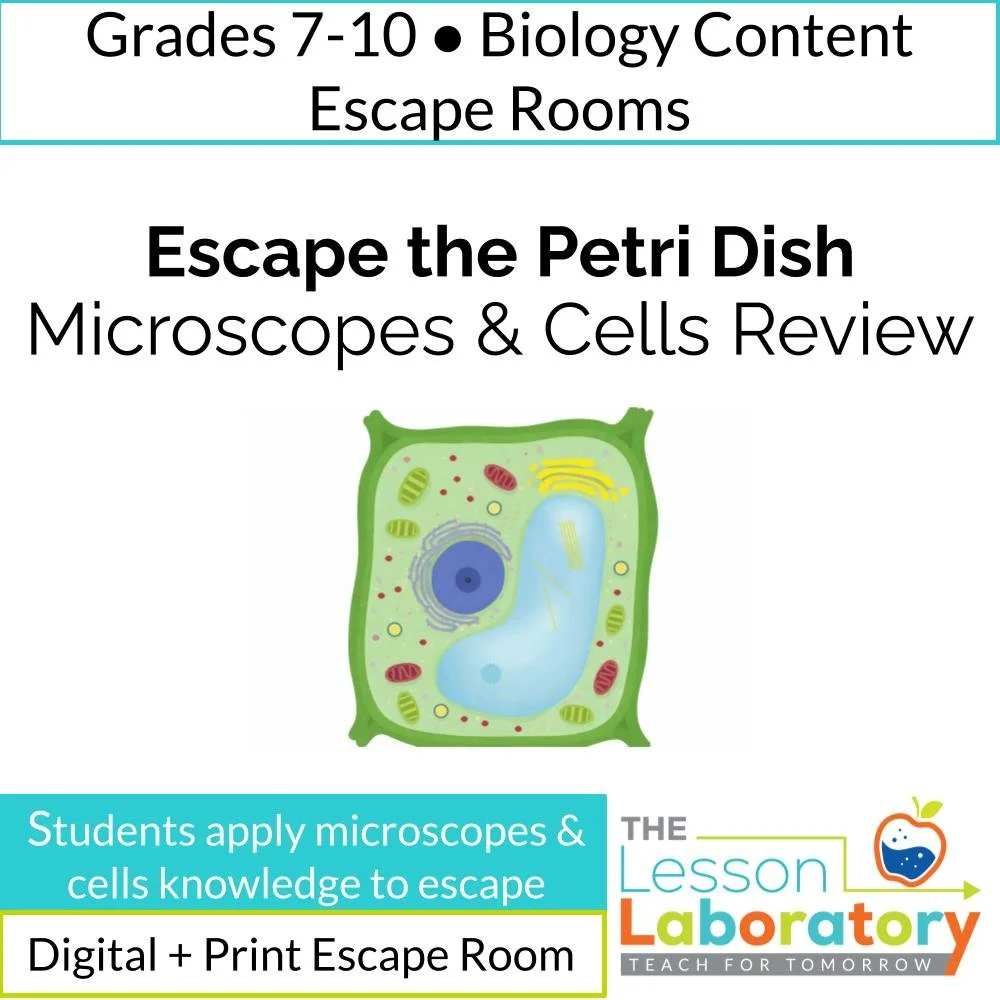
Escape the Petri Dish! (A Microscopes and Cells Escape Room Activity)
Embark on an Epic Microscopic Escape Adventure with Dr. Znorgberg!
Prepare for an electrifying journey as students find themselves miniaturized and trapped within a petri dish, courtesy of the diabolical Dr. Znorgberg and his nefarious Maniacal Microgenitor! To break free, they'll need to apply all the microscopes and cell organelle skills they've mastered in this chapter. The clock is ticking—Dr. Znorgberg is poised to switch to high power!
This microscopes and cells review activity isn't just challenging—it's a heart-pounding experience! Leveraging the excitement of the "escape the room" trend, this online escape promises an adventure like no other. All that's needed is the provided printout and some microscopes, and you're set for a mission that's both rigorous and exhilarating. Ideally placed at the conclusion of your microscopes and cells unit, this mission calls on students to apply their knowledge and skills in:
Navigating microscope parts and functions
Mastering Cell Theory principles
Identifying cell organelle names and functions
Understanding cell transport (diffusion, osmosis, and active transport)
Delving into photosynthesis and cellular respiration
The Pulse-Pounding Journey:
Station One: Students utilize their knowledge of microscope parts and functions to request a specific slide from their teacher. Placing it under the microscope, they unveil the "escape code" written on the slide. With the codes printed in microscopic font, students must rely on the microscope to read it!
Station Two: A hyperlink sends students on an exploration of the first 10 million digits of pi. Answering cell theory-related questions leads them to specific positions in pi containing their hidden escape code.
Station Three: Students undertake a challenge involving a "doodad factory" diagram and a plant cell diagram. Organelle names have been replaced with code digits. By matching doodad factory components to organelles, students unveil the escape code.
Station Four: Diagrams of solute and water molecules present a diffusion, osmosis, and active transport puzzle. By deciphering maritime flag codes on ships, students unlock the escape code.
Station Five: Chemical equations for photosynthesis and cellular respiration hold the key. Students correlate molecule pictures to the letters and numbers in the equations. These molecule pictures contain code digits, leading to the ultimate escape!
This isn't just a lesson—it's a high octane adventure that will leave students on the edge of their seats! Will they outsmart Dr. Znorgberg and break free in time? Get ready for an unforgettable blend of excitement and education! Don't wait—embark on the microscopic escape now!
This file includes a teacher key, along with printouts of microscope slides as described in station one. Please remind your students that their codes will have to be in all capital letters without spaces, or else they won't be able to escape!
Grade Recommendation
Middle School:
Grades 7–8
Highly suitable—students at this level study cells, microscopes, organelles, and basic biochemistry. The puzzle format supports inquiry-based learning and builds lab science confidence.
High School:
Grades 9–10 (Living Environment / Biology)
Perfect fit—this escape room reinforces foundational NYS Living Environment content such as microscope use, cell theory, organelles, transport, and photosynthesis/respiration.
Cross-Curricular Connections and/or Extensions
ELA
Reading comprehension required for multi-step puzzle instructions.
Students must decode reasoning-heavy scenario text.
Optional extension: Students write their own “escape room station,” incorporating scientific content and narrative writing.
Math
Understanding magnification calculations (multiplicative reasoning).
Logical sequencing based on diagrams.
Station 2 uses positional digit retrieval of pi, which reinforces number sense and pattern recognition.
Art / Media Literacy
Students analyze diagrams and visual codes (microscope views, maritime flags, cell diagrams).
Optional: Students design a slide or create their own themed escape station graphics.
Technology
Integrates digital problem-solving, Google Forms interface, hyperlinking, and online simulation tools (e.g., pi exploration tool).
Science Extension Options
Have students create microscope slides that peers must interpret.
Add a bonus “Station 6: Experimental Design” where students must design a microscopic investigation to escape a final lock.
Use real microscopes for Station 1 (already embedded), reinforcing authentic lab skills.
Join the Lesson Laboratory and Teach for Tomorrow!
NGSS Standards (MS + HS)
Because this escape room blends microscopes, cell theory, organelles, transport, and energy transformations, it naturally aligns with multiple NGSS performance expectations.
Middle School NGSS Performance Expectations
MS-LS1-1
Conduct investigations to provide evidence that living things are made of cells.
(Station 2 cell theory; organelles; prokaryote vs eukaryote questions)
MS-LS1-2
Develop and use a model to describe the function of a cell as a whole and ways parts contribute to the function.
(Station 3 organelle–factory analogy)
MS-LS1-7
Use models to describe how food is rearranged during respiration.
(Station 5 photosynthesis vs respiration equations)
MS-PS3-3
Apply scientific principles to design or revise a system that transfers energy.
(Transport station; molecules moving across membrane)
High School NGSS Performance Expectations
HS-LS1-1
Construct an explanation based on evidence for how the structure of DNA determines the structure of proteins.
(Lightly aligned through organelle references; not a core focus)
HS-LS1-2
Develop and use a model to illustrate hierarchical organization of interacting systems.
(Cell → tissue → organ → organism question in Station 2)
HS-LS1-3
Plan and conduct an investigation to provide evidence that cells are the basic structural and functional units of life.
(Microscope station directly supports this)
HS-LS1-5 / HS-LS1-7
Photosynthesis and cellular respiration equations and energy flow concepts.
(Station 5 heavily supports these)
Crosscutting Concepts (CCC's)
1. Structure and Function
Seen throughout microscopy questions, organelle functions, membrane transport diagrams.
2. Systems and System Models
Cells are presented as interacting subsystems; molecules move within the system in predictable ways.
3. Energy and Matter: Flows, Cycles, and Conservation
Photosynthesis, respiration, and transport stations explicitly require tracking movement of matter and energy.
4. Cause and Effect
Correct use of microscope parts leads to correct image visibility; movement of solutes/water has predictable causes.
Science & Engineering Practices (SEP's)
1. Developing and Using Models
Interpreting diagrams of microscope fields of view
Modeling organelle functions through analogies
Modeling molecular movement across membranes
2. Analyzing and Interpreting Data
Reading microscope slide images
Analyzing maritime flag codes
Interpreting chemical equations
3. Using Mathematics and Computational Thinking
Calculating magnification
Using pi-position retrieval to decode answers
4. Obtaining, Evaluating, and Communicating Information
Reading and synthesizing multi-step instructions across stations
Common Core Standards
ELA – Literacy in Science
CCSS.ELA-LITERACY.RST.6-8.7 / 9-10.7
Integrating quantitative or technical information in diagrams.CCSS.ELA-LITERACY.RST.6-8.3 / 9-10.3
Following multistep lab procedures.CCSS.ELA-LITERACY.RST.6-8.4 / 9-10.4
Determining meaning of symbols and science-specific vocabulary.
Math (CCSS-Math)
CCSS.MATH.CONTENT.6.RP.A.3
Ratios used in magnification.CCSS.MATH.CONTENT.7.SP
Logical reasoning, interpreting patterns (pi retrieval tool).
Embark on an Epic Microscopic Escape Adventure with Dr. Znorgberg!
Prepare for an electrifying journey as students find themselves miniaturized and trapped within a petri dish, courtesy of the diabolical Dr. Znorgberg and his nefarious Maniacal Microgenitor! To break free, they'll need to apply all the microscopes and cell organelle skills they've mastered in this chapter. The clock is ticking—Dr. Znorgberg is poised to switch to high power!
This microscopes and cells review activity isn't just challenging—it's a heart-pounding experience! Leveraging the excitement of the "escape the room" trend, this online escape promises an adventure like no other. All that's needed is the provided printout and some microscopes, and you're set for a mission that's both rigorous and exhilarating. Ideally placed at the conclusion of your microscopes and cells unit, this mission calls on students to apply their knowledge and skills in:
Navigating microscope parts and functions
Mastering Cell Theory principles
Identifying cell organelle names and functions
Understanding cell transport (diffusion, osmosis, and active transport)
Delving into photosynthesis and cellular respiration
The Pulse-Pounding Journey:
Station One: Students utilize their knowledge of microscope parts and functions to request a specific slide from their teacher. Placing it under the microscope, they unveil the "escape code" written on the slide. With the codes printed in microscopic font, students must rely on the microscope to read it!
Station Two: A hyperlink sends students on an exploration of the first 10 million digits of pi. Answering cell theory-related questions leads them to specific positions in pi containing their hidden escape code.
Station Three: Students undertake a challenge involving a "doodad factory" diagram and a plant cell diagram. Organelle names have been replaced with code digits. By matching doodad factory components to organelles, students unveil the escape code.
Station Four: Diagrams of solute and water molecules present a diffusion, osmosis, and active transport puzzle. By deciphering maritime flag codes on ships, students unlock the escape code.
Station Five: Chemical equations for photosynthesis and cellular respiration hold the key. Students correlate molecule pictures to the letters and numbers in the equations. These molecule pictures contain code digits, leading to the ultimate escape!
This isn't just a lesson—it's a high octane adventure that will leave students on the edge of their seats! Will they outsmart Dr. Znorgberg and break free in time? Get ready for an unforgettable blend of excitement and education! Don't wait—embark on the microscopic escape now!
This file includes a teacher key, along with printouts of microscope slides as described in station one. Please remind your students that their codes will have to be in all capital letters without spaces, or else they won't be able to escape!
Grade Recommendation
Middle School:
Grades 7–8
Highly suitable—students at this level study cells, microscopes, organelles, and basic biochemistry. The puzzle format supports inquiry-based learning and builds lab science confidence.
High School:
Grades 9–10 (Living Environment / Biology)
Perfect fit—this escape room reinforces foundational NYS Living Environment content such as microscope use, cell theory, organelles, transport, and photosynthesis/respiration.
Cross-Curricular Connections and/or Extensions
ELA
Reading comprehension required for multi-step puzzle instructions.
Students must decode reasoning-heavy scenario text.
Optional extension: Students write their own “escape room station,” incorporating scientific content and narrative writing.
Math
Understanding magnification calculations (multiplicative reasoning).
Logical sequencing based on diagrams.
Station 2 uses positional digit retrieval of pi, which reinforces number sense and pattern recognition.
Art / Media Literacy
Students analyze diagrams and visual codes (microscope views, maritime flags, cell diagrams).
Optional: Students design a slide or create their own themed escape station graphics.
Technology
Integrates digital problem-solving, Google Forms interface, hyperlinking, and online simulation tools (e.g., pi exploration tool).
Science Extension Options
Have students create microscope slides that peers must interpret.
Add a bonus “Station 6: Experimental Design” where students must design a microscopic investigation to escape a final lock.
Use real microscopes for Station 1 (already embedded), reinforcing authentic lab skills.
Join the Lesson Laboratory and Teach for Tomorrow!
NGSS Standards (MS + HS)
Because this escape room blends microscopes, cell theory, organelles, transport, and energy transformations, it naturally aligns with multiple NGSS performance expectations.
Middle School NGSS Performance Expectations
MS-LS1-1
Conduct investigations to provide evidence that living things are made of cells.
(Station 2 cell theory; organelles; prokaryote vs eukaryote questions)
MS-LS1-2
Develop and use a model to describe the function of a cell as a whole and ways parts contribute to the function.
(Station 3 organelle–factory analogy)
MS-LS1-7
Use models to describe how food is rearranged during respiration.
(Station 5 photosynthesis vs respiration equations)
MS-PS3-3
Apply scientific principles to design or revise a system that transfers energy.
(Transport station; molecules moving across membrane)
High School NGSS Performance Expectations
HS-LS1-1
Construct an explanation based on evidence for how the structure of DNA determines the structure of proteins.
(Lightly aligned through organelle references; not a core focus)
HS-LS1-2
Develop and use a model to illustrate hierarchical organization of interacting systems.
(Cell → tissue → organ → organism question in Station 2)
HS-LS1-3
Plan and conduct an investigation to provide evidence that cells are the basic structural and functional units of life.
(Microscope station directly supports this)
HS-LS1-5 / HS-LS1-7
Photosynthesis and cellular respiration equations and energy flow concepts.
(Station 5 heavily supports these)
Crosscutting Concepts (CCC's)
1. Structure and Function
Seen throughout microscopy questions, organelle functions, membrane transport diagrams.
2. Systems and System Models
Cells are presented as interacting subsystems; molecules move within the system in predictable ways.
3. Energy and Matter: Flows, Cycles, and Conservation
Photosynthesis, respiration, and transport stations explicitly require tracking movement of matter and energy.
4. Cause and Effect
Correct use of microscope parts leads to correct image visibility; movement of solutes/water has predictable causes.
Science & Engineering Practices (SEP's)
1. Developing and Using Models
Interpreting diagrams of microscope fields of view
Modeling organelle functions through analogies
Modeling molecular movement across membranes
2. Analyzing and Interpreting Data
Reading microscope slide images
Analyzing maritime flag codes
Interpreting chemical equations
3. Using Mathematics and Computational Thinking
Calculating magnification
Using pi-position retrieval to decode answers
4. Obtaining, Evaluating, and Communicating Information
Reading and synthesizing multi-step instructions across stations
Common Core Standards
ELA – Literacy in Science
CCSS.ELA-LITERACY.RST.6-8.7 / 9-10.7
Integrating quantitative or technical information in diagrams.CCSS.ELA-LITERACY.RST.6-8.3 / 9-10.3
Following multistep lab procedures.CCSS.ELA-LITERACY.RST.6-8.4 / 9-10.4
Determining meaning of symbols and science-specific vocabulary.
Math (CCSS-Math)
CCSS.MATH.CONTENT.6.RP.A.3
Ratios used in magnification.CCSS.MATH.CONTENT.7.SP
Logical reasoning, interpreting patterns (pi retrieval tool).