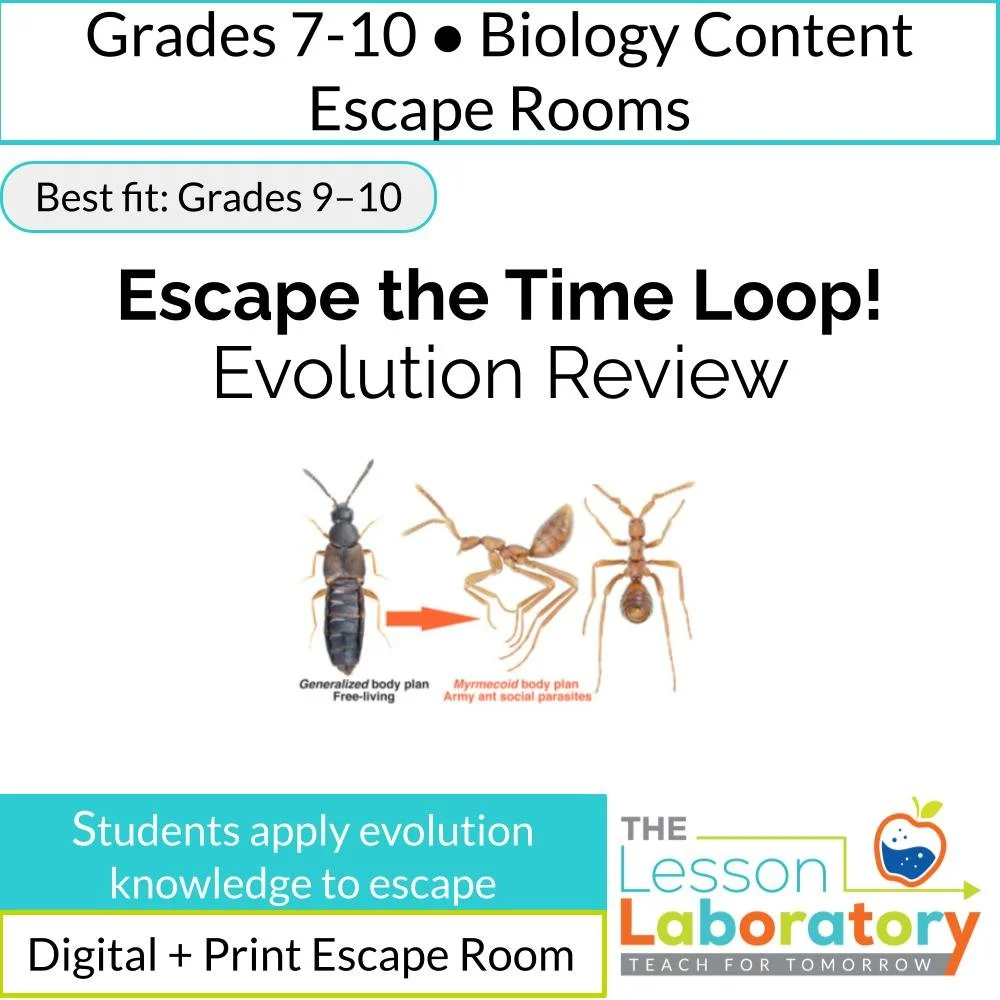
Escape the Time Loop! (An Evolution Escape Room Activity)
Embark on an Epic Evolutionary Escape Quest Against Time with Dr. Znorgberg!
Prepare for a mind-bending adventure as students find themselves ensnared in a time loop, thanks to the nefarious Dr. Znorgberg and his ominous tick-tock tube! To break free, they'll need to apply all the evolutionary investigation skills they've mastered in this chapter. Time is running out—Dr. Znorgberg is on the brink of unleashing his transgenic T-Rex!
This evolution review activity isn't just challenging—it's a heart-pounding experience! Leveraging the excitement of the "escape the room" trend, this online escape promises an adventure like no other. Perfectly situated at the conclusion of your evolution unit, this mission calls on students to apply their knowledge and skills in:
Analyzing evidence of evolution
Distinguishing between Lamarck's and Darwin's ideas
Evaluating examples of natural selection
Creating an evolutionary tree
Unraveling the mysteries of co-evolution
The Epic Adventure:
Station One: Students delve into questions about evidence for evolution to uncover an enigmatic Egyptian hieroglyph. Translating it into English letters reveals the escape code!
Station Two: Lamarck's and Darwin's ideas stand at the crossroads. Students must decide which path to take. The choice determines the fate of a PLINKO ball, guiding them to the ultimate escape code.
Station Three: Real graphs and actual evolutionary examples form the foundation of a compelling CER table. Completing it leads students straight to the escape code.
Station Four: Students undertake the exhilarating task of crafting an evolutionary tree from adorable clipart monsters. The tree holds the key to their escape.
Station Five: True/false questions about co-evolution unlock the secrets of a "book cipher." As the cipher codes align with a paragraph on co-evolution, the escape code emerges.
This isn't just a lesson—it's an adrenaline-charged adventure that will leave students on the edge of their seats! Will they outsmart Dr. Znorgberg and break free from the time loop ... in time? Get ready for an unforgettable blend of excitement and education! Don't wait—embark on the evolutionary quest now!
This file includes a teacher key. Please remind your students that their codes will have to be in all capital letters without spaces, or else they won't be able to escape!
Grade Recommendation
Middle School (Advanced): Grades 7–8
Appropriate for advanced learners during an evolution unit.
Students need foundational knowledge of fossils, natural selection, and basic classification patterns.
High School: Grades 9–10
Ideal for:
Biology / Living Environment Evolution Unit
Regents review (covers: natural selection, evidence for evolution, comparative anatomy, cladistics, biochemistry)
This escape room aligns extremely well with the NYS Living Environment Evolution topic, making it classroom-ready for 9th grade.
Cross-Curricular Connections & Extensions
ELA
Reading scientific scenarios
Interpreting graph-based CER evidence
Hieroglyphic decoding → pattern recognition and visual literacy
Structured written reasoning in the student packet
Math
Half-life calculations
Ordering fossils by depth
Translating numerical book cipher codes to letters (Station 5)
Logical sequencing in cladogram-building
Social Studies / History
Egyptian hieroglyphs analogy (cryptography and archaeology)
Technology
Google Forms interface
Digital lock system
Multimedia integration (video in Station 5)
Possible Extensions
Students create their own evolutionary puzzle
Use real half-life manipulatives (e.g., M&Ms → radioactive decay)
Create a “biochemical evidence” gel using cut-up paper bands
Group discussion on historical misconceptions (Lamarck)
Join the Lesson Laboratory and Teach for Tomorrow!
NGSS Standards (MS & HS)
This escape room strongly reinforces multiple evolutionary performance expectations across grade bands.
Middle School Performance Expectations
MS-LS4-1
Analyze and interpret data for patterns in the fossil record.
— Fossil depth ordering & relative dating (Station 1)
MS-LS4-2
Apply scientific ideas to explain how variations and natural selection lead to adaptations.
— Natural selection CER table (Station 3)
MS-LS4-3
Analyze data supporting that organisms with advantageous traits reproduce more.
— Peppered moths, finch beaks, antibiotic resistance (Station 3)
MS-LS4-4
Construct explanations for anatomical similarities and differences.
— Homologous vs. analogous structures question (Station 1)
MS-LS4-6
Use mathematical representations to support explanations of natural selection.
— Graph-based reasoning in CER
— Frequency changes across generations
High School Performance Expectations
HS-LS4-1
Communicate scientific information showing common ancestry and biological evolution.
— Homologous structures and gel electrophoresis evidence
HS-LS4-2
Construct explanations based on evidence that evolution results from several factors.
— Environmental pressures in CER scenarios
— Pollution, drought, antibiotics
HS-LS4-3
Apply statistical/graphical data to support claims of evolution.
— Moth frequency graph, finch beak data, antibiotic resistance curves
HS-LS4-4
Construct explanations based on evidence for how natural selection leads to adaptation.
— CER reasoning choices A–D (Station 3)
HS-LS4-5
Evaluate evidence for mechanisms of evolution (including coevolution).
— Coevolution scenarios in Station 5
Crosscutting Concepts (CCCs)
Patterns
Fossil layering, gel electrophoresis bands, anatomical similarities, trait frequency graphs.
Cause and Effect
Environmental changes → trait frequency shifts (moths, finches, bacteria).
Stability and Change
Population frequency changes due to selective pressures.
Structure and Function
Homologous vs. analogous structures, vestigial structures.
Systems and System Models
Cladograms as models of evolutionary relationships.
Science & Engineering Practices (SEPs)
Analyzing & Interpreting Data
Graphs, fossils, gel bands, CER tables.
Constructing Explanations
Students explain evolutionary mechanisms using evidence & reasoning.
Developing & Using Models
Cladograms, anatomical comparisons.
Using Mathematics and Computational Thinking
Half-life calculations, ordering, probability of mutations.
Obtaining, Evaluating, and Communicating Information
Evaluating evolutionary scenarios, decoding hieroglyphs/book ciphers.
Common Core Standards
This lesson includes substantial literacy + data analysis → Common Core applies strongly.
ELA (Science Literacy)
RST.9-10.3 — Follow multistep scientific procedures (escape station steps).
RST.9-10.7 — Integrate info from diagrams, graphs, & text (natural selection + fossils).
RST.9-10.8 — Distinguish claims from evidence in CER tables.
RST.9-10.9 — Compare multiple sources of evidence (fossils, anatomy, biochemistry).
Math
HSS.ID.A.1 — Interpret data in graphs.
MP.2 — Reason quantitatively (half-lives).
MP.4 — Use math to model evolutionary patterns.
Embark on an Epic Evolutionary Escape Quest Against Time with Dr. Znorgberg!
Prepare for a mind-bending adventure as students find themselves ensnared in a time loop, thanks to the nefarious Dr. Znorgberg and his ominous tick-tock tube! To break free, they'll need to apply all the evolutionary investigation skills they've mastered in this chapter. Time is running out—Dr. Znorgberg is on the brink of unleashing his transgenic T-Rex!
This evolution review activity isn't just challenging—it's a heart-pounding experience! Leveraging the excitement of the "escape the room" trend, this online escape promises an adventure like no other. Perfectly situated at the conclusion of your evolution unit, this mission calls on students to apply their knowledge and skills in:
Analyzing evidence of evolution
Distinguishing between Lamarck's and Darwin's ideas
Evaluating examples of natural selection
Creating an evolutionary tree
Unraveling the mysteries of co-evolution
The Epic Adventure:
Station One: Students delve into questions about evidence for evolution to uncover an enigmatic Egyptian hieroglyph. Translating it into English letters reveals the escape code!
Station Two: Lamarck's and Darwin's ideas stand at the crossroads. Students must decide which path to take. The choice determines the fate of a PLINKO ball, guiding them to the ultimate escape code.
Station Three: Real graphs and actual evolutionary examples form the foundation of a compelling CER table. Completing it leads students straight to the escape code.
Station Four: Students undertake the exhilarating task of crafting an evolutionary tree from adorable clipart monsters. The tree holds the key to their escape.
Station Five: True/false questions about co-evolution unlock the secrets of a "book cipher." As the cipher codes align with a paragraph on co-evolution, the escape code emerges.
This isn't just a lesson—it's an adrenaline-charged adventure that will leave students on the edge of their seats! Will they outsmart Dr. Znorgberg and break free from the time loop ... in time? Get ready for an unforgettable blend of excitement and education! Don't wait—embark on the evolutionary quest now!
This file includes a teacher key. Please remind your students that their codes will have to be in all capital letters without spaces, or else they won't be able to escape!
Grade Recommendation
Middle School (Advanced): Grades 7–8
Appropriate for advanced learners during an evolution unit.
Students need foundational knowledge of fossils, natural selection, and basic classification patterns.
High School: Grades 9–10
Ideal for:
Biology / Living Environment Evolution Unit
Regents review (covers: natural selection, evidence for evolution, comparative anatomy, cladistics, biochemistry)
This escape room aligns extremely well with the NYS Living Environment Evolution topic, making it classroom-ready for 9th grade.
Cross-Curricular Connections & Extensions
ELA
Reading scientific scenarios
Interpreting graph-based CER evidence
Hieroglyphic decoding → pattern recognition and visual literacy
Structured written reasoning in the student packet
Math
Half-life calculations
Ordering fossils by depth
Translating numerical book cipher codes to letters (Station 5)
Logical sequencing in cladogram-building
Social Studies / History
Egyptian hieroglyphs analogy (cryptography and archaeology)
Technology
Google Forms interface
Digital lock system
Multimedia integration (video in Station 5)
Possible Extensions
Students create their own evolutionary puzzle
Use real half-life manipulatives (e.g., M&Ms → radioactive decay)
Create a “biochemical evidence” gel using cut-up paper bands
Group discussion on historical misconceptions (Lamarck)
Join the Lesson Laboratory and Teach for Tomorrow!
NGSS Standards (MS & HS)
This escape room strongly reinforces multiple evolutionary performance expectations across grade bands.
Middle School Performance Expectations
MS-LS4-1
Analyze and interpret data for patterns in the fossil record.
— Fossil depth ordering & relative dating (Station 1)
MS-LS4-2
Apply scientific ideas to explain how variations and natural selection lead to adaptations.
— Natural selection CER table (Station 3)
MS-LS4-3
Analyze data supporting that organisms with advantageous traits reproduce more.
— Peppered moths, finch beaks, antibiotic resistance (Station 3)
MS-LS4-4
Construct explanations for anatomical similarities and differences.
— Homologous vs. analogous structures question (Station 1)
MS-LS4-6
Use mathematical representations to support explanations of natural selection.
— Graph-based reasoning in CER
— Frequency changes across generations
High School Performance Expectations
HS-LS4-1
Communicate scientific information showing common ancestry and biological evolution.
— Homologous structures and gel electrophoresis evidence
HS-LS4-2
Construct explanations based on evidence that evolution results from several factors.
— Environmental pressures in CER scenarios
— Pollution, drought, antibiotics
HS-LS4-3
Apply statistical/graphical data to support claims of evolution.
— Moth frequency graph, finch beak data, antibiotic resistance curves
HS-LS4-4
Construct explanations based on evidence for how natural selection leads to adaptation.
— CER reasoning choices A–D (Station 3)
HS-LS4-5
Evaluate evidence for mechanisms of evolution (including coevolution).
— Coevolution scenarios in Station 5
Crosscutting Concepts (CCCs)
Patterns
Fossil layering, gel electrophoresis bands, anatomical similarities, trait frequency graphs.
Cause and Effect
Environmental changes → trait frequency shifts (moths, finches, bacteria).
Stability and Change
Population frequency changes due to selective pressures.
Structure and Function
Homologous vs. analogous structures, vestigial structures.
Systems and System Models
Cladograms as models of evolutionary relationships.
Science & Engineering Practices (SEPs)
Analyzing & Interpreting Data
Graphs, fossils, gel bands, CER tables.
Constructing Explanations
Students explain evolutionary mechanisms using evidence & reasoning.
Developing & Using Models
Cladograms, anatomical comparisons.
Using Mathematics and Computational Thinking
Half-life calculations, ordering, probability of mutations.
Obtaining, Evaluating, and Communicating Information
Evaluating evolutionary scenarios, decoding hieroglyphs/book ciphers.
Common Core Standards
This lesson includes substantial literacy + data analysis → Common Core applies strongly.
ELA (Science Literacy)
RST.9-10.3 — Follow multistep scientific procedures (escape station steps).
RST.9-10.7 — Integrate info from diagrams, graphs, & text (natural selection + fossils).
RST.9-10.8 — Distinguish claims from evidence in CER tables.
RST.9-10.9 — Compare multiple sources of evidence (fossils, anatomy, biochemistry).
Math
HSS.ID.A.1 — Interpret data in graphs.
MP.2 — Reason quantitatively (half-lives).
MP.4 — Use math to model evolutionary patterns.