Escape the Zombie Maze! (A Life Functions Escape Room Activity)
Embark on a Spine-Tingling Escape from the Undead with Dr. Znorgberg!
Prepare for a heart-stopping adventure as students find themselves trapped in a maze, surrounded by menacing zombies, courtesy of the diabolical Dr. Znorgberg and his dreaded Metabolism Machete! To break free, they'll need to utilize all the life processes skills they've honed in this chapter. Time is of the essence—those ravenous zombies are hot on their heels, hungry for BRAINNNNNNSSSSS!
This life functions and human body systems review activity isn't just challenging—it's an edge-of-your-seat experience! Riding the wave of the "escape the room" phenomenon, this online escape promises an adventure like no other. Strategically placed at the conclusion of your life functions and human body systems unit, this mission calls on students to apply their knowledge and skills in:
Distinguishing between living and non-living entities
Maintaining homeostasis
Blood typing expertise
Matching essential molecules (antigens and antibodies, hormones and receptors, neurotransmitters)
Mastering the anatomy of the digestive system
The Heart-Pounding Journey:
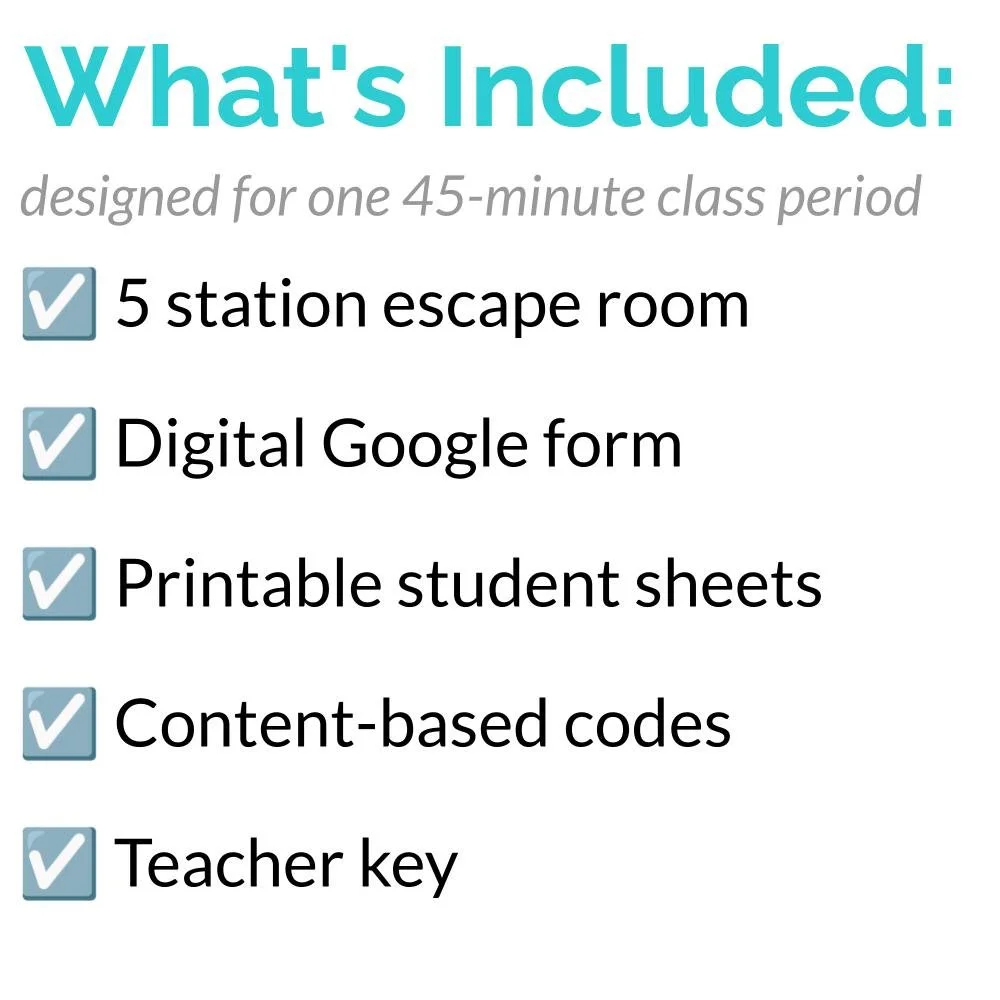
Station One: Students decipher cuneiform symbols, translating them into modern letters to unveil the escape code.
Station Two: In a high-stakes game of two truths and a lie, students interact with three zombies, each making claims about homeostasis. Discerning the truth about the code becomes their key to freedom.
Station Three: Students determine the appropriate blood type for five potential zombie bite victims. The escape code lies at the end of the correct blood bag.
Station Four: Matching molecules provides vital clues about the code. The right molecules guide students to uncover the code using an online Caesar cypher wheel.
Station Five: By correctly ordering the organs of a zombie's digestive system, students unearth the final piece of the escape code.
This isn't just a lesson—it's a pulse-pounding adventure that will leave students on the edge of their seats! Will they outsmart Dr. Znorgberg and evade the clutches of the undead? Get ready for an unforgettable blend of excitement and education! Don't wait—embark on this reanimated escape now!
This file includes a teacher key. Please remind your students that their codes will have to be in all capital letters without spaces, or else they won't be able to escape!
Grade Recommendation
Middle School (Grades 7–8)
Excellent fit: life processes, homeostasis, body systems, basic immunity, classification of living vs. nonliving.
Cognitive load appropriate for independent or group escape-room play.
High School (Grades 9–10, Living Environment / Biology)
Fully appropriate: includes classic NYS Regents–style items on life functions, blood typing, immune response, endocrine signaling, and digestion.
Works well as a review, warm-up, early-year reinforcement, or end-of-unit challenge.
Cross-Curricular Connections / Extensions
English Language Arts
Decoding cuneiform, interpreting riddles, and following clues support critical reading, inferencing, and logic-based reasoning.
Students analyze statements, identify truth vs. lie, and justify conclusions.
Mathematics / Logic
Station 4 involves cipher decoding, pattern recognition, and variable substitution.
Students follow multi-step logic sequences that mirror algebraic reasoning.
Health / Human Body Systems
Includes homeostasis, thermoregulation, digestive order, blood typing, immune system molecules.
Easy extension: connect to vaccines, public health, or medical diagnostics.
Social Studies / Ancient Civilizations (light connection)
Station 1’s Sumerian cuneiform decoding can connect to history of writing and communication.
Join the Lesson Laboratory and Teach for Tomorrow!
NGSS Standards (Middle + High School)
The escape room covers multiple life science dimensions.
MS-LS Standards
Performance Expectations
MS-LS1-1 — Structure & function (cells, organs, life processes)
MS-LS1-2 — Body systems & homeostasis
MS-LS1-3 — Feedback mechanisms (thermoregulation, blood glucose, hydration—all present in Station 2)
MS-LS1-5 — Response to environment (homeostasis situations)
MS-LS1-7 — Matter cycling in organisms (digestion sequence in Station 5)
MS-LS4-2 — Evidence of common ancestry & classification (living vs. nonliving distinctions in Station 1)
High School NGSS Standards (HS-LS)
Performance Expectations
HS-LS1-1 — Structure and function (antigen/antibody binding, hormone receptors, neurotransmitters—Station 4)
HS-LS1-2 — Interaction of body systems in maintaining life (homeostasis, organs, digestion)
HS-LS1-3 — Feedback and homeostasis (Station 2 is entirely about homeostatic regulation)
HS-LS1-7 — Matter and energy in organisms (digestion sequence in Station 5)
HS-LS3-1 — DNA and heredity influence traits (blood types, antigens)
HS-LS3-2 — Patterns of inheritance (blood typing compatibility in Station 3)
Science & Engineering Practices (SEPs)
Present throughout:
SEP1: Asking Questions and Defining Problems — solving puzzles requires interpreting scientific clues.
SEP2: Developing and Using Models — blood compatibility model, homeostasis feedback models.
SEP4: Analyzing and Interpreting Data — students evaluate statements, diagrams, organs, antibodies.
SEP6: Constructing Explanations — justifying answers to “truth vs. lie” statements.
SEP7: Engaging in Argument from Evidence — determining which statement is scientifically valid.
Crosscutting Concepts (CCCs)
Systems & System Models — body systems, immune system interactions, digestive system sequencing.
Structure and Function — antigens & antibodies, hormones & receptors, match-the-molecule station.
Stability and Change — homeostasis questions; how organisms maintain internal balance.
Cause and Effect — why a donor blood type works; why prions aren’t living; why organs must be in order.
Common Core Standards
CCSS.ELA-LITERACY.RST.6–8.3 / RST.9–10.3
Follow multistep procedures (escape room puzzles, blood typing rules, digestive order).
CCSS.ELA-LITERACY.RST.6–8.4 / RST.9–10.4
Determine meaning of technical terms (antigen, receptor, prion, homeostasis).
CCSS.ELA-LITERACY.RST.6–8.8 / RST.9–10.8
Distinguish between scientific claims and statements lacking scientific support (the “truth vs. lie” station).
CCSS.MATH.PRACTICE.MP1 & MP2
Perseverance in problem solving & reasoning abstractly (cipher decoding, logic puzzles).
Embark on a Spine-Tingling Escape from the Undead with Dr. Znorgberg!
Prepare for a heart-stopping adventure as students find themselves trapped in a maze, surrounded by menacing zombies, courtesy of the diabolical Dr. Znorgberg and his dreaded Metabolism Machete! To break free, they'll need to utilize all the life processes skills they've honed in this chapter. Time is of the essence—those ravenous zombies are hot on their heels, hungry for BRAINNNNNNSSSSS!
This life functions and human body systems review activity isn't just challenging—it's an edge-of-your-seat experience! Riding the wave of the "escape the room" phenomenon, this online escape promises an adventure like no other. Strategically placed at the conclusion of your life functions and human body systems unit, this mission calls on students to apply their knowledge and skills in:
Distinguishing between living and non-living entities
Maintaining homeostasis
Blood typing expertise
Matching essential molecules (antigens and antibodies, hormones and receptors, neurotransmitters)
Mastering the anatomy of the digestive system
The Heart-Pounding Journey:
Station One: Students decipher cuneiform symbols, translating them into modern letters to unveil the escape code.
Station Two: In a high-stakes game of two truths and a lie, students interact with three zombies, each making claims about homeostasis. Discerning the truth about the code becomes their key to freedom.
Station Three: Students determine the appropriate blood type for five potential zombie bite victims. The escape code lies at the end of the correct blood bag.
Station Four: Matching molecules provides vital clues about the code. The right molecules guide students to uncover the code using an online Caesar cypher wheel.
Station Five: By correctly ordering the organs of a zombie's digestive system, students unearth the final piece of the escape code.
This isn't just a lesson—it's a pulse-pounding adventure that will leave students on the edge of their seats! Will they outsmart Dr. Znorgberg and evade the clutches of the undead? Get ready for an unforgettable blend of excitement and education! Don't wait—embark on this reanimated escape now!
This file includes a teacher key. Please remind your students that their codes will have to be in all capital letters without spaces, or else they won't be able to escape!
Grade Recommendation
Middle School (Grades 7–8)
Excellent fit: life processes, homeostasis, body systems, basic immunity, classification of living vs. nonliving.
Cognitive load appropriate for independent or group escape-room play.
High School (Grades 9–10, Living Environment / Biology)
Fully appropriate: includes classic NYS Regents–style items on life functions, blood typing, immune response, endocrine signaling, and digestion.
Works well as a review, warm-up, early-year reinforcement, or end-of-unit challenge.
Cross-Curricular Connections / Extensions
English Language Arts
Decoding cuneiform, interpreting riddles, and following clues support critical reading, inferencing, and logic-based reasoning.
Students analyze statements, identify truth vs. lie, and justify conclusions.
Mathematics / Logic
Station 4 involves cipher decoding, pattern recognition, and variable substitution.
Students follow multi-step logic sequences that mirror algebraic reasoning.
Health / Human Body Systems
Includes homeostasis, thermoregulation, digestive order, blood typing, immune system molecules.
Easy extension: connect to vaccines, public health, or medical diagnostics.
Social Studies / Ancient Civilizations (light connection)
Station 1’s Sumerian cuneiform decoding can connect to history of writing and communication.
Join the Lesson Laboratory and Teach for Tomorrow!
NGSS Standards (Middle + High School)
The escape room covers multiple life science dimensions.
MS-LS Standards
Performance Expectations
MS-LS1-1 — Structure & function (cells, organs, life processes)
MS-LS1-2 — Body systems & homeostasis
MS-LS1-3 — Feedback mechanisms (thermoregulation, blood glucose, hydration—all present in Station 2)
MS-LS1-5 — Response to environment (homeostasis situations)
MS-LS1-7 — Matter cycling in organisms (digestion sequence in Station 5)
MS-LS4-2 — Evidence of common ancestry & classification (living vs. nonliving distinctions in Station 1)
High School NGSS Standards (HS-LS)
Performance Expectations
HS-LS1-1 — Structure and function (antigen/antibody binding, hormone receptors, neurotransmitters—Station 4)
HS-LS1-2 — Interaction of body systems in maintaining life (homeostasis, organs, digestion)
HS-LS1-3 — Feedback and homeostasis (Station 2 is entirely about homeostatic regulation)
HS-LS1-7 — Matter and energy in organisms (digestion sequence in Station 5)
HS-LS3-1 — DNA and heredity influence traits (blood types, antigens)
HS-LS3-2 — Patterns of inheritance (blood typing compatibility in Station 3)
Science & Engineering Practices (SEPs)
Present throughout:
SEP1: Asking Questions and Defining Problems — solving puzzles requires interpreting scientific clues.
SEP2: Developing and Using Models — blood compatibility model, homeostasis feedback models.
SEP4: Analyzing and Interpreting Data — students evaluate statements, diagrams, organs, antibodies.
SEP6: Constructing Explanations — justifying answers to “truth vs. lie” statements.
SEP7: Engaging in Argument from Evidence — determining which statement is scientifically valid.
Crosscutting Concepts (CCCs)
Systems & System Models — body systems, immune system interactions, digestive system sequencing.
Structure and Function — antigens & antibodies, hormones & receptors, match-the-molecule station.
Stability and Change — homeostasis questions; how organisms maintain internal balance.
Cause and Effect — why a donor blood type works; why prions aren’t living; why organs must be in order.
Common Core Standards
CCSS.ELA-LITERACY.RST.6–8.3 / RST.9–10.3
Follow multistep procedures (escape room puzzles, blood typing rules, digestive order).
CCSS.ELA-LITERACY.RST.6–8.4 / RST.9–10.4
Determine meaning of technical terms (antigen, receptor, prion, homeostasis).
CCSS.ELA-LITERACY.RST.6–8.8 / RST.9–10.8
Distinguish between scientific claims and statements lacking scientific support (the “truth vs. lie” station).
CCSS.MATH.PRACTICE.MP1 & MP2
Perseverance in problem solving & reasoning abstractly (cipher decoding, logic puzzles).