 Image 1 of 4
 Image 2 of 4
 Image 3 of 4
 Image 4 of 4
Student-Centered Biology Activity with CER, Data Analysis, and Differentiated Tasks.
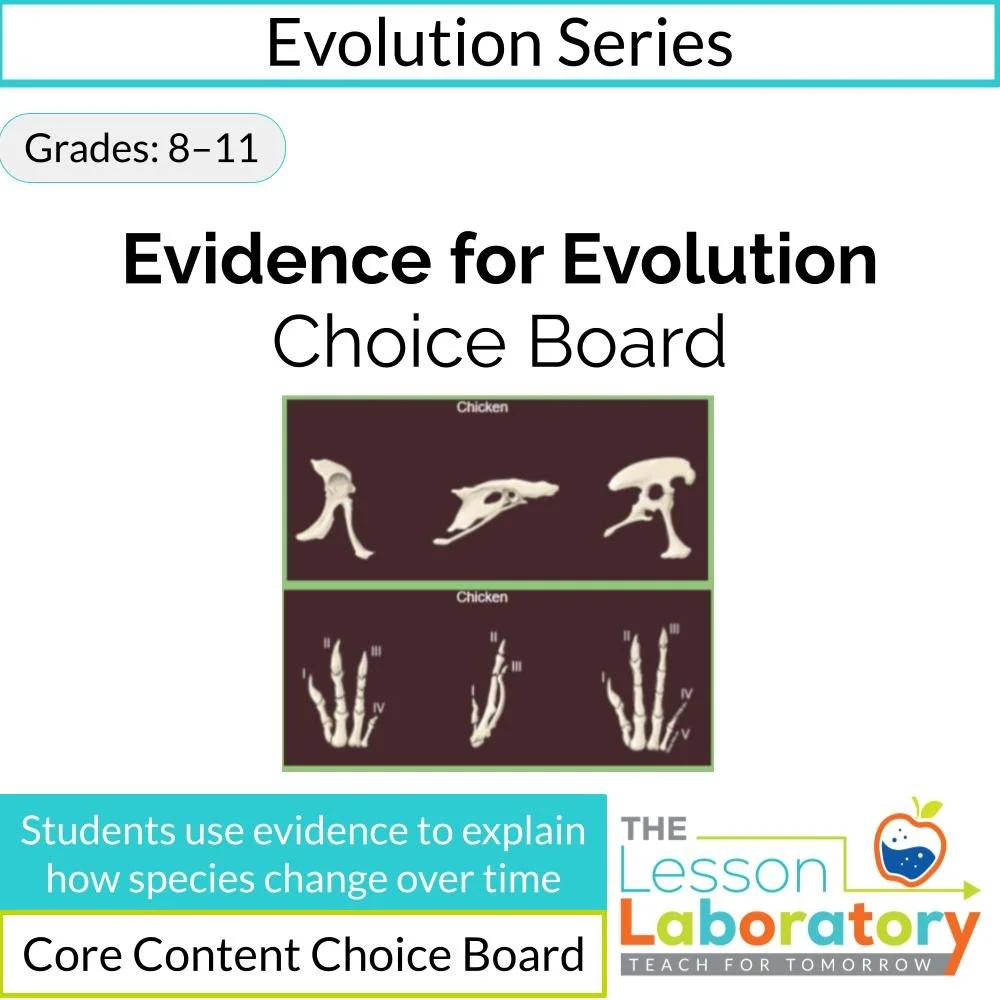
This lesson is designed to help students build a clear, evidence-based understanding of how scientists know that evolution has occurred over time. Rather than memorizing isolated facts, students engage with multiple lines of evidence and use them to construct and support scientific explanations.
Students complete a structured choice board in which they analyze fossils, comparative anatomy, and DNA evidence. Through these tasks, they identify patterns, make claims, and use evidence to support their reasoning. Each required task focuses on a core type of evolutionary evidence, while optional tasks provide opportunities for extension and differentiation.
The lesson concludes with a synthesis task in which students combine multiple sources of evidence to explain how scientists support the theory of evolution. This structure ensures that students move beyond completing activities and toward building a coherent scientific argument.
What Students Do
Analyze fossil evidence to identify patterns of change over time
Compare anatomical structures to infer evolutionary relationships
Use DNA evidence to support claims about common ancestry
Construct CER (Claim–Evidence–Reasoning) responses
Synthesize multiple lines of evidence into a scientific explanation
What’s Included
Student-facing Google Slides choice board
Three required (MUST DO) evidence-based tasks
Six optional (MAY DO) differentiated extension tasks
Structured CER response slides
Final synthesis analysis task
Printable exit ticket
Teacher key
Instructional Design
This lesson is built around a consistent instructional model: students learn by thinking. Tasks are designed to create productive cognitive demand, requiring students to identify patterns, interpret data, and construct explanations using evidence. The choice board structure supports differentiation while maintaining a clear, rigorous learning target for all students.
Grade Range
Grades 8–11 (General Biology / Life Science)
Why Teachers Use This Lesson
Moves beyond memorization to evidence-based reasoning
Provides structured differentiation through choice
Produces meaningful, written student work
Easy to implement with no prep required
Aligns with NGSS practices and CER instruction
Value
This lesson provides a complete, student-centered approach to teaching evidence of evolution, combining multiple modalities into a single, coherent experience that can be used as a standalone lesson or as part of a larger evolution unit.
To see a preview of this lesson, click here.
NGSS Alignment (High School):
HS-LS4-1; HS-LS4-5
NGSS Alignment (Middle School):
MS-LS4-1; MS-LS4-2; MS-LS4-3
Science & Engineering Practices (SEPs):
Analyzing and Interpreting Data
Constructing Explanations
Engaging in Argument from Evidence
Crosscutting Concepts (CCCs):
Patterns
Cause and Effect
Common Core (Literacy in Science):
RST.6-8.1 / RST.9-10.1
RST.6-8.7 / RST.9-10.7
WHST.6-8.2 / WHST.9-10.2
Bundle Upgrade Policy
This lesson is included in one or more bundles. To support flexible purchasing and long-term use of our curriculum, Lesson Laboratory offers a bundle upgrade policy.
If you purchase this lesson and decide at a later date that you would like to upgrade to a bundle, you may request a store credit equal to the total amount paid for duplicate items.
To request an upgrade credit, please email thelessonlaboratory@gmail.com and include:
Your username
The order numbers for both the original purchase(s) and the bundle
The names of the duplicate resources
Requests must be submitted within 30 days of the bundle purchase. Credits are issued as store credit for future Lesson Laboratory purchases and are not provided as cash refunds.
This policy applies only to purchases of resources that are later included in a Lesson Laboratory bundle and is limited to one adjustment per upgrade pathway.
Student-Centered Biology Activity with CER, Data Analysis, and Differentiated Tasks.
This lesson is designed to help students build a clear, evidence-based understanding of how scientists know that evolution has occurred over time. Rather than memorizing isolated facts, students engage with multiple lines of evidence and use them to construct and support scientific explanations.
Students complete a structured choice board in which they analyze fossils, comparative anatomy, and DNA evidence. Through these tasks, they identify patterns, make claims, and use evidence to support their reasoning. Each required task focuses on a core type of evolutionary evidence, while optional tasks provide opportunities for extension and differentiation.
The lesson concludes with a synthesis task in which students combine multiple sources of evidence to explain how scientists support the theory of evolution. This structure ensures that students move beyond completing activities and toward building a coherent scientific argument.
What Students Do
Analyze fossil evidence to identify patterns of change over time
Compare anatomical structures to infer evolutionary relationships
Use DNA evidence to support claims about common ancestry
Construct CER (Claim–Evidence–Reasoning) responses
Synthesize multiple lines of evidence into a scientific explanation
What’s Included
Student-facing Google Slides choice board
Three required (MUST DO) evidence-based tasks
Six optional (MAY DO) differentiated extension tasks
Structured CER response slides
Final synthesis analysis task
Printable exit ticket
Teacher key
Instructional Design
This lesson is built around a consistent instructional model: students learn by thinking. Tasks are designed to create productive cognitive demand, requiring students to identify patterns, interpret data, and construct explanations using evidence. The choice board structure supports differentiation while maintaining a clear, rigorous learning target for all students.
Grade Range
Grades 8–11 (General Biology / Life Science)
Why Teachers Use This Lesson
Moves beyond memorization to evidence-based reasoning
Provides structured differentiation through choice
Produces meaningful, written student work
Easy to implement with no prep required
Aligns with NGSS practices and CER instruction
Value
This lesson provides a complete, student-centered approach to teaching evidence of evolution, combining multiple modalities into a single, coherent experience that can be used as a standalone lesson or as part of a larger evolution unit.
To see a preview of this lesson, click here.
NGSS Alignment (High School):
HS-LS4-1; HS-LS4-5
NGSS Alignment (Middle School):
MS-LS4-1; MS-LS4-2; MS-LS4-3
Science & Engineering Practices (SEPs):
Analyzing and Interpreting Data
Constructing Explanations
Engaging in Argument from Evidence
Crosscutting Concepts (CCCs):
Patterns
Cause and Effect
Common Core (Literacy in Science):
RST.6-8.1 / RST.9-10.1
RST.6-8.7 / RST.9-10.7
WHST.6-8.2 / WHST.9-10.2
Bundle Upgrade Policy
This lesson is included in one or more bundles. To support flexible purchasing and long-term use of our curriculum, Lesson Laboratory offers a bundle upgrade policy.
If you purchase this lesson and decide at a later date that you would like to upgrade to a bundle, you may request a store credit equal to the total amount paid for duplicate items.
To request an upgrade credit, please email thelessonlaboratory@gmail.com and include:
Your username
The order numbers for both the original purchase(s) and the bundle
The names of the duplicate resources
Requests must be submitted within 30 days of the bundle purchase. Credits are issued as store credit for future Lesson Laboratory purchases and are not provided as cash refunds.
This policy applies only to purchases of resources that are later included in a Lesson Laboratory bundle and is limited to one adjustment per upgrade pathway.