 Image 1 of 4
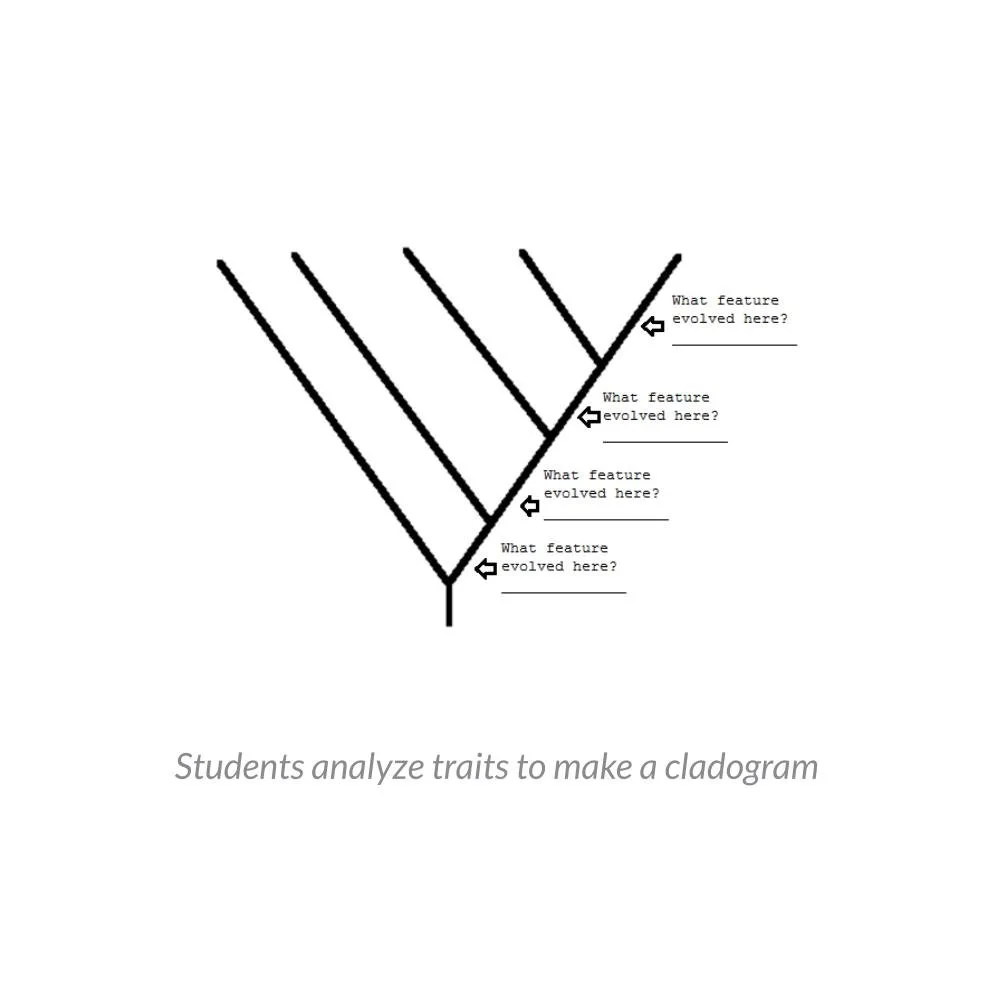 Image 2 of 4
 Image 3 of 4
 Image 4 of 4
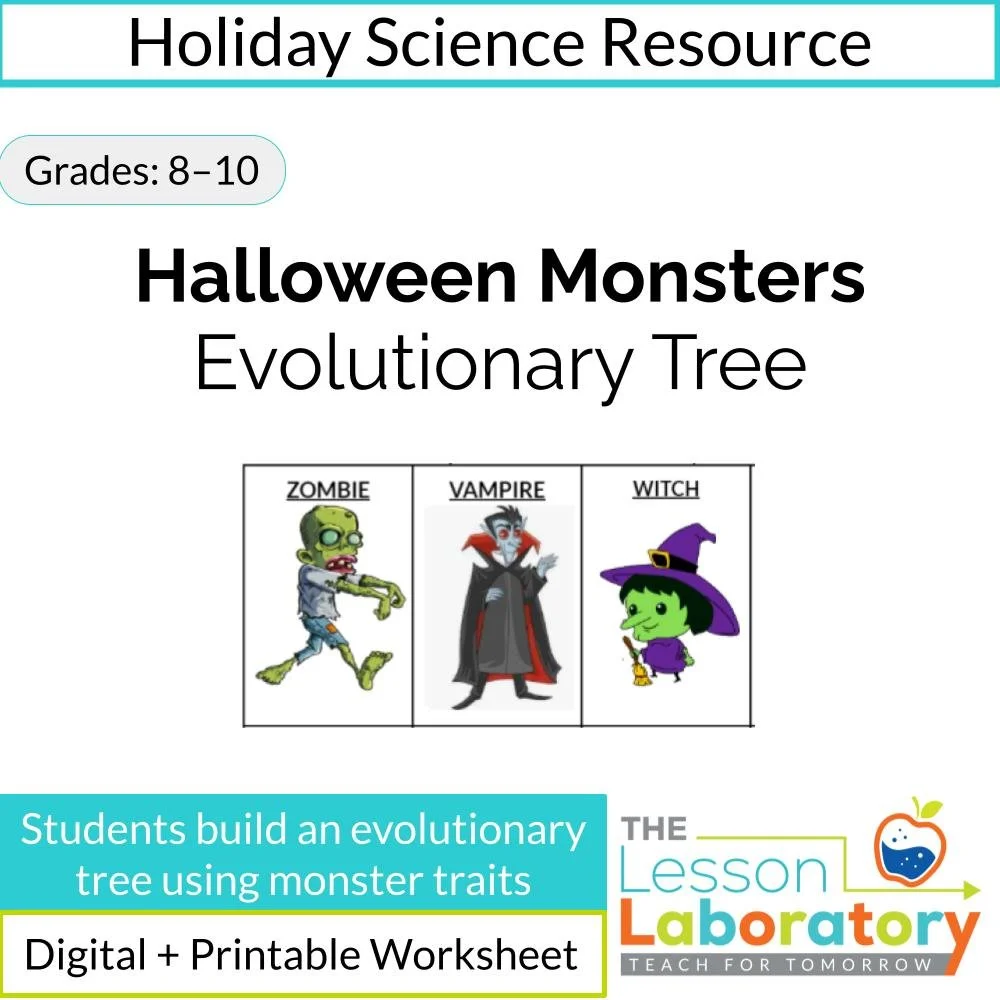
Engaging Halloween-Themed Evolution Worksheet (digital and paper options) for Teaching Traits, Common Ancestry & Parsimony.
This activity introduces students to evolutionary relationships and common ancestry through construction of an evolutionary tree using fictional organisms. Students practice the same reasoning used in real phylogenetics by comparing traits and proposing relationships based on shared characteristics.
Students are given a set of “organisms” (Halloween monsters) and:
analyze traits to determine relatedness
propose branching patterns based on shared features
construct an evolutionary tree to represent those relationships
justify placement using comparative reasoning
The lesson is available in both:
a printable version for hands-on construction
a digital version for drag-and-drop tree building
Although the organisms are fictional, the cognitive task mirrors authentic evolutionary reasoning: students must infer ancestry based on observable traits and represent those in a branching model.
This lesson is designed to support:
understanding of evolutionary trees and branching patterns
reasoning about common ancestry
comparison of traits across organisms
visual modeling of evolutionary relationships
It functions well as:
a seasonal evolution activity
an introductory or reinforcement lesson on phylogenetic trees
a creative application task after instruction on evolution
The format allows students to demonstrate conceptual understanding through model construction rather than recall, making it suitable for application and synthesis of evolution content.
Middle School: 7–8
High School: 9–10 (intro evolution, cladograms, common ancestry)
Justification:
• The task requires comparing traits, constructing a parsimony-based tree, and identifying derived characteristics — all comfortably within MS-LS4 and HS-LS4 levels.
• Fictional creatures reduce the cognitive load and avoid student misconceptions about real organisms.
To see a preview of this activity, click here.
NGSS Alignment (High School):
HS-LS4-1, HS-LS4-2
NGSS Alignment (Middle School):
MS-LS4-1, MS-LS4-2
Science & Engineering Practices (SEPs):
Developing and Using Models; Analyzing and Interpreting Data; Constructing Explanations
Crosscutting Concepts (CCCs):
Patterns; Systems and System Models
Common Core (Literacy in Science):
RST.6-8.1, RST.9-10.1
RST.6-8.7, RST.9-10.7
WHST.6-8.2, WHST.9-10.2
Bundle Upgrade Policy
This lesson is included in one or more bundles. To support flexible purchasing and long-term use of our curriculum, Lesson Laboratory offers a bundle upgrade policy.
If you purchase this lesson and decide at a later date that you would like to upgrade to a bundle, you may request a store credit equal to the total amount paid for duplicate items.
To request an upgrade credit, please email thelessonlaboratory@gmail.com and include:
Your username
The order numbers for both the original purchase(s) and the bundle
The names of the duplicate resources
Requests must be submitted within 30 days of the bundle purchase. Credits are issued as store credit for future Lesson Laboratory purchases and are not provided as cash refunds.
This policy applies only to purchases of resources that are later included in a Lesson Laboratory bundle and is limited to one adjustment per upgrade pathway.
Engaging Halloween-Themed Evolution Worksheet (digital and paper options) for Teaching Traits, Common Ancestry & Parsimony.
This activity introduces students to evolutionary relationships and common ancestry through construction of an evolutionary tree using fictional organisms. Students practice the same reasoning used in real phylogenetics by comparing traits and proposing relationships based on shared characteristics.
Students are given a set of “organisms” (Halloween monsters) and:
analyze traits to determine relatedness
propose branching patterns based on shared features
construct an evolutionary tree to represent those relationships
justify placement using comparative reasoning
The lesson is available in both:
a printable version for hands-on construction
a digital version for drag-and-drop tree building
Although the organisms are fictional, the cognitive task mirrors authentic evolutionary reasoning: students must infer ancestry based on observable traits and represent those in a branching model.
This lesson is designed to support:
understanding of evolutionary trees and branching patterns
reasoning about common ancestry
comparison of traits across organisms
visual modeling of evolutionary relationships
It functions well as:
a seasonal evolution activity
an introductory or reinforcement lesson on phylogenetic trees
a creative application task after instruction on evolution
The format allows students to demonstrate conceptual understanding through model construction rather than recall, making it suitable for application and synthesis of evolution content.
Middle School: 7–8
High School: 9–10 (intro evolution, cladograms, common ancestry)
Justification:
• The task requires comparing traits, constructing a parsimony-based tree, and identifying derived characteristics — all comfortably within MS-LS4 and HS-LS4 levels.
• Fictional creatures reduce the cognitive load and avoid student misconceptions about real organisms.
To see a preview of this activity, click here.
NGSS Alignment (High School):
HS-LS4-1, HS-LS4-2
NGSS Alignment (Middle School):
MS-LS4-1, MS-LS4-2
Science & Engineering Practices (SEPs):
Developing and Using Models; Analyzing and Interpreting Data; Constructing Explanations
Crosscutting Concepts (CCCs):
Patterns; Systems and System Models
Common Core (Literacy in Science):
RST.6-8.1, RST.9-10.1
RST.6-8.7, RST.9-10.7
WHST.6-8.2, WHST.9-10.2
Bundle Upgrade Policy
This lesson is included in one or more bundles. To support flexible purchasing and long-term use of our curriculum, Lesson Laboratory offers a bundle upgrade policy.
If you purchase this lesson and decide at a later date that you would like to upgrade to a bundle, you may request a store credit equal to the total amount paid for duplicate items.
To request an upgrade credit, please email thelessonlaboratory@gmail.com and include:
Your username
The order numbers for both the original purchase(s) and the bundle
The names of the duplicate resources
Requests must be submitted within 30 days of the bundle purchase. Credits are issued as store credit for future Lesson Laboratory purchases and are not provided as cash refunds.
This policy applies only to purchases of resources that are later included in a Lesson Laboratory bundle and is limited to one adjustment per upgrade pathway.