 Image 1 of 4
 Image 2 of 4
 Image 3 of 4
 Image 4 of 4
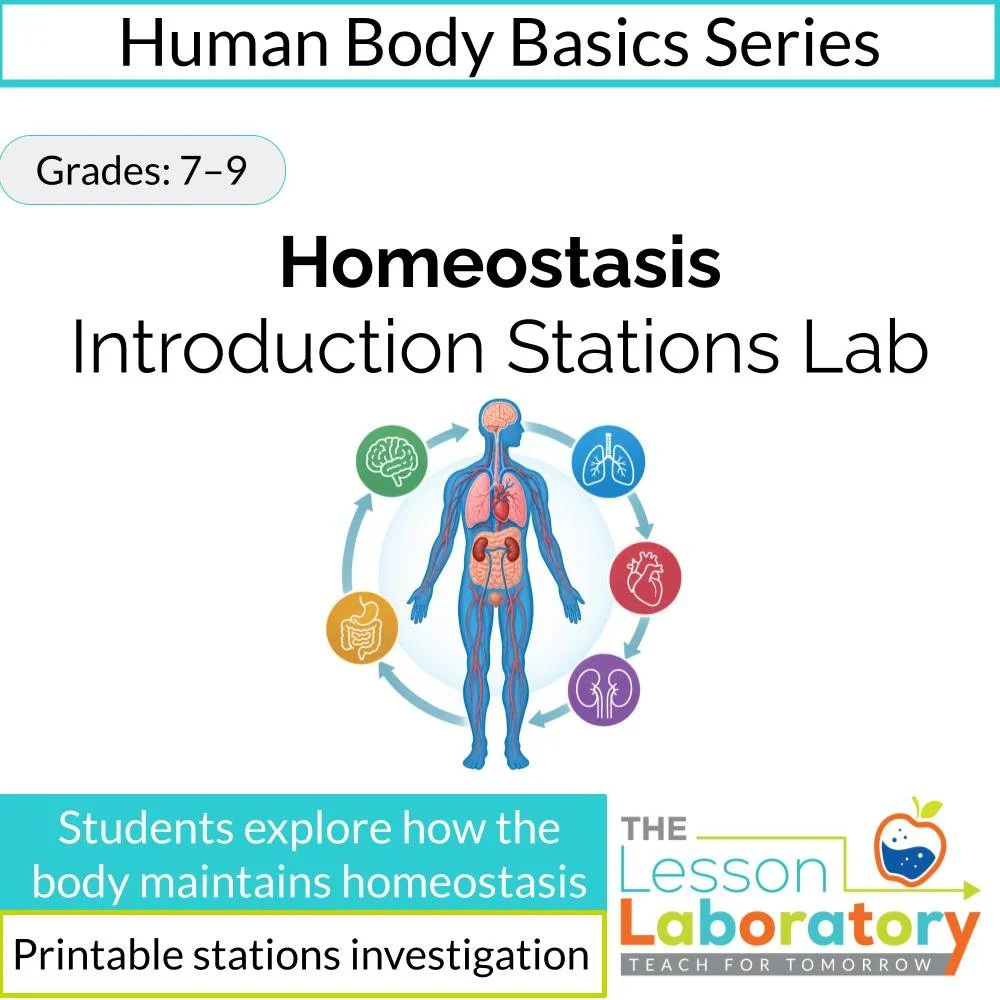
An engaging introduction to homeostasis through 5 hands-on stations exploring body systems, feedback, and homeostatic responses.
Help students build a foundational understanding of homeostasis and the human body systems that work together to maintain it with this ready-to-use stations lab.
Designed as an introduction to homeostasis, this lesson gives students multiple opportunities to apply the concept rather than simply define it. Across five stations, students identify how body systems contribute to homeostasis, determine appropriate homeostatic responses, analyze interactions between body systems, and demonstrate their understanding of negative feedback.
Identify ways that different human body systems contribute to homeostasis.
Determine whether the body should increase or decrease a variable in response to a change.
Apply their understanding of homeostatic responses to common situations involving the human body.
Explain how two body systems can interact to maintain homeostasis.
Create a representation of a negative feedback response.
Demonstrate their understanding of how the body maintains homeostasis on an exit ticket.
Station 1: Two Truths and a Lie Escape Room — Zombie Style!
Students examine statements about human body systems and homeostasis to determine the correct escape code.
Station 2: Homeostasis Maze
Students determine which body reaction would help return the body to homeostasis and trace the correct path.
Station 3: Card Slap
Students rapidly determine whether a body variable should increase or decrease in response to a given situation, then explain one of their responses.
Station 4: Body Systems Interactions
Students analyze real-world scenarios and explain how two body systems could interact to maintain homeostasis. Multiple answers may be possible.
Station 5: Homeostasis Hero
Students create a short comic demonstrating a negative feedback loop responding to a disruption in homeostasis.
Student recording sheets
Five station activities
Station cards and materials
Teacher answer keys
Homeostasis Hero activity
Exit ticket
Self-contained materials for classroom use
This lesson works well as an introductory human body or homeostasis lesson, particularly at the beginning of a unit or as part of a broader study of the human body systems.
No additional lesson preparation or student materials are required beyond printing and preparing the included station materials.
To see a preview of this lesson, click here
Literacy - based exit ticket included with purchase
Join the Lesson Laboratory and Teach for Tomorrow!
NGSS Alignment (High School):
None
NGSS Alignment (Middle School):
MS-LS1-3
Science & Engineering Practices (SEPs):
Developing and Using Models
Constructing Explanations
Obtaining, Evaluating, and Communicating Information
Crosscutting Concepts (CCCs):
Systems and System Models
Cause and Effect
Stability and Change
Common Core (Literacy in Science):
WHST.6-8.2
WHST.9-10.2
An engaging introduction to homeostasis through 5 hands-on stations exploring body systems, feedback, and homeostatic responses.
Help students build a foundational understanding of homeostasis and the human body systems that work together to maintain it with this ready-to-use stations lab.
Designed as an introduction to homeostasis, this lesson gives students multiple opportunities to apply the concept rather than simply define it. Across five stations, students identify how body systems contribute to homeostasis, determine appropriate homeostatic responses, analyze interactions between body systems, and demonstrate their understanding of negative feedback.
Identify ways that different human body systems contribute to homeostasis.
Determine whether the body should increase or decrease a variable in response to a change.
Apply their understanding of homeostatic responses to common situations involving the human body.
Explain how two body systems can interact to maintain homeostasis.
Create a representation of a negative feedback response.
Demonstrate their understanding of how the body maintains homeostasis on an exit ticket.
Station 1: Two Truths and a Lie Escape Room — Zombie Style!
Students examine statements about human body systems and homeostasis to determine the correct escape code.
Station 2: Homeostasis Maze
Students determine which body reaction would help return the body to homeostasis and trace the correct path.
Station 3: Card Slap
Students rapidly determine whether a body variable should increase or decrease in response to a given situation, then explain one of their responses.
Station 4: Body Systems Interactions
Students analyze real-world scenarios and explain how two body systems could interact to maintain homeostasis. Multiple answers may be possible.
Station 5: Homeostasis Hero
Students create a short comic demonstrating a negative feedback loop responding to a disruption in homeostasis.
Student recording sheets
Five station activities
Station cards and materials
Teacher answer keys
Homeostasis Hero activity
Exit ticket
Self-contained materials for classroom use
This lesson works well as an introductory human body or homeostasis lesson, particularly at the beginning of a unit or as part of a broader study of the human body systems.
No additional lesson preparation or student materials are required beyond printing and preparing the included station materials.
To see a preview of this lesson, click here
Literacy - based exit ticket included with purchase
Join the Lesson Laboratory and Teach for Tomorrow!
NGSS Alignment (High School):
None
NGSS Alignment (Middle School):
MS-LS1-3
Science & Engineering Practices (SEPs):
Developing and Using Models
Constructing Explanations
Obtaining, Evaluating, and Communicating Information
Crosscutting Concepts (CCCs):
Systems and System Models
Cause and Effect
Stability and Change
Common Core (Literacy in Science):
WHST.6-8.2
WHST.9-10.2