 Image 1 of 4
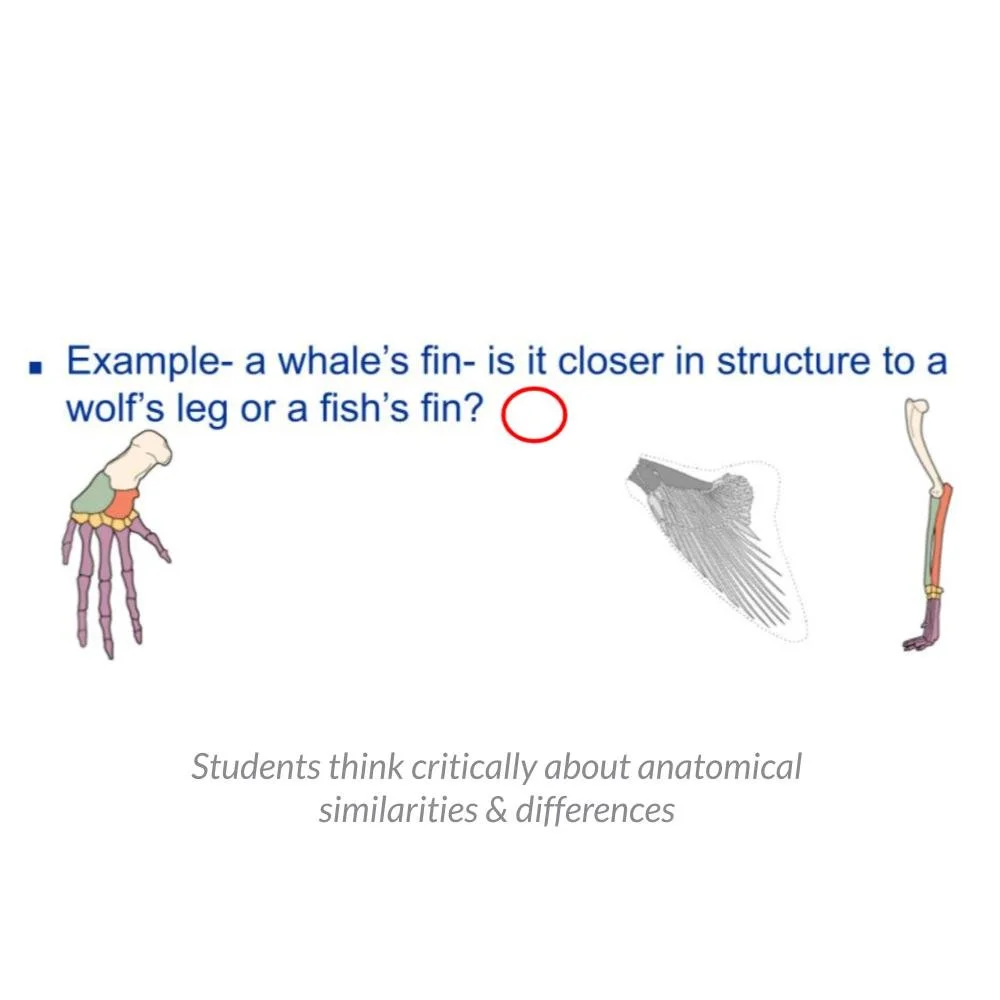 Image 2 of 4
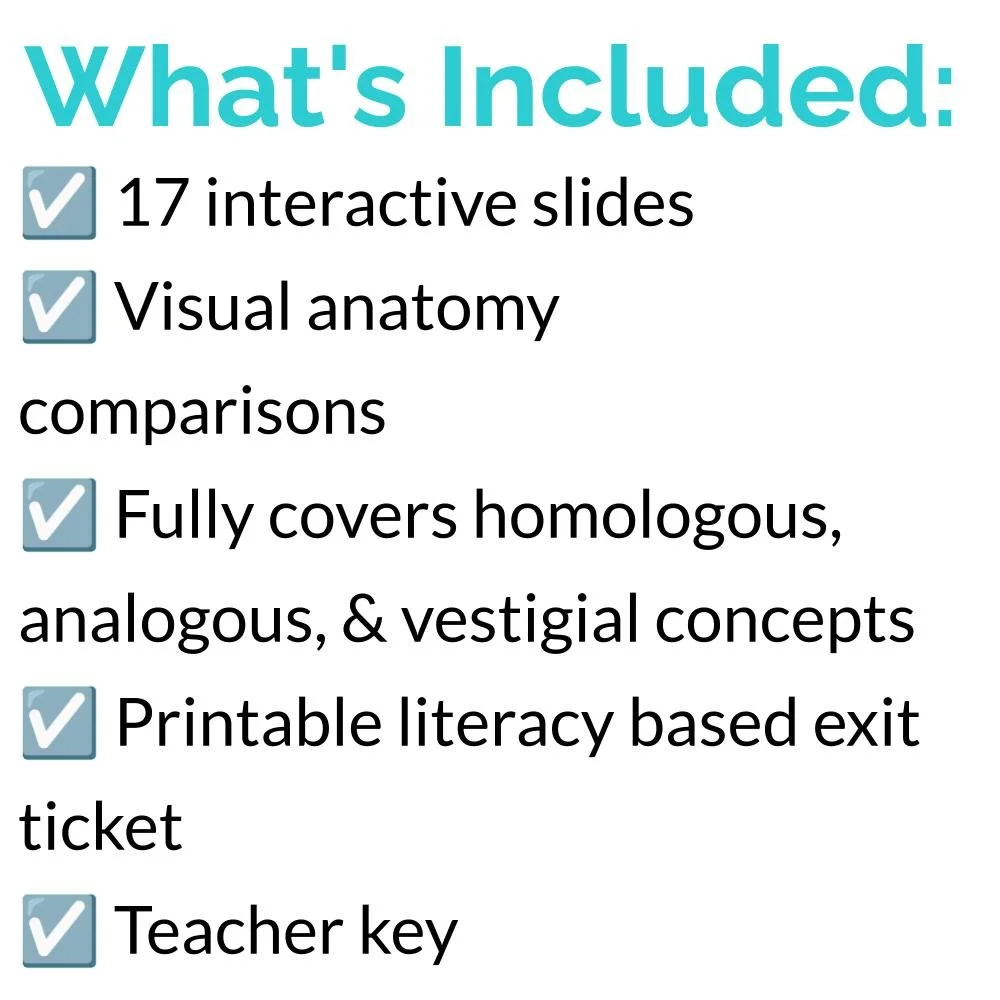 Image 3 of 4
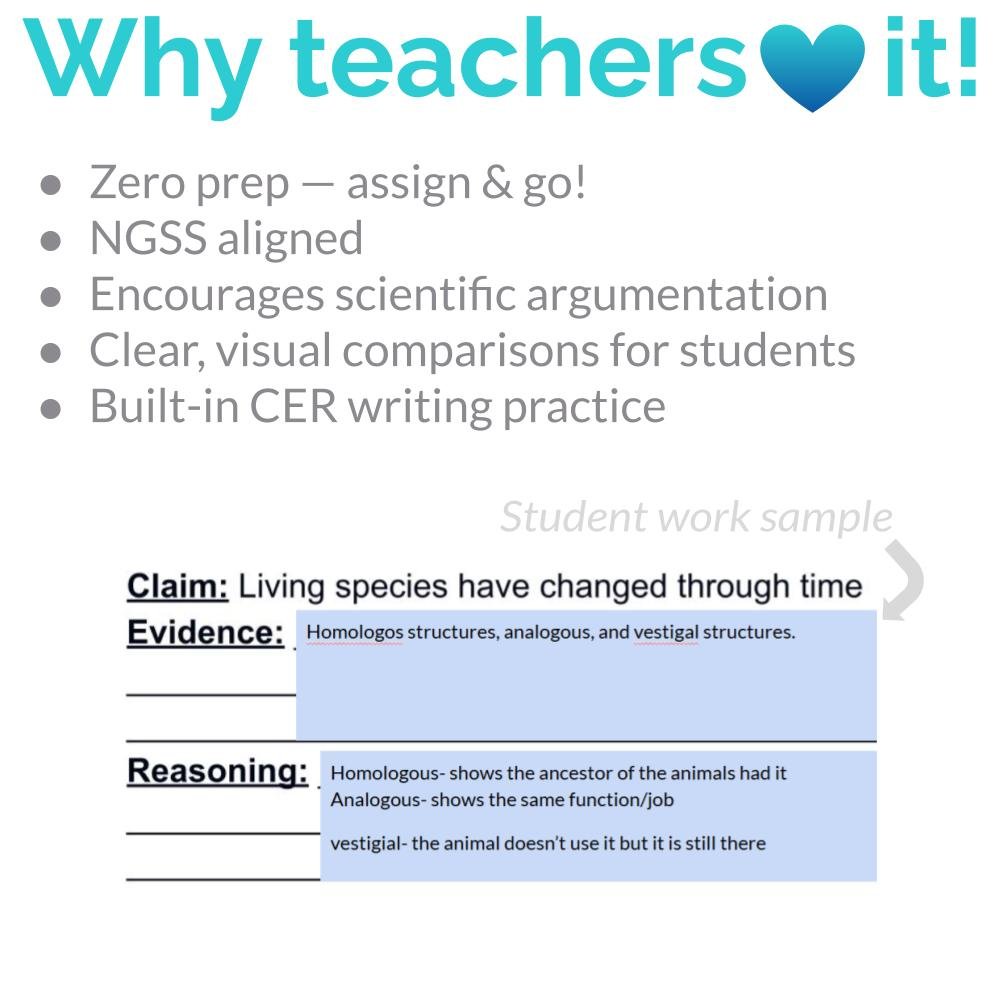 Image 4 of 4
Homologous, Analogous, and Vestigial Structures Analysis.
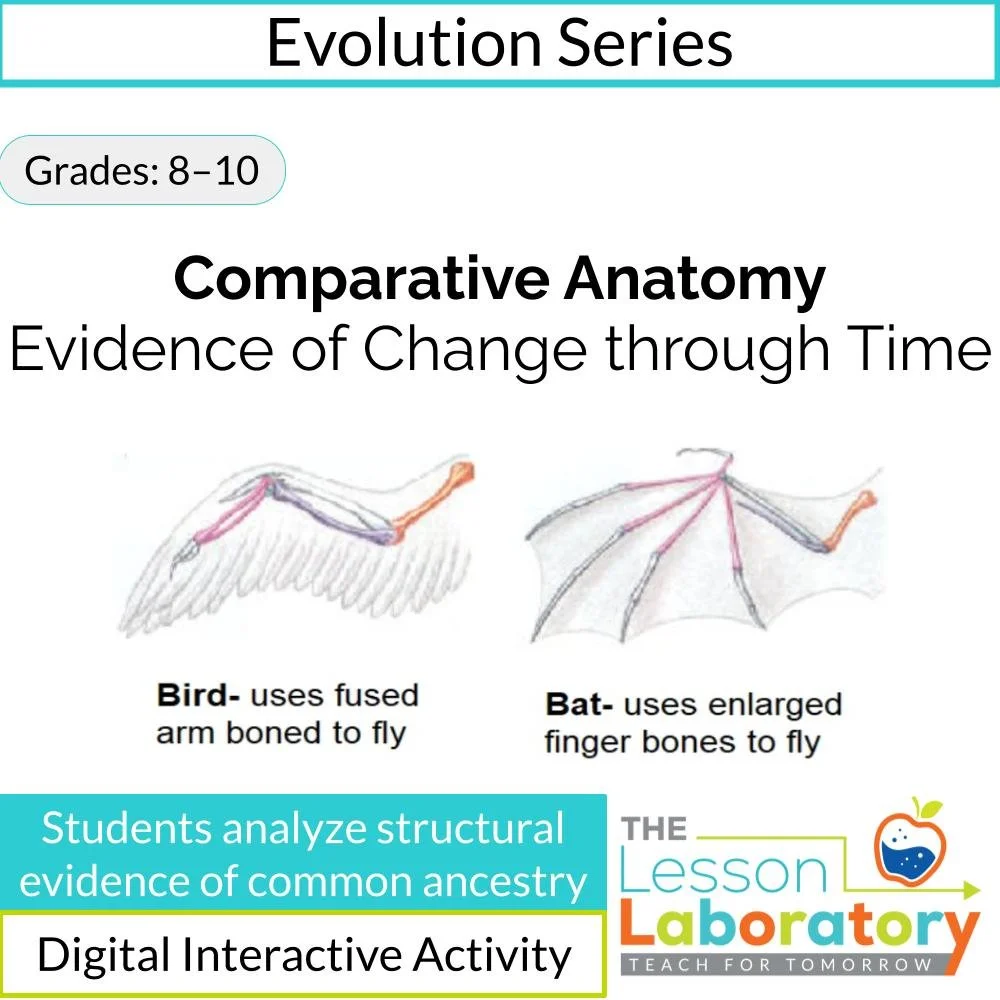
This digital biology lesson introduces students to comparative anatomy as evidence for evolutionary change. Students analyze homologous, analogous, and vestigial structures to determine how similarities and differences in anatomy support common ancestry and adaptation.
Rather than memorizing definitions, students work directly with visual data, models, and guided reasoning tasks to build an evidence-based understanding of evolution.
Students complete three major investigations:
Homologous Structures
Students examine examples of whale evolution and compare the front limb bones of multiple organisms. They identify shared bone patterns, connect structure to function, and analyze fossil organisms to infer common ancestry.
Analogous Structures
Students compare wings in four distantly related organisms and determine which structures enable flight in each. They evaluate how similar functions can arise from different anatomical designs.
Vestigial Structures
Students analyze a chart of human vestigial structures and complete a table describing:
• the structure
• its ancestral function
• why it is reduced or no longer functional
To conclude the lesson, students complete an online activity showing the evolutionary relationship between birds and dinosaurs and then write a Claim–Evidence–Reasoning (CER) statement explaining how comparative anatomy provides evidence for evolution.
• Homologous structures
• Analogous structures
• Vestigial structures
• Common ancestry
• Adaptation and divergence
• Using evidence to support evolutionary claims
• Scientific reasoning (CER)
• Makes evolutionary evidence concrete and visual
• Builds reasoning skills rather than memorization
• Integrates data analysis and writing
• Supports NGSS practices and CER
• Works for guided instruction or independent work
• Minimal prep required
This resource is a digital interactive lesson (Google Slides compatible) with built-in student tasks.
Includes:
✔ Student lesson slides
✔ Teacher answer key
✔ Printable literacy-based exit ticket
• Middle school life science
• High school biology
• Evolution units
• Comparative anatomy lessons
• CER practice
To see a preview of this lesson, click here.
NGSS Alignment:
HS-LS4-1, HS-LS4-2
Science & Engineering Practices (SEPs):
Constructing Explanations; Analyzing and Interpreting Data; Engaging in Argument from Evidence; Communicating Scientific Information
Crosscutting Concepts (CCCs):
Patterns; Structure and Function; Cause and Effect
Common Core (Literacy in Science):
RST.9-10.1 / RST.11-12.1
RST.9-10.7 / RST.11-12.7
WHST.9-10.1 / WHST.11-12.1
Bundle Upgrade Policy
This lesson is included in one or more bundles. To support flexible purchasing and long-term use of our curriculum, Lesson Laboratory offers a bundle upgrade policy.
If you purchase this lesson and decide at a later date that you would like to upgrade to a bundle, you may request a store credit equal to the total amount paid for duplicate items.
To request an upgrade credit, please email thelessonlaboratory@gmail.com and include:
Your username
The order numbers for both the original purchase(s) and the bundle
The names of the duplicate resources
Requests must be submitted within 30 days of the bundle purchase. Credits are issued as store credit for future Lesson Laboratory purchases and are not provided as cash refunds.
This policy applies only to purchases of resources that are later included in a Lesson Laboratory bundle and is limited to one adjustment per upgrade pathway.
Homologous, Analogous, and Vestigial Structures Analysis.
This digital biology lesson introduces students to comparative anatomy as evidence for evolutionary change. Students analyze homologous, analogous, and vestigial structures to determine how similarities and differences in anatomy support common ancestry and adaptation.
Rather than memorizing definitions, students work directly with visual data, models, and guided reasoning tasks to build an evidence-based understanding of evolution.
Students complete three major investigations:
Homologous Structures
Students examine examples of whale evolution and compare the front limb bones of multiple organisms. They identify shared bone patterns, connect structure to function, and analyze fossil organisms to infer common ancestry.
Analogous Structures
Students compare wings in four distantly related organisms and determine which structures enable flight in each. They evaluate how similar functions can arise from different anatomical designs.
Vestigial Structures
Students analyze a chart of human vestigial structures and complete a table describing:
• the structure
• its ancestral function
• why it is reduced or no longer functional
To conclude the lesson, students complete an online activity showing the evolutionary relationship between birds and dinosaurs and then write a Claim–Evidence–Reasoning (CER) statement explaining how comparative anatomy provides evidence for evolution.
• Homologous structures
• Analogous structures
• Vestigial structures
• Common ancestry
• Adaptation and divergence
• Using evidence to support evolutionary claims
• Scientific reasoning (CER)
• Makes evolutionary evidence concrete and visual
• Builds reasoning skills rather than memorization
• Integrates data analysis and writing
• Supports NGSS practices and CER
• Works for guided instruction or independent work
• Minimal prep required
This resource is a digital interactive lesson (Google Slides compatible) with built-in student tasks.
Includes:
✔ Student lesson slides
✔ Teacher answer key
✔ Printable literacy-based exit ticket
• Middle school life science
• High school biology
• Evolution units
• Comparative anatomy lessons
• CER practice
To see a preview of this lesson, click here.
NGSS Alignment:
HS-LS4-1, HS-LS4-2
Science & Engineering Practices (SEPs):
Constructing Explanations; Analyzing and Interpreting Data; Engaging in Argument from Evidence; Communicating Scientific Information
Crosscutting Concepts (CCCs):
Patterns; Structure and Function; Cause and Effect
Common Core (Literacy in Science):
RST.9-10.1 / RST.11-12.1
RST.9-10.7 / RST.11-12.7
WHST.9-10.1 / WHST.11-12.1
Bundle Upgrade Policy
This lesson is included in one or more bundles. To support flexible purchasing and long-term use of our curriculum, Lesson Laboratory offers a bundle upgrade policy.
If you purchase this lesson and decide at a later date that you would like to upgrade to a bundle, you may request a store credit equal to the total amount paid for duplicate items.
To request an upgrade credit, please email thelessonlaboratory@gmail.com and include:
Your username
The order numbers for both the original purchase(s) and the bundle
The names of the duplicate resources
Requests must be submitted within 30 days of the bundle purchase. Credits are issued as store credit for future Lesson Laboratory purchases and are not provided as cash refunds.
This policy applies only to purchases of resources that are later included in a Lesson Laboratory bundle and is limited to one adjustment per upgrade pathway.