 Image 1 of 4
 Image 2 of 4
 Image 3 of 4
 Image 4 of 4
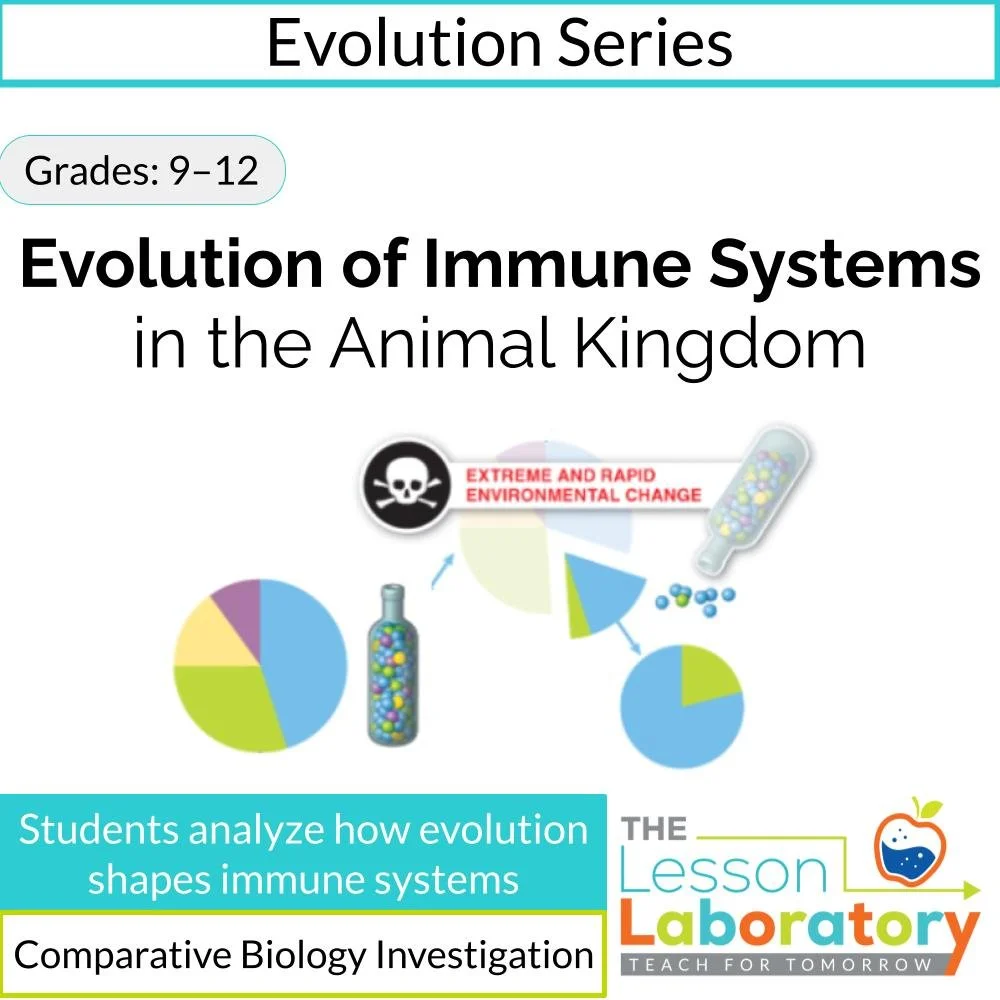
This structured digital investigation explores how immune systems have evolved across the animal kingdom and how evolutionary pressures shape disease resistance. Students apply natural selection, genetic diversity, and bottleneck reasoning to analyze why some species exhibit extraordinary immune adaptations.
Through guided instruction and comparative analysis, students examine how immune defenses differ among organisms and how evolutionary history influences susceptibility, longevity, and resilience.
This lesson emphasizes evolutionary reasoning rather than simple immune system overview. Immune structure and function are revisited as context, but the primary focus is comparative biology and evolutionary application.
Students begin by reviewing foundational immune system concepts before exploring the evolutionary timeline of immunity. They analyze case studies involving species with unusual immune adaptations and evaluate how genetic bottlenecks influence immune diversity.
A structured research component requires students to consult linked scientific sources, synthesize information, and communicate conclusions clearly in writing or presentation form.
Throughout the lesson, students practice:
Applying natural selection to immune traits
Interpreting genetic bottlenecks and population diversity
Comparing immune adaptations across species
Connecting animal immunity to implications for human medicine
Defending claims with evidence from scientific sources
18 student-facing Google Slides
Comparative organism case studies
Guided analysis and discussion prompts
Hyperlinked evolutionary resources
Structured research task
Teacher key
Printable literacy-based exit ticket
High school biology (evolution units)
Regents Living Environment
Honors or advanced biology
Anatomy & Physiology (evolutionary extension)
Zoology or animal science electives
This lesson works particularly well after students have studied natural selection and population genetics, serving as a synthesis application that integrates evolution with immunology.
This resource moves beyond recall to comparative reasoning. Students evaluate evidence, apply evolutionary principles to real organisms, and construct supported explanations about immune system strength and adaptation.
It is structured, academically rigorous, and ready to implement with minimal preparation.
To see a preview of this lesson, click here.
NGSS Alignment (High School):
HS-LS1-2
HS-LS4-2
HS-LS4-4
NGSS Alignment (Middle School):
MS-LS1-2
MS-LS1-3
MS-LS4-4
Science & Engineering Practices (SEPs):
Analyzing and Interpreting Data; Constructing Explanations; Engaging in Argument from Evidence; Obtaining, Evaluating, and Communicating Information
Crosscutting Concepts (CCCs):
Structure and Function; Cause and Effect; Stability and Change; Patterns
Common Core (Literacy in Science):
RST.9-10.1
RST.9-10.7
WHST.9-10.2
WHST.9-10.7
Bundle Upgrade Policy
This lesson is included in one or more bundles. To support flexible purchasing and long-term use of our curriculum, Lesson Laboratory offers a bundle upgrade policy.
If you purchase this lesson and decide at a later date that you would like to upgrade to a bundle, you may request a store credit equal to the total amount paid for duplicate items.
To request an upgrade credit, please email thelessonlaboratory@gmail.com and include:
Your username
The order numbers for both the original purchase(s) and the bundle
The names of the duplicate resources
Requests must be submitted within 30 days of the bundle purchase. Credits are issued as store credit for future Lesson Laboratory purchases and are not provided as cash refunds.
This policy applies only to purchases of resources that are later included in a Lesson Laboratory bundle and is limited to one adjustment per upgrade pathway.
This structured digital investigation explores how immune systems have evolved across the animal kingdom and how evolutionary pressures shape disease resistance. Students apply natural selection, genetic diversity, and bottleneck reasoning to analyze why some species exhibit extraordinary immune adaptations.
Through guided instruction and comparative analysis, students examine how immune defenses differ among organisms and how evolutionary history influences susceptibility, longevity, and resilience.
This lesson emphasizes evolutionary reasoning rather than simple immune system overview. Immune structure and function are revisited as context, but the primary focus is comparative biology and evolutionary application.
Students begin by reviewing foundational immune system concepts before exploring the evolutionary timeline of immunity. They analyze case studies involving species with unusual immune adaptations and evaluate how genetic bottlenecks influence immune diversity.
A structured research component requires students to consult linked scientific sources, synthesize information, and communicate conclusions clearly in writing or presentation form.
Throughout the lesson, students practice:
Applying natural selection to immune traits
Interpreting genetic bottlenecks and population diversity
Comparing immune adaptations across species
Connecting animal immunity to implications for human medicine
Defending claims with evidence from scientific sources
18 student-facing Google Slides
Comparative organism case studies
Guided analysis and discussion prompts
Hyperlinked evolutionary resources
Structured research task
Teacher key
Printable literacy-based exit ticket
High school biology (evolution units)
Regents Living Environment
Honors or advanced biology
Anatomy & Physiology (evolutionary extension)
Zoology or animal science electives
This lesson works particularly well after students have studied natural selection and population genetics, serving as a synthesis application that integrates evolution with immunology.
This resource moves beyond recall to comparative reasoning. Students evaluate evidence, apply evolutionary principles to real organisms, and construct supported explanations about immune system strength and adaptation.
It is structured, academically rigorous, and ready to implement with minimal preparation.
To see a preview of this lesson, click here.
NGSS Alignment (High School):
HS-LS1-2
HS-LS4-2
HS-LS4-4
NGSS Alignment (Middle School):
MS-LS1-2
MS-LS1-3
MS-LS4-4
Science & Engineering Practices (SEPs):
Analyzing and Interpreting Data; Constructing Explanations; Engaging in Argument from Evidence; Obtaining, Evaluating, and Communicating Information
Crosscutting Concepts (CCCs):
Structure and Function; Cause and Effect; Stability and Change; Patterns
Common Core (Literacy in Science):
RST.9-10.1
RST.9-10.7
WHST.9-10.2
WHST.9-10.7
Bundle Upgrade Policy
This lesson is included in one or more bundles. To support flexible purchasing and long-term use of our curriculum, Lesson Laboratory offers a bundle upgrade policy.
If you purchase this lesson and decide at a later date that you would like to upgrade to a bundle, you may request a store credit equal to the total amount paid for duplicate items.
To request an upgrade credit, please email thelessonlaboratory@gmail.com and include:
Your username
The order numbers for both the original purchase(s) and the bundle
The names of the duplicate resources
Requests must be submitted within 30 days of the bundle purchase. Credits are issued as store credit for future Lesson Laboratory purchases and are not provided as cash refunds.
This policy applies only to purchases of resources that are later included in a Lesson Laboratory bundle and is limited to one adjustment per upgrade pathway.