Lab Safety and Laboratory Equipment: Introductory Science Skills Lesson
Students identify safety rules and common lab equipment.
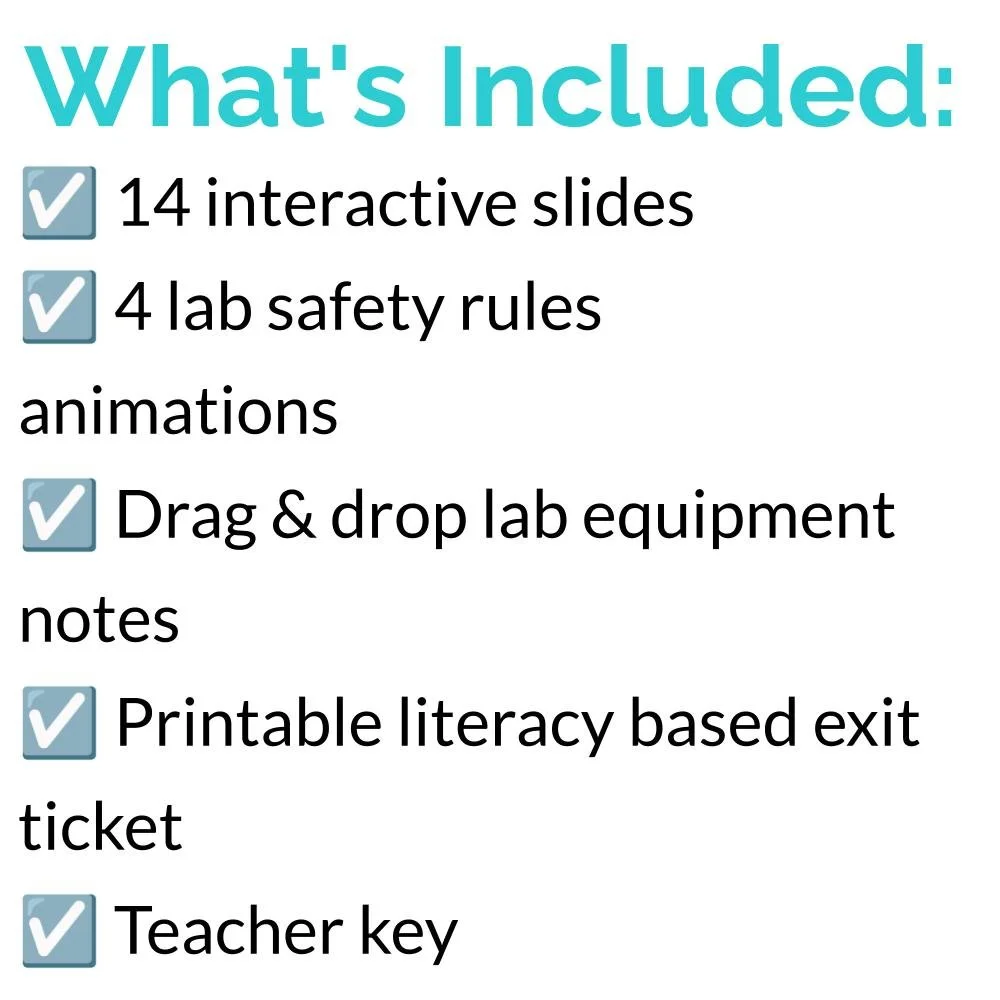
This interactive digital lesson introduces students to laboratory safety practices and common lab equipment through visual analysis and structured identification tasks.
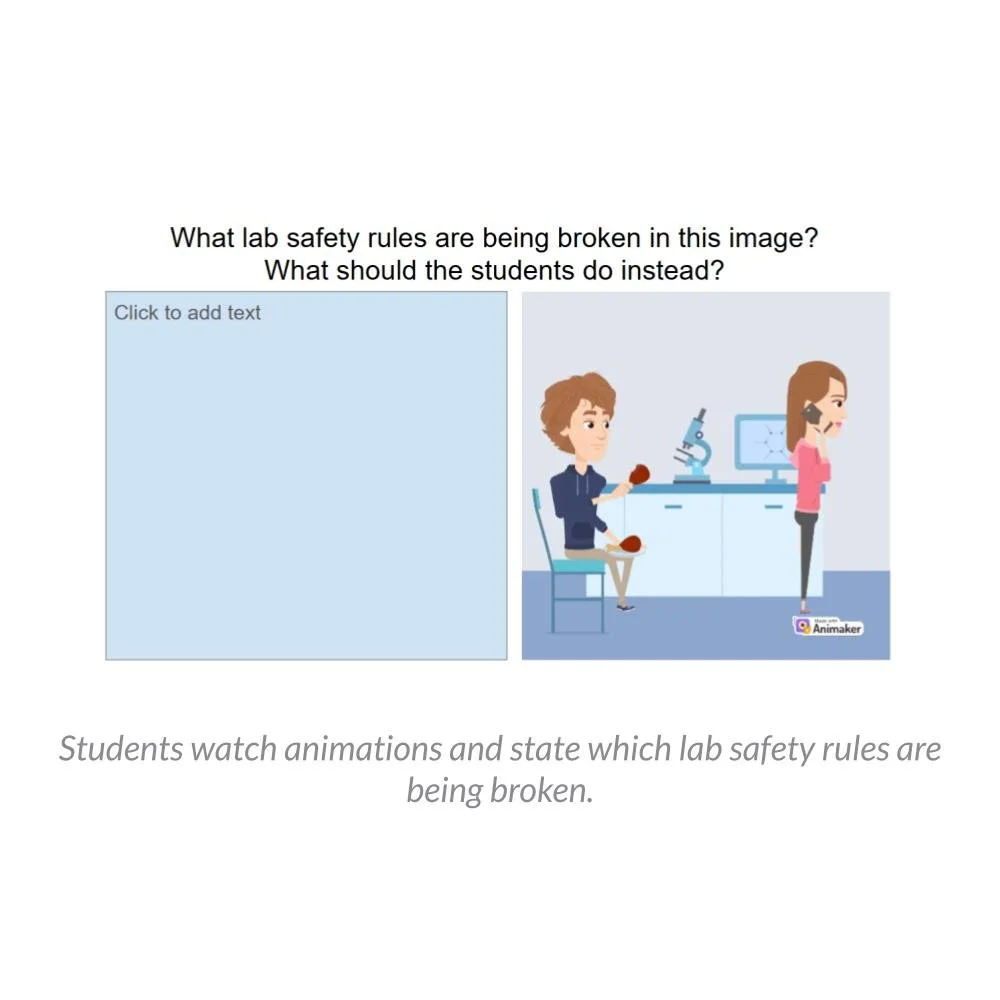
Students begin by examining animated lab scenes and identifying safety rules that are being followed or violated. For each scenario, they determine:
which safety rule applies
what action is incorrect
what should be done instead
This approach requires students to analyze behavior rather than memorize a list of rules.
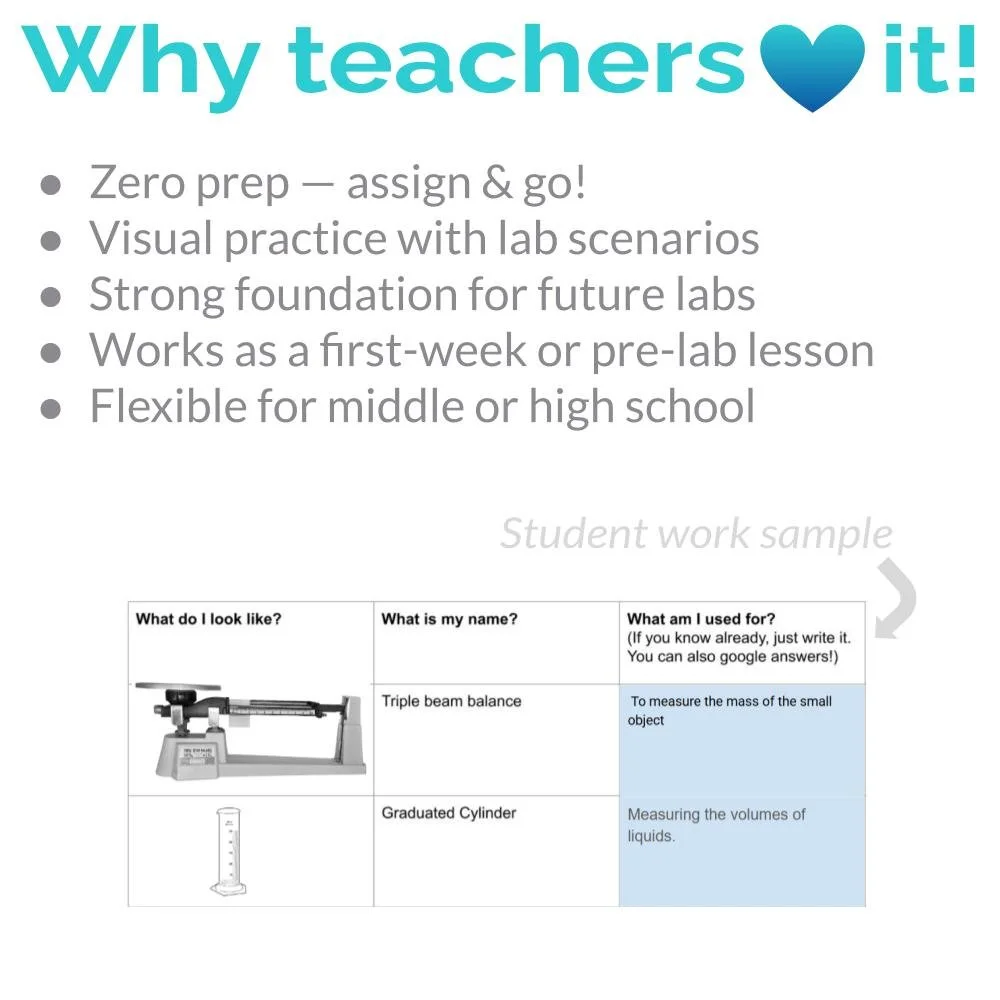
Students then complete a lab equipment identification task in which they:
match equipment names to images
record functions on a vocabulary chart
connect tools to their proper classroom use
The lesson emphasizes:
recognizing unsafe laboratory behavior
applying safety rules to real situations
accurate identification of common lab tools
understanding the purpose of each piece of equipment
This lesson is designed to support:
early instruction in lab safety
development of procedural awareness
consistent use of lab vocabulary
preparation for hands-on laboratory work
It functions well as:
a beginning-of-year lab safety lesson
an introduction to laboratory tools
or a prerequisite activity before physical lab investigations
The digital format allows for low-prep implementation while keeping students actively engaged through visual reasoning and interactive practice.
Grade & Course Recommendation:
Middle School:Grades 6–8, first-week lab orientation and science skills.
High School:Grade 9, introductory lab review or start-of-year refresher.
To preview this lesson, click here.
Cross-Curricular Connections:
ELA Integration: Reading and interpreting lab directions and safety symbols.
Health and Occupational Safety Integration: Links to real-world lab and career applications.
Technology Integration: Option to include digital simulations for tool identification.
Daily slide + literacy - based exit ticket included with purchase
Join the Lesson Laboratory and Teach for Tomorrow!
NGSS (Next Generation Science Standards)
Middle School NGSS Alignment
MS-ETS1-1: Define the criteria and constraints of a design problem with sufficient precision to ensure a successful solution, taking into account relevant scientific principles and potential impacts.
Connection: Students discuss how safety and tool selection are criteria for successful lab investigations.MS-ETS1-2: Evaluate competing design solutions using a systematic process to determine how well they meet the criteria and constraints of the problem.
Connection: Students examine classroom situations in safety cartoons to determine which actions do or do not meet lab safety “criteria.”MS-PS1-2: Analyze and interpret data on the properties of substances before and after they interact to determine if a chemical reaction has occurred.
Connection: Students learn to identify and use lab tools safely and correctly before applying them in experimental work.
Science & Engineering Practices:
Analyzing and interpreting data
Constructing explanations
Engaging in argument from evidence
Obtaining, evaluating, and communicating information
Crosscutting Concepts:
Cause and effect
Systems and system models
Structure and function
High School NGSS Connections (for adaptation or review)
HS-ETS1-1: Analyze a major global challenge to specify qualitative and quantitative criteria and constraints for solutions. (Applied as students identify potential risks in lab design and suggest safe procedures.)
HS-LS1-3: Plan and conduct an investigation to provide evidence that feedback mechanisms maintain homeostasis. (Safety and tool awareness are foundational to safe lab investigation practices.)
Common Core Standards
Grades 6–8 / 9–10:
CCSS.ELA-LITERACY.RST.6-8.3 / RST.9-10.3: Follow precisely a multistep procedure when carrying out experiments, taking measurements, or performing technical tasks.
CCSS.ELA-LITERACY.RST.6-8.7 / RST.9-10.7: Integrate quantitative or technical information expressed in words with a version expressed visually (e.g., lab tool diagrams, safety icons).
CCSS.ELA-LITERACY.WHST.6-8.2 / WHST.9-10.2: Write informative/explanatory texts to convey complex scientific procedures or safety guidelines clearly.
CCSS.ELA-LITERACY.WHST.6-8.9 / WHST.9-10.9: Draw evidence from informational texts to support analysis, reflection, and explanation.
Students identify safety rules and common lab equipment.
This interactive digital lesson introduces students to laboratory safety practices and common lab equipment through visual analysis and structured identification tasks.
Students begin by examining animated lab scenes and identifying safety rules that are being followed or violated. For each scenario, they determine:
which safety rule applies
what action is incorrect
what should be done instead
This approach requires students to analyze behavior rather than memorize a list of rules.
Students then complete a lab equipment identification task in which they:
match equipment names to images
record functions on a vocabulary chart
connect tools to their proper classroom use
The lesson emphasizes:
recognizing unsafe laboratory behavior
applying safety rules to real situations
accurate identification of common lab tools
understanding the purpose of each piece of equipment
This lesson is designed to support:
early instruction in lab safety
development of procedural awareness
consistent use of lab vocabulary
preparation for hands-on laboratory work
It functions well as:
a beginning-of-year lab safety lesson
an introduction to laboratory tools
or a prerequisite activity before physical lab investigations
The digital format allows for low-prep implementation while keeping students actively engaged through visual reasoning and interactive practice.
Grade & Course Recommendation:
Middle School:Grades 6–8, first-week lab orientation and science skills.
High School:Grade 9, introductory lab review or start-of-year refresher.
To preview this lesson, click here.
Cross-Curricular Connections:
ELA Integration: Reading and interpreting lab directions and safety symbols.
Health and Occupational Safety Integration: Links to real-world lab and career applications.
Technology Integration: Option to include digital simulations for tool identification.
Daily slide + literacy - based exit ticket included with purchase
Join the Lesson Laboratory and Teach for Tomorrow!
NGSS (Next Generation Science Standards)
Middle School NGSS Alignment
MS-ETS1-1: Define the criteria and constraints of a design problem with sufficient precision to ensure a successful solution, taking into account relevant scientific principles and potential impacts.
Connection: Students discuss how safety and tool selection are criteria for successful lab investigations.MS-ETS1-2: Evaluate competing design solutions using a systematic process to determine how well they meet the criteria and constraints of the problem.
Connection: Students examine classroom situations in safety cartoons to determine which actions do or do not meet lab safety “criteria.”MS-PS1-2: Analyze and interpret data on the properties of substances before and after they interact to determine if a chemical reaction has occurred.
Connection: Students learn to identify and use lab tools safely and correctly before applying them in experimental work.
Science & Engineering Practices:
Analyzing and interpreting data
Constructing explanations
Engaging in argument from evidence
Obtaining, evaluating, and communicating information
Crosscutting Concepts:
Cause and effect
Systems and system models
Structure and function
High School NGSS Connections (for adaptation or review)
HS-ETS1-1: Analyze a major global challenge to specify qualitative and quantitative criteria and constraints for solutions. (Applied as students identify potential risks in lab design and suggest safe procedures.)
HS-LS1-3: Plan and conduct an investigation to provide evidence that feedback mechanisms maintain homeostasis. (Safety and tool awareness are foundational to safe lab investigation practices.)
Common Core Standards
Grades 6–8 / 9–10:
CCSS.ELA-LITERACY.RST.6-8.3 / RST.9-10.3: Follow precisely a multistep procedure when carrying out experiments, taking measurements, or performing technical tasks.
CCSS.ELA-LITERACY.RST.6-8.7 / RST.9-10.7: Integrate quantitative or technical information expressed in words with a version expressed visually (e.g., lab tool diagrams, safety icons).
CCSS.ELA-LITERACY.WHST.6-8.2 / WHST.9-10.2: Write informative/explanatory texts to convey complex scientific procedures or safety guidelines clearly.
CCSS.ELA-LITERACY.WHST.6-8.9 / WHST.9-10.9: Draw evidence from informational texts to support analysis, reflection, and explanation.