 Image 1 of 4
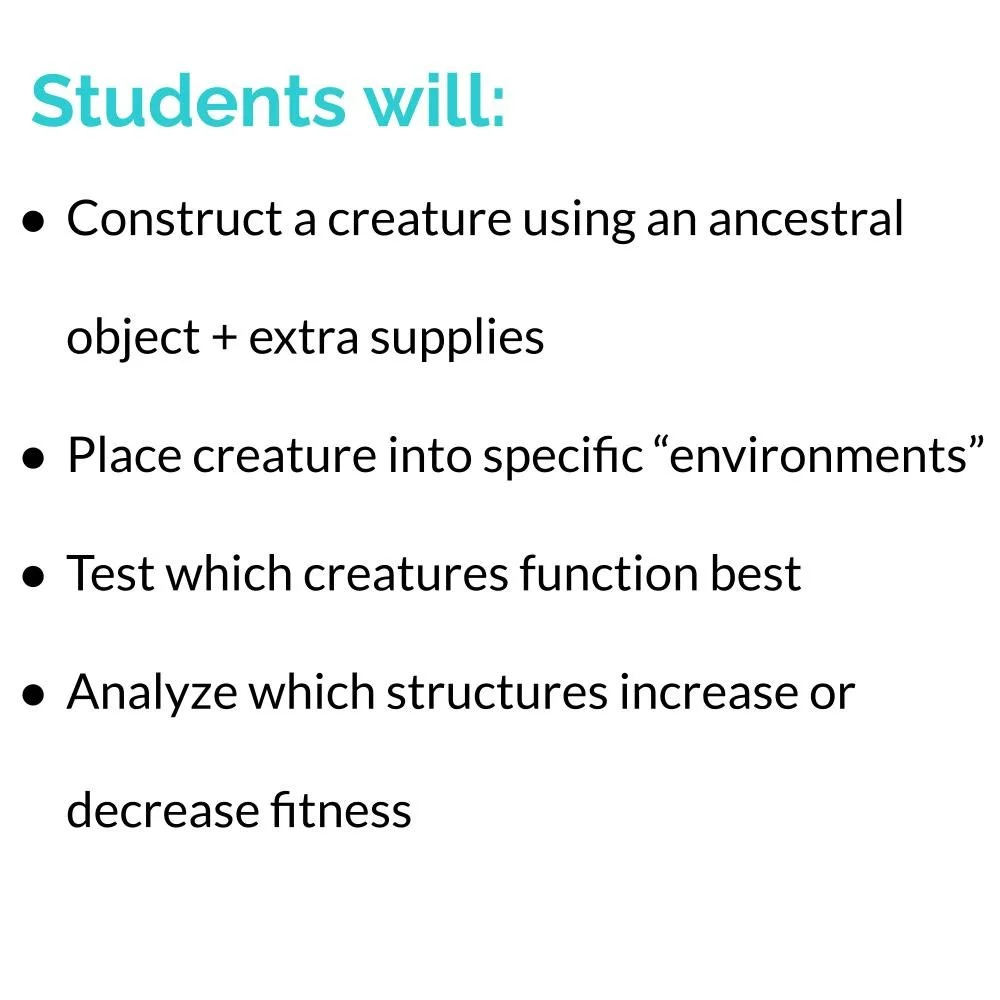 Image 2 of 4
 Image 3 of 4
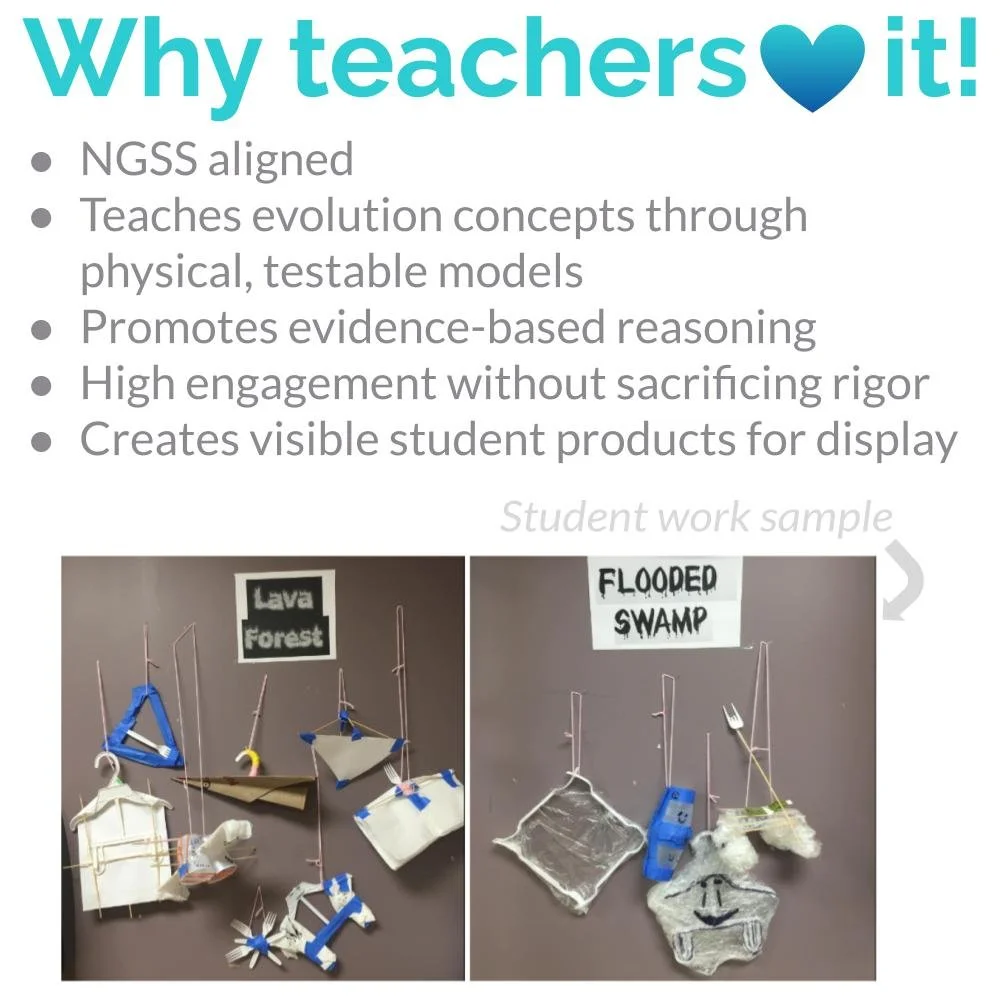 Image 4 of 4
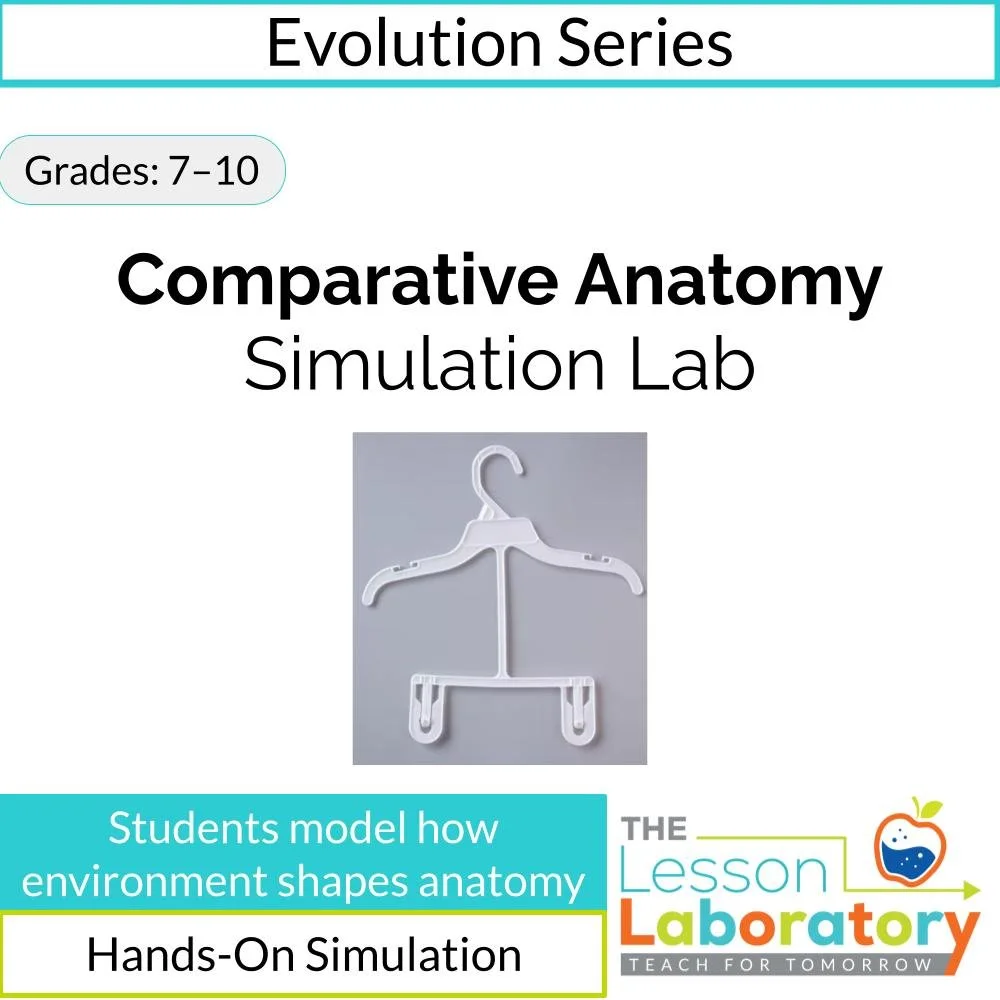
A creative, hands-on lab where students build “organisms,” test survival in two environments, and analyze homologous, analogous, and vestigial structures.
This simulation introduces students to comparative anatomy and adaptation by modeling how environmental conditions influence which structures are most likely to persist. Students build organisms using a shared set of base materials and then test how those structures perform under different environmental constraints.
Students are organized into lab groups, each representing an “organism family” derived from a common starting object (for example, hangers, forks, or cups). This shared starting structure allows students to later compare homologous features across their designs. Groups modify their organisms using classroom materials while maintaining at least one identifiable component of their original family structure.
Midway through the simulation, a “natural disaster” divides the class into two environments with different survival demands. One environment favors organisms that can float, while the other favors organisms that can fly. Students must adapt their designs to meet the functional requirements of their assigned environment while preserving their family traits.
After testing and comparing organisms, students analyze:
which structures improved survival
which features were shared across related organisms
which traits differed between environments
and which structures became nonfunctional
Students then use these observations to reason about homologous, analogous, and vestigial structures. They also make predictions about how organisms in each environment might continue to change over time based on which traits were most successful.
The lesson concludes with a critical discussion of model limitations, including the unrealistic ability of organisms to “choose” their traits. Students use this limitation to contrast Lamarckian ideas with natural selection and to clarify how real evolutionary change occurs across generations rather than by individual choice.
This simulation functions as a physical model of natural selection and structure–function relationships. It provides a concrete way for students to explore adaptation, comparative anatomy, and evolutionary reasoning before moving into more abstract examples and data-based evidence.
To see a preview of this lesson, click here.
NGSS Alignment (Middle School):
MS-LS4-2, MS-LS4-3, MS-LS4-4
NGSS Alignment (High School):
HS-LS4-1, HS-LS4-2, HS-LS4-4
Science & Engineering Practices (SEPs):
Developing and Using Models; Analyzing and Interpreting Data; Constructing Explanations; Engaging in Argument from Evidence
Crosscutting Concepts (CCCs):
Cause and Effect; Structure and Function; Stability and Change; Systems and System Models; Patterns
Common Core (Literacy in Science):
RST.6-8.1 / RST.9-10.1
RST.6-8.4 / RST.9-10.4
RST.6-8.7 / RST.9-10.7
WHST.6-8.2 / WHST.9-10.2
Bundle Upgrade Policy
This lesson is included in one or more bundles. To support flexible purchasing and long-term use of our curriculum, Lesson Laboratory offers a bundle upgrade policy.
If you purchase this lesson and decide at a later date that you would like to upgrade to a bundle, you may request a store credit equal to the total amount paid for duplicate items.
To request an upgrade credit, please email thelessonlaboratory@gmail.com and include:
Your username
The order numbers for both the original purchase(s) and the bundle
The names of the duplicate resources
Requests must be submitted within 30 days of the bundle purchase. Credits are issued as store credit for future Lesson Laboratory purchases and are not provided as cash refunds.
This policy applies only to purchases of resources that are later included in a Lesson Laboratory bundle and is limited to one adjustment per upgrade pathway.
A creative, hands-on lab where students build “organisms,” test survival in two environments, and analyze homologous, analogous, and vestigial structures.
This simulation introduces students to comparative anatomy and adaptation by modeling how environmental conditions influence which structures are most likely to persist. Students build organisms using a shared set of base materials and then test how those structures perform under different environmental constraints.
Students are organized into lab groups, each representing an “organism family” derived from a common starting object (for example, hangers, forks, or cups). This shared starting structure allows students to later compare homologous features across their designs. Groups modify their organisms using classroom materials while maintaining at least one identifiable component of their original family structure.
Midway through the simulation, a “natural disaster” divides the class into two environments with different survival demands. One environment favors organisms that can float, while the other favors organisms that can fly. Students must adapt their designs to meet the functional requirements of their assigned environment while preserving their family traits.
After testing and comparing organisms, students analyze:
which structures improved survival
which features were shared across related organisms
which traits differed between environments
and which structures became nonfunctional
Students then use these observations to reason about homologous, analogous, and vestigial structures. They also make predictions about how organisms in each environment might continue to change over time based on which traits were most successful.
The lesson concludes with a critical discussion of model limitations, including the unrealistic ability of organisms to “choose” their traits. Students use this limitation to contrast Lamarckian ideas with natural selection and to clarify how real evolutionary change occurs across generations rather than by individual choice.
This simulation functions as a physical model of natural selection and structure–function relationships. It provides a concrete way for students to explore adaptation, comparative anatomy, and evolutionary reasoning before moving into more abstract examples and data-based evidence.
To see a preview of this lesson, click here.
NGSS Alignment (Middle School):
MS-LS4-2, MS-LS4-3, MS-LS4-4
NGSS Alignment (High School):
HS-LS4-1, HS-LS4-2, HS-LS4-4
Science & Engineering Practices (SEPs):
Developing and Using Models; Analyzing and Interpreting Data; Constructing Explanations; Engaging in Argument from Evidence
Crosscutting Concepts (CCCs):
Cause and Effect; Structure and Function; Stability and Change; Systems and System Models; Patterns
Common Core (Literacy in Science):
RST.6-8.1 / RST.9-10.1
RST.6-8.4 / RST.9-10.4
RST.6-8.7 / RST.9-10.7
WHST.6-8.2 / WHST.9-10.2
Bundle Upgrade Policy
This lesson is included in one or more bundles. To support flexible purchasing and long-term use of our curriculum, Lesson Laboratory offers a bundle upgrade policy.
If you purchase this lesson and decide at a later date that you would like to upgrade to a bundle, you may request a store credit equal to the total amount paid for duplicate items.
To request an upgrade credit, please email thelessonlaboratory@gmail.com and include:
Your username
The order numbers for both the original purchase(s) and the bundle
The names of the duplicate resources
Requests must be submitted within 30 days of the bundle purchase. Credits are issued as store credit for future Lesson Laboratory purchases and are not provided as cash refunds.
This policy applies only to purchases of resources that are later included in a Lesson Laboratory bundle and is limited to one adjustment per upgrade pathway.