 Image 1 of 4
 Image 2 of 4
 Image 3 of 4
 Image 4 of 4
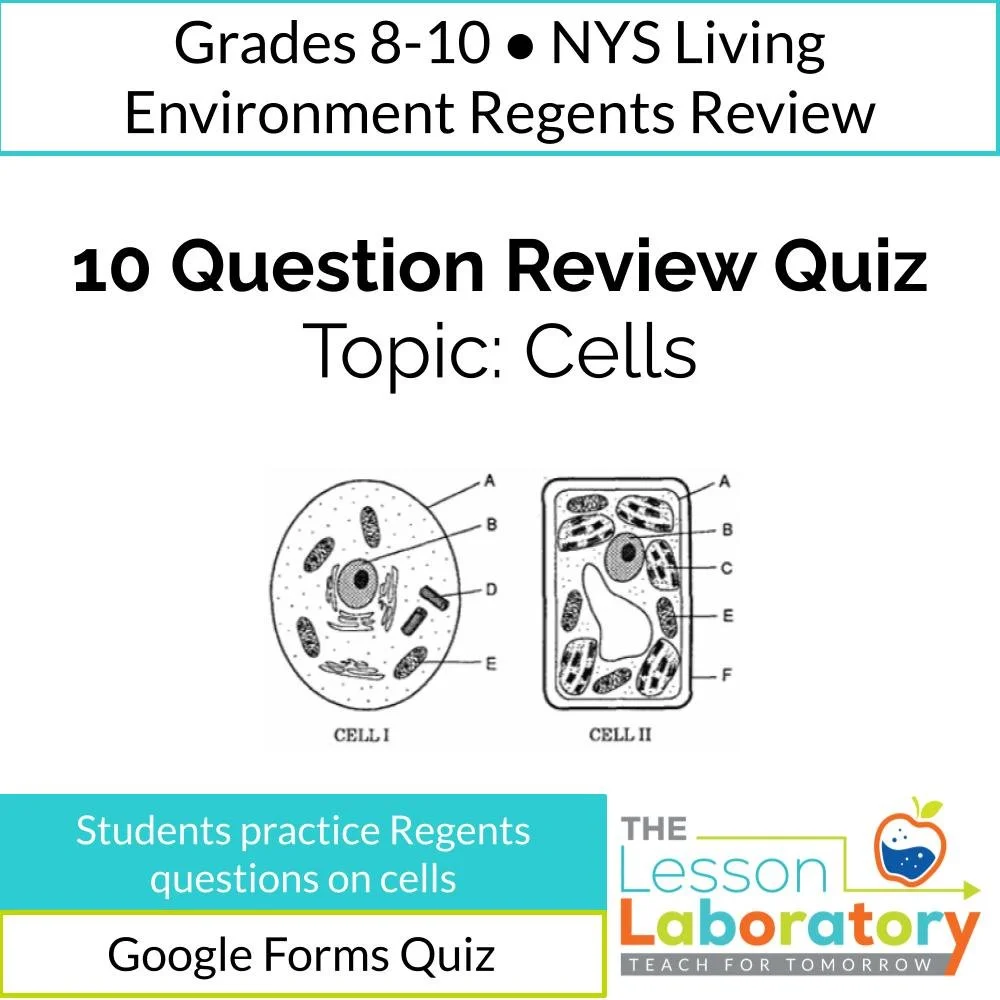
10 Regents-Style Questions on Cell Theory, Organelles, and Energy
This NYS Living Environment Regents Review quiz provides targeted practice on cell biology concepts using authentic Regents-style multiple-choice questions. The quiz is delivered through Google Forms for easy assignment, automatic grading, and efficient data collection.
The assessment includes 10 questions drawn from past New York State Living Environment Regents exams. Questions address cell theory, organelle structure and function, ATP and energy use, and comparisons between plant and animal cells. The goal is to provide focused practice on commonly tested cell concepts in a format that mirrors the Regents exam.
To support meaningful review, both the question order and answer choices are randomized with each attempt. This allows students to retake the quiz for additional practice while ensuring that improved scores reflect improved understanding rather than memorization.
The Google Form integrates smoothly with Google Classroom. Teachers can sync grades automatically and, if desired, delete a student’s submission to allow for retakes.
This quiz works well as:
a formative check during a cell biology unit
a Regents review warm-up or homework assignment
targeted practice before cumulative review
a quick assessment to identify areas for reteaching
10 NYS Regents-aligned multiple-choice questions
Auto-graded Google Form
Randomized question and answer order
Immediate performance data for instructional decisions
To preview this quiz, click here.
- HS-LS1-2: Develop and use a model to illustrate the hierarchical organization of interacting systems within cells.
- HS-LS1-7: Use a model to illustrate cellular respiration.
Crosscutting Concepts (CCCs)
Systems and system models; Structure and function
Science & Engineering Practices (SEPs)
Developing and using models; Analyzing and interpreting data
Bundle Upgrade Policy
This lesson is included in one or more bundles. To support flexible purchasing and long-term use of our curriculum, Lesson Laboratory offers a bundle upgrade policy.
If you purchase this lesson and decide at a later date that you would like to upgrade to a bundle, you may request a store credit equal to the total amount paid for duplicate items.
To request an upgrade credit, please email thelessonlaboratory@gmail.com and include:
Your username
The order numbers for both the original purchase(s) and the bundle
The names of the duplicate resources
Requests must be submitted within 30 days of the bundle purchase. Credits are issued as store credit for future Lesson Laboratory purchases and are not provided as cash refunds.
This policy applies only to purchases of resources that are later included in a Lesson Laboratory bundle and is limited to one adjustment per upgrade pathway.
10 Regents-Style Questions on Cell Theory, Organelles, and Energy
This NYS Living Environment Regents Review quiz provides targeted practice on cell biology concepts using authentic Regents-style multiple-choice questions. The quiz is delivered through Google Forms for easy assignment, automatic grading, and efficient data collection.
The assessment includes 10 questions drawn from past New York State Living Environment Regents exams. Questions address cell theory, organelle structure and function, ATP and energy use, and comparisons between plant and animal cells. The goal is to provide focused practice on commonly tested cell concepts in a format that mirrors the Regents exam.
To support meaningful review, both the question order and answer choices are randomized with each attempt. This allows students to retake the quiz for additional practice while ensuring that improved scores reflect improved understanding rather than memorization.
The Google Form integrates smoothly with Google Classroom. Teachers can sync grades automatically and, if desired, delete a student’s submission to allow for retakes.
This quiz works well as:
a formative check during a cell biology unit
a Regents review warm-up or homework assignment
targeted practice before cumulative review
a quick assessment to identify areas for reteaching
10 NYS Regents-aligned multiple-choice questions
Auto-graded Google Form
Randomized question and answer order
Immediate performance data for instructional decisions
To preview this quiz, click here.
- HS-LS1-2: Develop and use a model to illustrate the hierarchical organization of interacting systems within cells.
- HS-LS1-7: Use a model to illustrate cellular respiration.
Crosscutting Concepts (CCCs)
Systems and system models; Structure and function
Science & Engineering Practices (SEPs)
Developing and using models; Analyzing and interpreting data
Bundle Upgrade Policy
This lesson is included in one or more bundles. To support flexible purchasing and long-term use of our curriculum, Lesson Laboratory offers a bundle upgrade policy.
If you purchase this lesson and decide at a later date that you would like to upgrade to a bundle, you may request a store credit equal to the total amount paid for duplicate items.
To request an upgrade credit, please email thelessonlaboratory@gmail.com and include:
Your username
The order numbers for both the original purchase(s) and the bundle
The names of the duplicate resources
Requests must be submitted within 30 days of the bundle purchase. Credits are issued as store credit for future Lesson Laboratory purchases and are not provided as cash refunds.
This policy applies only to purchases of resources that are later included in a Lesson Laboratory bundle and is limited to one adjustment per upgrade pathway.