Making & Reading Evolutionary Trees | Cladograms, Common Ancestry & DNA Evidence Digital Activity
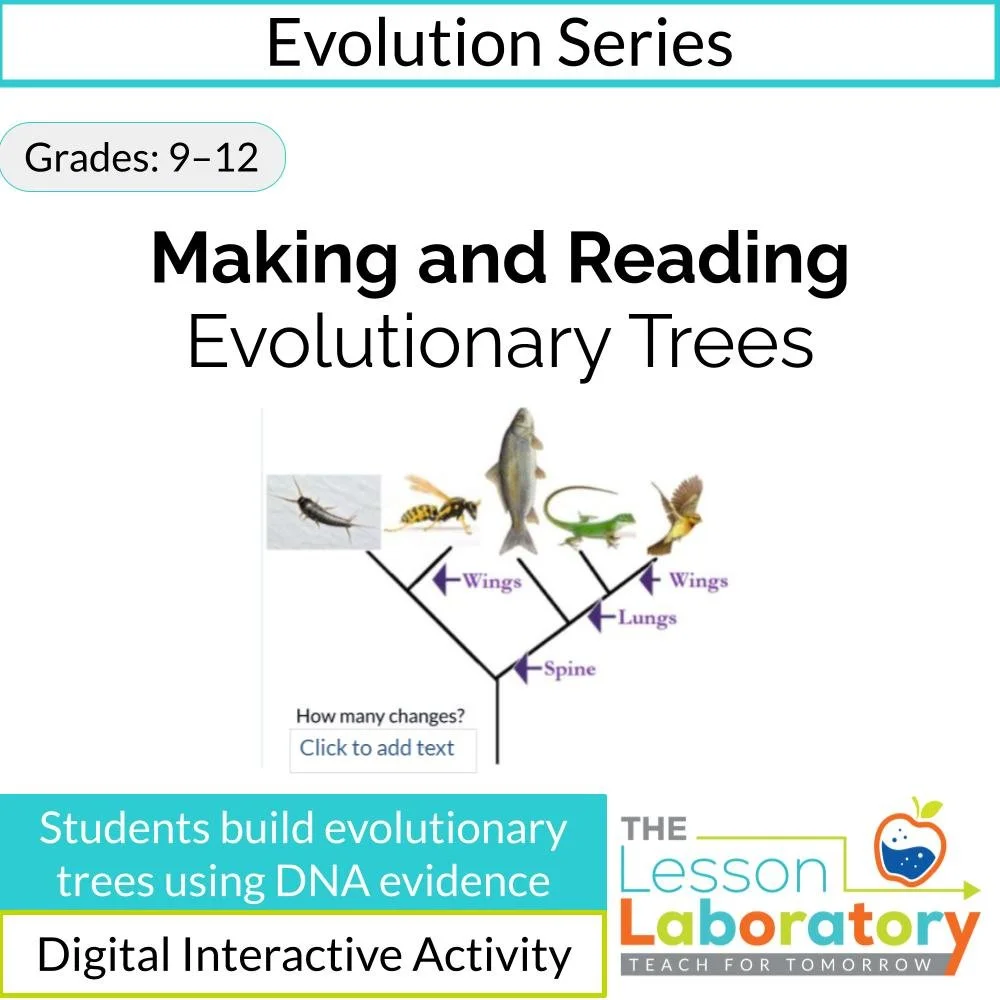
Interactive Google Slides lesson where students construct and analyze evolutionary trees using real species evidence.
Embark on an exciting journey of discovery with our comprehensive Google Slides lesson designed for remote learning. This engaging tutorial is meticulously crafted to empower students with a deep understanding of evolutionary trees while mastering the art of constructing the most parsimonious tree from a given dataset. Dive into the world of biological relationships like never before through a series of captivating student tasks that promise both education and enjoyment.
What Awaits You:
Connecting Evolution to Family Trees: Begin by unraveling the fascinating similarity between evolutionary trees and family trees. Explore a four-generation family tree, answer intriguing questions, and set the stage for an enlightening exploration.
The Unity of Life Unveiled: Delve into the interconnectedness of all living beings. Grasp essential rules and conventions governing evolutionary trees that will form the foundation of your understanding.
Gene Trees and Divergence: Immerse yourself in a riveting video journey that unveils the split between polar bears and brown bears using gene trees. Witness the power of genetic evidence in tracing the history of life.
The Quest for Parsimony: Uncover the concept of parsimony in constructing evolutionary trees. Engage in interactive activities, where you'll discern the most parsimonious tree from a set, refining your analytical skills along the way.
Craft Your Evolutionary Masterpiece: Collaborate as a class to construct a tree from real organism features. Immerse yourself in the process, learning to piece together the puzzle of evolutionary relationships.
The Solo Expedition: Independently construct a tree for a set of fictional organisms called "squidgens." Apply your newfound expertise to create a parsimonious tree that stands as a testament to your growth.
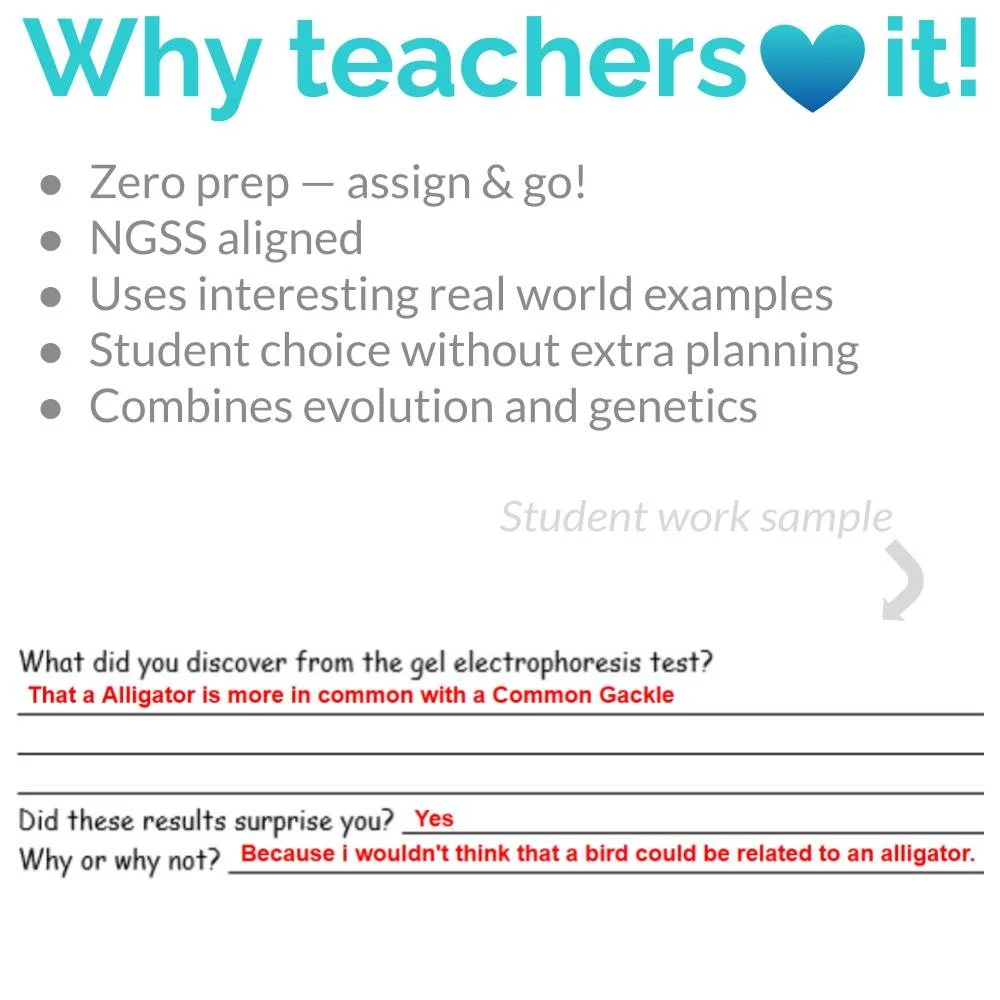
Revelations through DNA: Unearth the astonishing impact of molecular evidence on our understanding of life's relationships. Select from a curated list of organism sets, predict connections based on appearance, and then unveil the truth using gel electrophoresis results to construct your own parsimonious DNA-based tree.
Dive Deeper with Intriguing Sets: Select from a captivating array of organism sets to unravel their intricate relationships:
Camels, Whales, Hippos, Pigs: Decipher the ties between seemingly diverse creatures.
Rhinoceroses, Rock Hyraxes, Wombats, Elephants: Unearth connections that transcend appearances.
Douglas Fir Tree, Daisy, Oak Tree, Moss: Explore the botanical world's hidden bonds.
Palm Tree, Cycad, Orchid, Grass: Dive into the plant kingdom's secrets of evolution.
Tortoise, Common Grackle, Bearded Dragon, Alligator: Bridge the gap between reptilian wonders.
Chimpanzee, Gorilla, Orangutan, Human: Trace our evolutionary journey among primates.
Pill Bug, Spider, Japanese Beetle, Lobster: Uncover surprising links in the world of arthropods.
Fly Amanita, Coral Cactus, Amoeba, Cheetah: Connect the threads between the most unlikely organisms.
Barnacle, Clam, Octopus, Sponge: Plunge into the mysteries of marine life's evolution.
Paramecium, E. coli Bacteria, Myxozoa, Giraffe: Decode the microscopic world's grand connections.
Engage, Learn, and Flourish: Our remote learning ready package promises a journey of exploration, insight, and mastery. Equip yourself with the knowledge and skills that define evolutionary science and unravel the tapestry of life's interconnectedness. Join us today and embark on a path of intellectual growth like never before!
Grade Recommendation
Middle School: 7th–8th Grade
Strong alignment to MS-LS4 (analyzing similarities/differences, common ancestry)
Visual and interactive → accessible to younger learners
High School: 9th–10th Grade Biology
DNA evidence, misconceptions correction ("humans evolved from monkeys"), and interpretation of molecular differences make it HS-rigorous.
Many examples use real datasets (e.g., bears, primates, crustaceans) suitable for Living Environment/Biology.
Cross-Curricular Connections & Extensions
ELA / Critical Thinking
Students must interpret scientific texts (e.g., Utah Genetics site).
Explanations require complete sentences and justification.
Math / Data Interpretation
Reading banding patterns, matching nucleotide differences, and interpreting DNA distance.
Art / Design (Optional Extension)
Students can design their own evolutionary tree poster.
Optional Extension Ideas
CER argument: “Why are whales most closely related to hippos?”
Student-generated cladogram using species in their local environment
Debate: Is appearance a reliable indicator of evolutionary relationship?
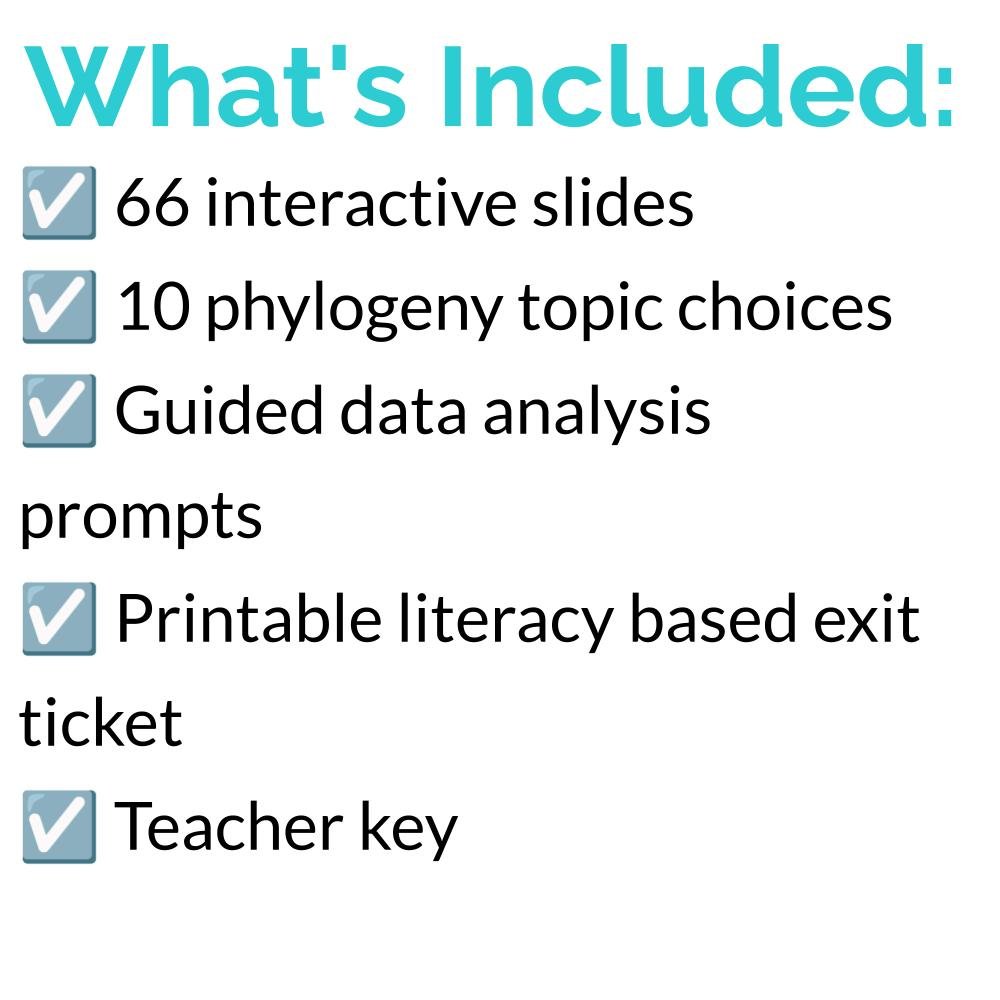
Daily slide + literacy - based exit ticket included with purchase
Join the Lesson Laboratory and Teach for Tomorrow!
NGSS Alignment (MS + HS)
This lesson is extremely strong for evolution standards because it includes:
✔ comparative anatomy
✔ molecular evidence
✔ interpreting trees
✔ analyzing misconceptions
✔ constructing explanations
Middle School NGSS Standards
MS-LS4-1
Analyze and interpret data for patterns in the fossil record documenting change over time.
Students observe patterns in physical traits and discuss lineage divergence.
MS-LS4-2
Apply scientific ideas to construct an explanation for anatomical similarities and differences among modern organisms and between modern and fossil organisms.
They repeatedly compare anatomical features across reptiles, primates, arthropods, etc.
MS-LS4-3
Analyze displays of pictorial data to compare organisms and infer patterns of ancestry and descent.
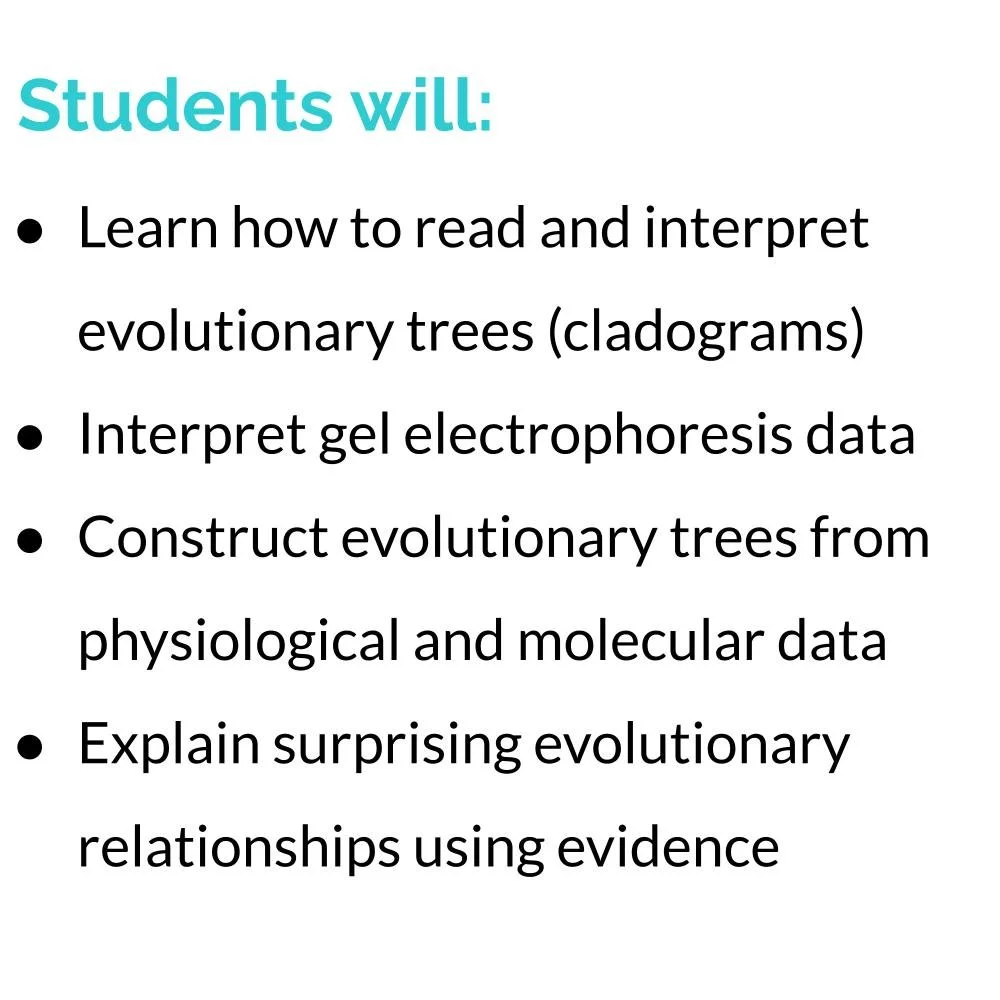
The core of the assignment: students interpret cladograms and phylogenetic trees.
High School NGSS Standards
HS-LS4-1
Communicate scientific information that common ancestry and biological evolution are supported by multiple lines of empirical evidence.
Students use anatomy + DNA evidence to determine relationships.
HS-LS4-2
Construct an explanation based on evidence that the process of evolution results primarily from genetic variation.
DNA banding and nucleotide differences explicitly highlight variation.
HS-LS4-3
Apply concepts of statistics and probability to support explanations of trait distribution.
Students analyze DNA band differences and interpret relationship strength.
HS-LS4-4
Construct an explanation based on evidence for how natural selection leads to adaptation of populations.
Several prompts discuss why misclassification occurs, how traits diverge, and why appearances can deceive.
NGSS Science & Engineering Practices (SEPs)
SEP 2: Developing & Using Models
Students analyze, interpret, and mentally reconstruct evolutionary trees.SEP 4: Analyzing & Interpreting Data
Banding patterns, anatomical traits, and DNA sequences.SEP 6: Constructing Explanations
Students explain unexpected relationships multiple times.SEP 7: Engaging in Argument from Evidence
The “Yes/No” justification columns require evidence-based argumentation.
NGSS Crosscutting Concepts (CCCs)
Patterns
Students observe trait + DNA patterns to infer relationships.Structure & Function
Anatomical structures do not always reflect evolutionary relationships—one of the lesson’s main takeaways.Cause & Effect
DNA divergence → evolutionary branching.Stability & Change
Myxozoa case: loss of multicellularity shows evolutionary reversal.Systems & System Models
Evolutionary trees are system models showing how parts relate.
Common Core Standards (ELA)
Because students support claims with evidence and write explanations, the following CCSS clearly apply:
CCSS.ELA-LITERACY.RST.6-8.1 / RST.9-10.1
Cite specific textual evidence.
CCSS.ELA-LITERACY.RST.6-8.7 / RST.9-10.7
Integrate quantitative or technical information from visual models (cladograms, DNA banding).
CCSS.ELA-LITERACY.WHST.6-8.1 / WHST.9-10.1
Write arguments focused on discipline-specific content.
CCSS.ELA-LITERACY.WHST.6-8.9 / WHST.9-10.9
Draw evidence from scientific texts (and datasets) to support explanations.
Interactive Google Slides lesson where students construct and analyze evolutionary trees using real species evidence.
Embark on an exciting journey of discovery with our comprehensive Google Slides lesson designed for remote learning. This engaging tutorial is meticulously crafted to empower students with a deep understanding of evolutionary trees while mastering the art of constructing the most parsimonious tree from a given dataset. Dive into the world of biological relationships like never before through a series of captivating student tasks that promise both education and enjoyment.
What Awaits You:
Connecting Evolution to Family Trees: Begin by unraveling the fascinating similarity between evolutionary trees and family trees. Explore a four-generation family tree, answer intriguing questions, and set the stage for an enlightening exploration.
The Unity of Life Unveiled: Delve into the interconnectedness of all living beings. Grasp essential rules and conventions governing evolutionary trees that will form the foundation of your understanding.
Gene Trees and Divergence: Immerse yourself in a riveting video journey that unveils the split between polar bears and brown bears using gene trees. Witness the power of genetic evidence in tracing the history of life.
The Quest for Parsimony: Uncover the concept of parsimony in constructing evolutionary trees. Engage in interactive activities, where you'll discern the most parsimonious tree from a set, refining your analytical skills along the way.
Craft Your Evolutionary Masterpiece: Collaborate as a class to construct a tree from real organism features. Immerse yourself in the process, learning to piece together the puzzle of evolutionary relationships.
The Solo Expedition: Independently construct a tree for a set of fictional organisms called "squidgens." Apply your newfound expertise to create a parsimonious tree that stands as a testament to your growth.
Revelations through DNA: Unearth the astonishing impact of molecular evidence on our understanding of life's relationships. Select from a curated list of organism sets, predict connections based on appearance, and then unveil the truth using gel electrophoresis results to construct your own parsimonious DNA-based tree.
Dive Deeper with Intriguing Sets: Select from a captivating array of organism sets to unravel their intricate relationships:
Camels, Whales, Hippos, Pigs: Decipher the ties between seemingly diverse creatures.
Rhinoceroses, Rock Hyraxes, Wombats, Elephants: Unearth connections that transcend appearances.
Douglas Fir Tree, Daisy, Oak Tree, Moss: Explore the botanical world's hidden bonds.
Palm Tree, Cycad, Orchid, Grass: Dive into the plant kingdom's secrets of evolution.
Tortoise, Common Grackle, Bearded Dragon, Alligator: Bridge the gap between reptilian wonders.
Chimpanzee, Gorilla, Orangutan, Human: Trace our evolutionary journey among primates.
Pill Bug, Spider, Japanese Beetle, Lobster: Uncover surprising links in the world of arthropods.
Fly Amanita, Coral Cactus, Amoeba, Cheetah: Connect the threads between the most unlikely organisms.
Barnacle, Clam, Octopus, Sponge: Plunge into the mysteries of marine life's evolution.
Paramecium, E. coli Bacteria, Myxozoa, Giraffe: Decode the microscopic world's grand connections.
Engage, Learn, and Flourish: Our remote learning ready package promises a journey of exploration, insight, and mastery. Equip yourself with the knowledge and skills that define evolutionary science and unravel the tapestry of life's interconnectedness. Join us today and embark on a path of intellectual growth like never before!
Grade Recommendation
Middle School: 7th–8th Grade
Strong alignment to MS-LS4 (analyzing similarities/differences, common ancestry)
Visual and interactive → accessible to younger learners
High School: 9th–10th Grade Biology
DNA evidence, misconceptions correction ("humans evolved from monkeys"), and interpretation of molecular differences make it HS-rigorous.
Many examples use real datasets (e.g., bears, primates, crustaceans) suitable for Living Environment/Biology.
Cross-Curricular Connections & Extensions
ELA / Critical Thinking
Students must interpret scientific texts (e.g., Utah Genetics site).
Explanations require complete sentences and justification.
Math / Data Interpretation
Reading banding patterns, matching nucleotide differences, and interpreting DNA distance.
Art / Design (Optional Extension)
Students can design their own evolutionary tree poster.
Optional Extension Ideas
CER argument: “Why are whales most closely related to hippos?”
Student-generated cladogram using species in their local environment
Debate: Is appearance a reliable indicator of evolutionary relationship?
Daily slide + literacy - based exit ticket included with purchase
Join the Lesson Laboratory and Teach for Tomorrow!
NGSS Alignment (MS + HS)
This lesson is extremely strong for evolution standards because it includes:
✔ comparative anatomy
✔ molecular evidence
✔ interpreting trees
✔ analyzing misconceptions
✔ constructing explanations
Middle School NGSS Standards
MS-LS4-1
Analyze and interpret data for patterns in the fossil record documenting change over time.
Students observe patterns in physical traits and discuss lineage divergence.
MS-LS4-2
Apply scientific ideas to construct an explanation for anatomical similarities and differences among modern organisms and between modern and fossil organisms.
They repeatedly compare anatomical features across reptiles, primates, arthropods, etc.
MS-LS4-3
Analyze displays of pictorial data to compare organisms and infer patterns of ancestry and descent.
The core of the assignment: students interpret cladograms and phylogenetic trees.
High School NGSS Standards
HS-LS4-1
Communicate scientific information that common ancestry and biological evolution are supported by multiple lines of empirical evidence.
Students use anatomy + DNA evidence to determine relationships.
HS-LS4-2
Construct an explanation based on evidence that the process of evolution results primarily from genetic variation.
DNA banding and nucleotide differences explicitly highlight variation.
HS-LS4-3
Apply concepts of statistics and probability to support explanations of trait distribution.
Students analyze DNA band differences and interpret relationship strength.
HS-LS4-4
Construct an explanation based on evidence for how natural selection leads to adaptation of populations.
Several prompts discuss why misclassification occurs, how traits diverge, and why appearances can deceive.
NGSS Science & Engineering Practices (SEPs)
SEP 2: Developing & Using Models
Students analyze, interpret, and mentally reconstruct evolutionary trees.SEP 4: Analyzing & Interpreting Data
Banding patterns, anatomical traits, and DNA sequences.SEP 6: Constructing Explanations
Students explain unexpected relationships multiple times.SEP 7: Engaging in Argument from Evidence
The “Yes/No” justification columns require evidence-based argumentation.
NGSS Crosscutting Concepts (CCCs)
Patterns
Students observe trait + DNA patterns to infer relationships.Structure & Function
Anatomical structures do not always reflect evolutionary relationships—one of the lesson’s main takeaways.Cause & Effect
DNA divergence → evolutionary branching.Stability & Change
Myxozoa case: loss of multicellularity shows evolutionary reversal.Systems & System Models
Evolutionary trees are system models showing how parts relate.
Common Core Standards (ELA)
Because students support claims with evidence and write explanations, the following CCSS clearly apply:
CCSS.ELA-LITERACY.RST.6-8.1 / RST.9-10.1
Cite specific textual evidence.
CCSS.ELA-LITERACY.RST.6-8.7 / RST.9-10.7
Integrate quantitative or technical information from visual models (cladograms, DNA banding).
CCSS.ELA-LITERACY.WHST.6-8.1 / WHST.9-10.1
Write arguments focused on discipline-specific content.
CCSS.ELA-LITERACY.WHST.6-8.9 / WHST.9-10.9
Draw evidence from scientific texts (and datasets) to support explanations.