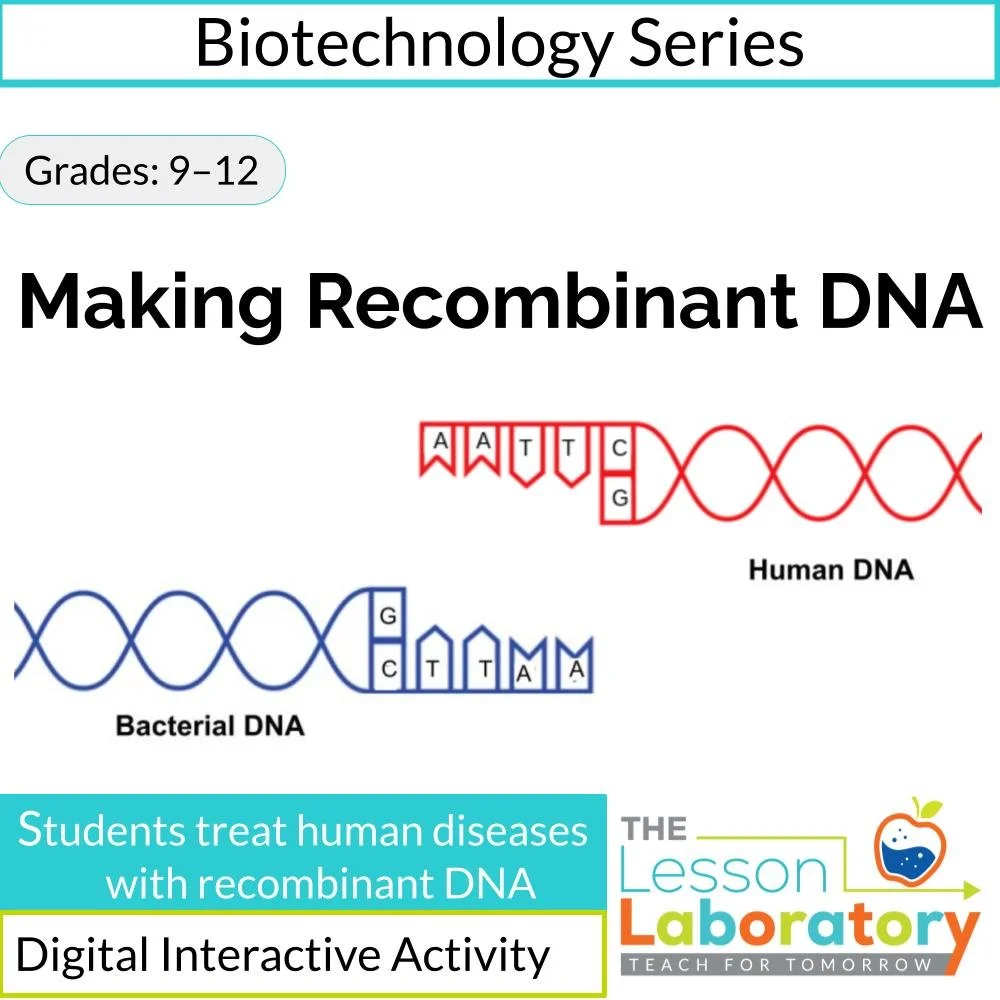
Making Recombinant DNA – Interactive Digital Lesson on Gene Technology & Protein Synthesis

$5.50

Hands-On Practice with Cutting & Combining DNA, Protein Synthesis Coding, and Disease Research.

Tired of sifting through lessons on recombinant DNA that just don't quite hit the mark? Look no further. This beautifully designed Google Slides lesson is here to revolutionize the way students learn about this crucial genetic technology. It's a game-changer for educators seeking an interactive and comprehensive approach.

Students learn exactly how scientists cut, paste, and express genes — using hands-on drag-and-drop practice, coded transcription/translation puzzles, and a research mini-project on real enzyme-related genetic disorders.

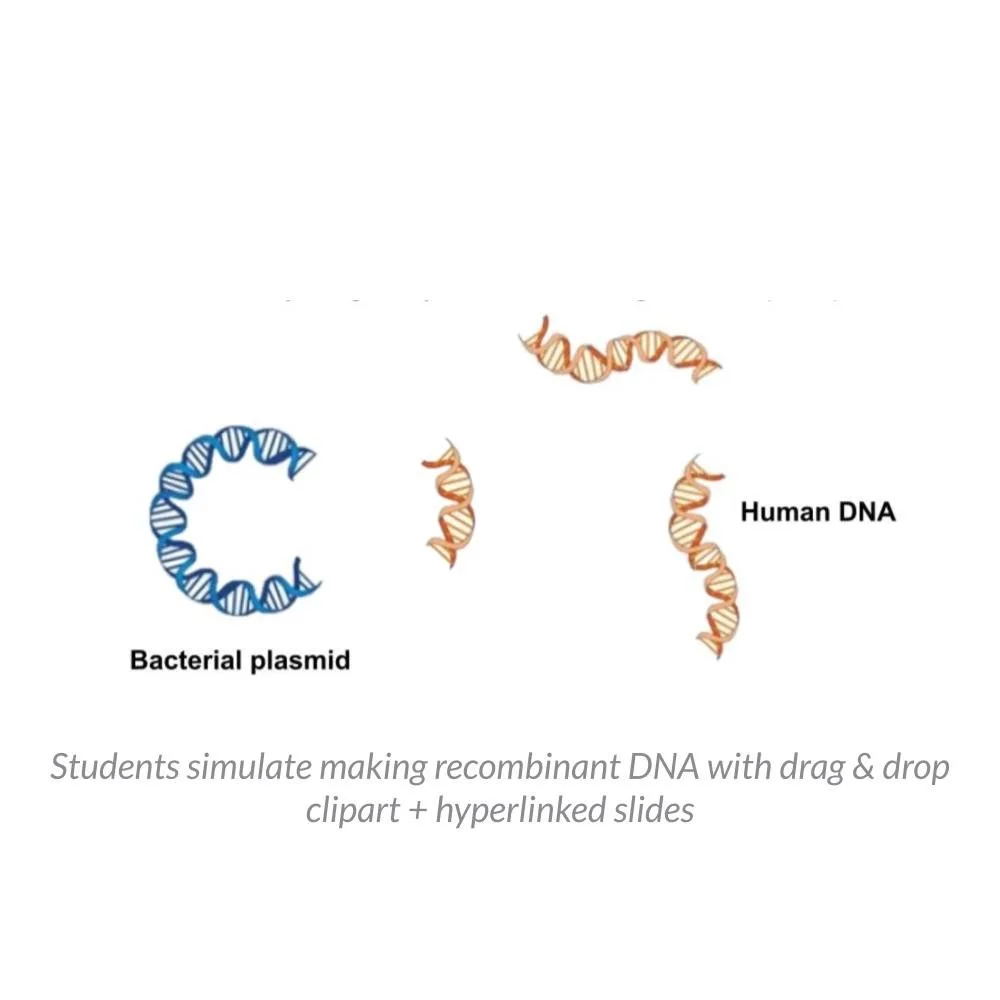
This digital activity walks students through: ✔ What recombinant DNA is ✔ How restriction enzymes and plasmids are used ✔ Why we insert genes (insulin, growth hormone, clotting proteins, cytokines, etc.) ✔ How DNA is transcribed and translated into a functional protein ✔ How missing or faulty enzymes or hormones cause disease (student research task)

Students will practice synthesizing proteins from DNA, decode secret messages using mRNA “English letter” codes, design recombinant DNA constructs, and finish with a research assignment on diseases — reinforcing real-world biological applications.

What’s Included

  • 🌟 Interactive Google Slides lesson (editable)

  • 🔬 Recombinant DNA drag-and-drop practice

  • 🧬 DNA → mRNA → English amino acid coding puzzles

  • 🧠 Student research task

  • Teacher key included

  • 💡 Exit ticket & reflection

Perfect for: • Genetics units • Molecular biology • NGSS-aligned biotech extensions • Sub plans or digital learning days • Honors biology, Living Environment, & intro-biotechnology courses

This lesson takes complex content and makes it accessible, engaging, and fun — no prior biotech experience required!

Grade & Course Recommendations

Middle School

  • Advanced 8th grade life science (as an enrichment or extension)

  • Best for students who have already learned basic DNA and protein synthesis

High School

Highly recommended for:

  • Biology / Living Environment

  • Honors Biology

  • Biotechnology

  • Anatomy & Physiology (genetics/enzymes units)

Difficulty level: Moderate to high — appropriate for grades 9–12.

Cross-Curricular Connections & Extensions

📘 ELA / Literacy

  • Research writing: Students investigate a genetic disease caused by a missing enzyme and answer structured research questions, aligning with informational writing standards.

  • Scientific communication: Students summarize processes such as transcription, translation, and gene insertion in their own words.

  • Evidence-based explanation: Students construct CER-style responses when explaining how enzyme deficiencies lead to symptoms.

🧮 Math

  • Codon decoding & pattern recognition: Students apply consistent rules to convert DNA → mRNA → English letters, which mirrors functions, mapping, and pattern-based reasoning.

  • Counting & probability connections: Extensions could include calculating the probability of inheritance patterns (connection to Punnett squares).

🧪 Biotechnology / Medical Science

  • Directly connects to:

    • Recombinant insulin production

    • Gene therapy models

    • CRISPR (possible extension)

  • Students can explore biotech careers (lab technician, genetic engineer, molecular biologist).

👩‍⚖️ Social Studies / Ethics

  • Bioethics extension: Students can evaluate ethical considerations around:

    • GMOs

    • Gene therapy

    • Patent ownership of genes

    • Commercialization of recombinant pharmaceuticals

    • Debate-style extensions such as “Should pharmaceutical companies own patents on genetically modified bacteria?”

🎨 Art / Media

  • Students can design:

    • Infographics explaining recombinant DNA

    • Posters about biotech careers

    • Graphic storyboards showing the “journey” of a gene through the process

Daily slide + literacy - based exit ticket included with purchase

Join the Lesson Laboratory and Teach for Tomorrow!


NGSS Standards (with SEP + CCC)

High School NGSS Performance Expectations

  • HS-LS1-1 – Students model DNA structure and the role of DNA in encoding instructions for traits.

  • HS-LS1-6 – Construct explanations of how DNA structure determines protein structure.

  • HS-LS3-1 – Ask questions to clarify how DNA mutations or missing enzymes lead to genetic disease.

  • HS-LS3-3 – Apply concepts of biotechnology and inheritance to real-world genetic case studies.

Science & Engineering Practices (SEPs)

  • Developing and Using Models – Students model the transcription/translation process and the creation of recombinant DNA.

  • Constructing Explanations – Students explain how recombinant DNA produces therapeutic proteins.

  • Analyzing and Interpreting Data – Students decode DNA sequences and analyze resulting proteins.

  • Obtaining, Evaluating, and Communicating Information – Research task on enzyme-related diseases.

Crosscutting Concepts (CCCs)

  • Structure & Function – How DNA sequences determine protein products; how missing enzymes cause disease.

  • Cause & Effect – Mutations or missing enzymes → physiological symptoms.

  • Systems & System Models – Gene insertion into plasmids models biological engineering systems.

  • Stability & Change – How introducing recombinant DNA changes an organism’s protein profile.

Common Core Standards

  • RST.9-10.1 / RST.11-12.1 – Cite specific evidence about enzyme functions & genetic disorders.

  • RST.9-10.2 / RST.11-12.2 – Summarize biotechnology processes clearly.

  • RST.9-10.3 – Follow multistep procedures when decoding DNA and making recombinant DNA.

  • WHST.9-10.2 / WHST.11-12.2 – Write informative explanations of a disease treatable with recombinant DNA technology

  • WHST.9-10.7 – Conduct short research on a chosen disorder.

  • WHST.9-10.9 – Draw evidence from informational texts when completing research portions.

Hands-On Practice with Cutting & Combining DNA, Protein Synthesis Coding, and Disease Research.

Tired of sifting through lessons on recombinant DNA that just don't quite hit the mark? Look no further. This beautifully designed Google Slides lesson is here to revolutionize the way students learn about this crucial genetic technology. It's a game-changer for educators seeking an interactive and comprehensive approach.

Students learn exactly how scientists cut, paste, and express genes — using hands-on drag-and-drop practice, coded transcription/translation puzzles, and a research mini-project on real enzyme-related genetic disorders.

This digital activity walks students through: ✔ What recombinant DNA is ✔ How restriction enzymes and plasmids are used ✔ Why we insert genes (insulin, growth hormone, clotting proteins, cytokines, etc.) ✔ How DNA is transcribed and translated into a functional protein ✔ How missing or faulty enzymes or hormones cause disease (student research task)

Students will practice synthesizing proteins from DNA, decode secret messages using mRNA “English letter” codes, design recombinant DNA constructs, and finish with a research assignment on diseases — reinforcing real-world biological applications.

What’s Included

  • 🌟 Interactive Google Slides lesson (editable)

  • 🔬 Recombinant DNA drag-and-drop practice

  • 🧬 DNA → mRNA → English amino acid coding puzzles

  • 🧠 Student research task

  • Teacher key included

  • 💡 Exit ticket & reflection

Perfect for: • Genetics units • Molecular biology • NGSS-aligned biotech extensions • Sub plans or digital learning days • Honors biology, Living Environment, & intro-biotechnology courses

This lesson takes complex content and makes it accessible, engaging, and fun — no prior biotech experience required!

Grade & Course Recommendations

Middle School

  • Advanced 8th grade life science (as an enrichment or extension)

  • Best for students who have already learned basic DNA and protein synthesis

High School

Highly recommended for:

  • Biology / Living Environment

  • Honors Biology

  • Biotechnology

  • Anatomy & Physiology (genetics/enzymes units)

Difficulty level: Moderate to high — appropriate for grades 9–12.

Cross-Curricular Connections & Extensions

📘 ELA / Literacy

  • Research writing: Students investigate a genetic disease caused by a missing enzyme and answer structured research questions, aligning with informational writing standards.

  • Scientific communication: Students summarize processes such as transcription, translation, and gene insertion in their own words.

  • Evidence-based explanation: Students construct CER-style responses when explaining how enzyme deficiencies lead to symptoms.

🧮 Math

  • Codon decoding & pattern recognition: Students apply consistent rules to convert DNA → mRNA → English letters, which mirrors functions, mapping, and pattern-based reasoning.

  • Counting & probability connections: Extensions could include calculating the probability of inheritance patterns (connection to Punnett squares).

🧪 Biotechnology / Medical Science

  • Directly connects to:

    • Recombinant insulin production

    • Gene therapy models

    • CRISPR (possible extension)

  • Students can explore biotech careers (lab technician, genetic engineer, molecular biologist).

👩‍⚖️ Social Studies / Ethics

  • Bioethics extension: Students can evaluate ethical considerations around:

    • GMOs

    • Gene therapy

    • Patent ownership of genes

    • Commercialization of recombinant pharmaceuticals

    • Debate-style extensions such as “Should pharmaceutical companies own patents on genetically modified bacteria?”

🎨 Art / Media

  • Students can design:

    • Infographics explaining recombinant DNA

    • Posters about biotech careers

    • Graphic storyboards showing the “journey” of a gene through the process

Daily slide + literacy - based exit ticket included with purchase

Join the Lesson Laboratory and Teach for Tomorrow!


NGSS Standards (with SEP + CCC)

High School NGSS Performance Expectations

  • HS-LS1-1 – Students model DNA structure and the role of DNA in encoding instructions for traits.

  • HS-LS1-6 – Construct explanations of how DNA structure determines protein structure.

  • HS-LS3-1 – Ask questions to clarify how DNA mutations or missing enzymes lead to genetic disease.

  • HS-LS3-3 – Apply concepts of biotechnology and inheritance to real-world genetic case studies.

Science & Engineering Practices (SEPs)

  • Developing and Using Models – Students model the transcription/translation process and the creation of recombinant DNA.

  • Constructing Explanations – Students explain how recombinant DNA produces therapeutic proteins.

  • Analyzing and Interpreting Data – Students decode DNA sequences and analyze resulting proteins.

  • Obtaining, Evaluating, and Communicating Information – Research task on enzyme-related diseases.

Crosscutting Concepts (CCCs)

  • Structure & Function – How DNA sequences determine protein products; how missing enzymes cause disease.

  • Cause & Effect – Mutations or missing enzymes → physiological symptoms.

  • Systems & System Models – Gene insertion into plasmids models biological engineering systems.

  • Stability & Change – How introducing recombinant DNA changes an organism’s protein profile.

Common Core Standards

  • RST.9-10.1 / RST.11-12.1 – Cite specific evidence about enzyme functions & genetic disorders.

  • RST.9-10.2 / RST.11-12.2 – Summarize biotechnology processes clearly.

  • RST.9-10.3 – Follow multistep procedures when decoding DNA and making recombinant DNA.

  • WHST.9-10.2 / WHST.11-12.2 – Write informative explanations of a disease treatable with recombinant DNA technology

  • WHST.9-10.7 – Conduct short research on a chosen disorder.

  • WHST.9-10.9 – Draw evidence from informational texts when completing research portions.