Microscopes Choice Board | Digital Microscope Lab, Measurement & History Activities

$6.25

Engaging Digital Microscopy Activities: Labeling, Focusing, History, Virtual Slides & 3-Step Measurement Method.

Bring microscopes to life with this fully interactive Microscopes Choice Board — perfect for middle school life science and high school biology review!

This engaging digital activity gives students ownership of their learning through a differentiated MUST-DO / MAY-DO format designed to build real microscope fluency, measurement skills, and content mastery.

Students explore microscope parts, proper focusing technique, slide preparation, measurement under magnification, and the fascinating history behind scientific discovery. Whether you use it as a digital station activity, substitute plan, enrichment lesson, or interactive intro to microscopes, this choice board provides everything you need for a meaningful, no-prep lesson your students will actually enjoy.

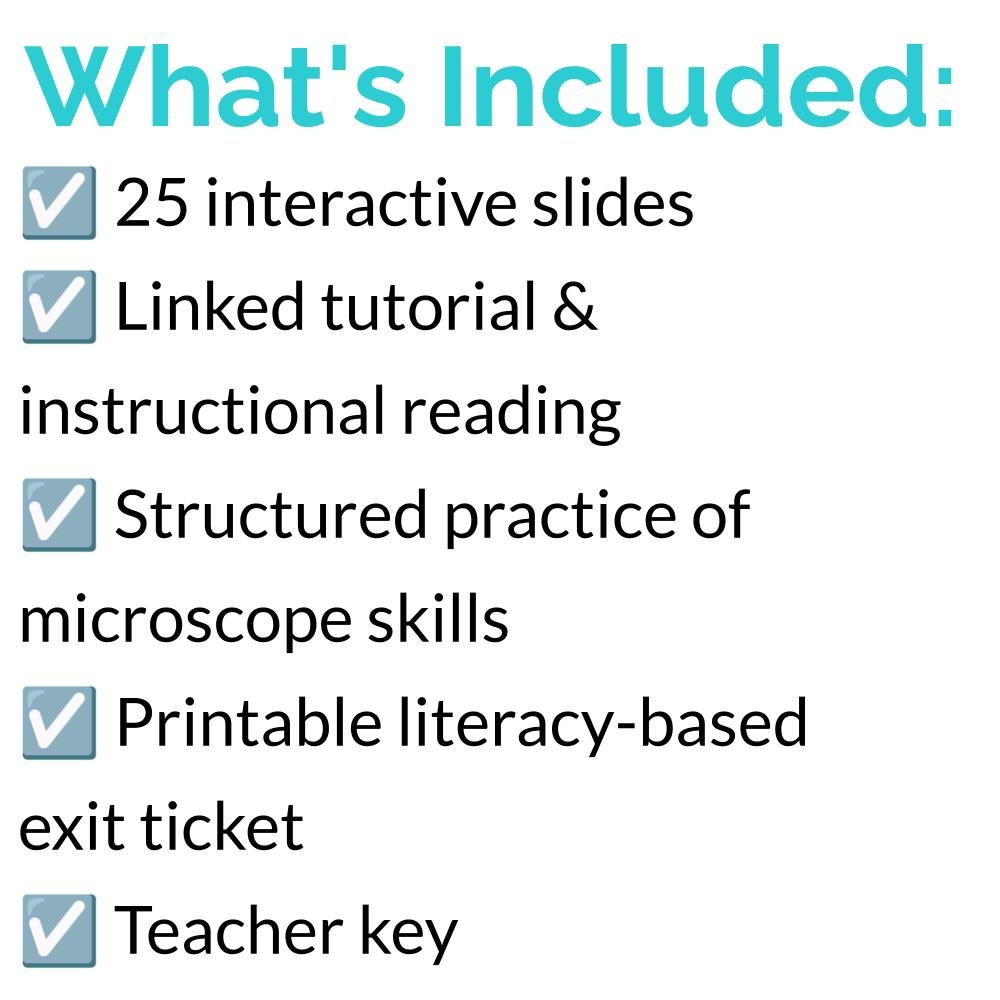
✨ What’s Included

✔ MUST-DO Activities:

 • Labeling a microscope

 • Reading comprehension passage

 • Warm-up: What can microscopes do?

 • Key vocabulary and focusing rules

 • Intro measurement activity

✔ MAY-DO Choice Menu:

 • Virtual microscope lab (linked)

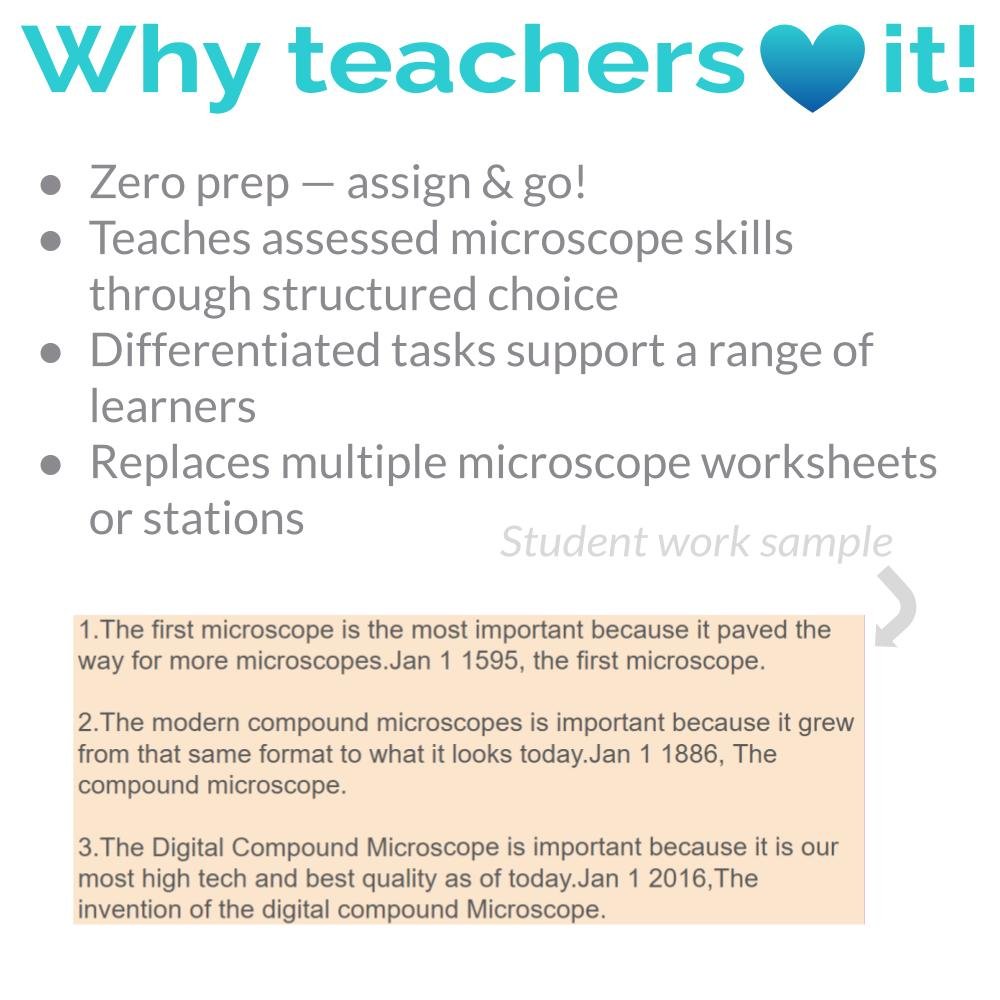
 • History of the microscope timeline

 • CER writing task: Who really discovered the microscope?

 • 3-Step Method practice for measuring specimens

 • Analyzing plant vs. animal cells under magnification

 • Diagram interpretation and labeling practice

 • Exit ticket reflection

✔ Teacher Answer Keys

 ✔ Student-friendly digital layout


Why Teachers Love It

⭐ Built-in differentiation

 ⭐ Strong NGSS & Common Core alignment

 ⭐ Engages students with real-world microscopy skills

 ⭐ Integrates reading, math, and scientific reasoning

 ⭐ Works for in-person, hybrid, or digital classrooms

 ⭐ Excellent for stations, early-finishers, or introductory units


Perfect For:

• Middle School Life Science

 • High School Biology (Review)

 • Substitute Plans

 • Digital Learning

 • Interactive Notebooks

 • STEM Enrichment

 • Observation Skills Stations


Grade Recommendation

Middle School: Grades 6–8

  • The structure (MUST DO + MAY DO), as well as foundational content (labeling, safety, basic measurement, history) is typical of MS life science curricula.

  • Reading level of the passages and tasks aligns well with MS expectations.

High School: Grades 9–10

  • High school students can use this meaningfully during the first week of biology, for station teaching, review, or early-year practice with microscope measurement methods.

Cross-Curricular Connections & Extensions

Cross-Curricular Connections

  • Math:

    • 3-Step method calculations (FOV ÷ object estimate), proportional reasoning, scientific measurement.

  • ELA:

    • Reading comprehension in the microscope passage.

    • CER writing task: claim-evidence-reasoning based on “Who Discovered the Microscope?”

  • History of Science:

    • Timeline activities referencing scientific innovations (pg. 12–16).

  • Technology:

    • Use of the Virtual Urchin platform, online microscope simulators, and Google Slides.

Possible Extensions

  • Compare traditional light microscopes with electron microscopes.

  • Add real specimen observation in class after digital practice.

  • Students create a short presentation about one scientist from the microscope timeline.

  • Integrate a lab practical in which students demonstrate the 3-step measurement method.

Daily slide + literacy - based exit ticket included with purchase

Join the Lesson Laboratory and Teach for Tomorrow!

✨ Middle School NGSS Alignment (MS-LS)

Performance Expectations

MS-LS1-1Conduct an investigation to provide evidence that living things are made of cells…
→ Applies to cell image analysis, plant vs. animal cell comparison, and virtual microscope work.

MS-LS1-2Develop and use a model to describe the function of a cell as a whole…
→ Students identify structures seen under magnification; interpret diagrams.

MS-LS1-3Use argument supported by evidence to support claims about interacting body systems.
→ Partially aligns with CER structure practice (skill, not content).

MS-LS1-8Gather and synthesize information that sensory receptors respond to stimuli…
Skill alignment through analyzing images and interpreting visual data (NGSS allows skill-overlap).

Science & Engineering Practices (MS)

  • Analyzing and Interpreting Data
    Students measure specimens, compare images, interpret field of view, analyze structures.

  • Constructing Explanations and Designing Solutions
    Students evaluate focusing rules, slide safety, history claims, and cell differences.

  • Engaging in Argument from Evidence
    CER “Who invented the microscope?” task.

  • Obtaining, Evaluating, and Communicating Information
    Reading informational text, interpreting diagrams, summarizing findings.

Crosscutting Concepts (MS)

  • Structure and Function
    Core concept throughout: microscope parts → purpose → outcome.

  • Scale, Proportion, and Quantity
    Measurement tasks, field of view, estimating object size.

  • Cause and Effect
    Focusing errors → blurry/broken slides; diaphragm changes → light adjustments.

  • Stability and Change
    How technology (microscopes) evolved over time.

✨ High School NGSS Alignment (HS-LS & HS Engineering Practices)

Performance Expectations

HS-LS1-1Construct an explanation based on evidence for how the structure of DNA determines the structure of proteins.
Skill overlap: focusing, interpreting images, identifying structure–function patterns.

HS-LS1-2Develop and use a model to illustrate hierarchical organization of interacting systems.
→ Students examine cells/tissues under magnification; interpret layered structures.

HS-LS1-3Plan and conduct an investigation using a microscope to gather evidence…
→ Virtual microscope & digital observation activities simulate HS-level microscopy lab skills.

HS-LS3-1Ask questions to clarify relationships about the role of DNA and chromosomes.
→ Indirect alignment through image analysis of cells, mitosis stages (if students see onion root tip images in extensions).

High School Science & Engineering Practices

  • Planning and Carrying Out Investigations
    Virtual microscope task; measurement scaling.

  • Using Mathematics and Computational Thinking
    Size estimation, converting field of view to object size.

  • Engaging in Argument from Evidence
    CER invention-of-microscope writing.

  • Developing and Using Models
    Labeling microscopes, interpreting diagrams, modeling measurement.

Crosscutting Concepts (HS)

  • Structure and Function
    A foundational CCC for all microscope-based observation.

  • Scale, Proportion, and Quantity
    Precise measurements + magnification relationships.

  • Systems and System Models
    A microscope is introduced as an optical model of light + lenses + specimen.

  • Stability and Change
    History of microscope development; changes in scientific technology.

Common Core ELA — Middle School

Reading Standards for Science (RST.6–8)

  • RST.6-8.1 — Cite evidence to support scientific explanations

  • RST.6-8.2 — Determine central ideas from informational text

  • RST.6-8.3 — Follow multistep technical procedures (focusing directions, slide handling)

  • RST.6-8.4 — Determine meaning of scientific terms (vocabulary sections)

  • RST.6-8.7 — Integrate quantitative info (diagrams, images, measurement)

Writing Standards for Science (WHST.6–8)

  • WHST.6-8.1 — Write arguments supported by evidence (CER)

  • WHST.6-8.2 — Informative/explanatory writing (history of microscopes)

  • WHST.6-8.9 — Draw evidence from informational texts

Common Core ELA — High School

Reading Standards for Science (RST.9–12)

  • RST.9-12.3 — Follow complex multistep procedures

  • RST.9-12.4 — Determine meanings of symbols/terms in scientific diagrams

  • RST.9-12.7 — Integrate quantitative or technical information (microscope images + measurement)

  • RST.9-12.9 — Compare findings from multiple sources (history timeline)

Writing Standards for Science (WHST.9–12)

  • WHST.9-12.1 — Write evidence-based arguments (full CER)

  • WHST.9-12.2 — Write explanatory scientific texts

  • WHST.9-12.7 — Conduct short research tasks

  • WHST.9-12.9 — Draw evidence from informational texts

Engaging Digital Microscopy Activities: Labeling, Focusing, History, Virtual Slides & 3-Step Measurement Method.

Bring microscopes to life with this fully interactive Microscopes Choice Board — perfect for middle school life science and high school biology review!

This engaging digital activity gives students ownership of their learning through a differentiated MUST-DO / MAY-DO format designed to build real microscope fluency, measurement skills, and content mastery.

Students explore microscope parts, proper focusing technique, slide preparation, measurement under magnification, and the fascinating history behind scientific discovery. Whether you use it as a digital station activity, substitute plan, enrichment lesson, or interactive intro to microscopes, this choice board provides everything you need for a meaningful, no-prep lesson your students will actually enjoy.

✨ What’s Included

✔ MUST-DO Activities:

 • Labeling a microscope

 • Reading comprehension passage

 • Warm-up: What can microscopes do?

 • Key vocabulary and focusing rules

 • Intro measurement activity

✔ MAY-DO Choice Menu:

 • Virtual microscope lab (linked)

 • History of the microscope timeline

 • CER writing task: Who really discovered the microscope?

 • 3-Step Method practice for measuring specimens

 • Analyzing plant vs. animal cells under magnification

 • Diagram interpretation and labeling practice

 • Exit ticket reflection

✔ Teacher Answer Keys

 ✔ Student-friendly digital layout


Why Teachers Love It

⭐ Built-in differentiation

 ⭐ Strong NGSS & Common Core alignment

 ⭐ Engages students with real-world microscopy skills

 ⭐ Integrates reading, math, and scientific reasoning

 ⭐ Works for in-person, hybrid, or digital classrooms

 ⭐ Excellent for stations, early-finishers, or introductory units


Perfect For:

• Middle School Life Science

 • High School Biology (Review)

 • Substitute Plans

 • Digital Learning

 • Interactive Notebooks

 • STEM Enrichment

 • Observation Skills Stations


Grade Recommendation

Middle School: Grades 6–8

  • The structure (MUST DO + MAY DO), as well as foundational content (labeling, safety, basic measurement, history) is typical of MS life science curricula.

  • Reading level of the passages and tasks aligns well with MS expectations.

High School: Grades 9–10

  • High school students can use this meaningfully during the first week of biology, for station teaching, review, or early-year practice with microscope measurement methods.

Cross-Curricular Connections & Extensions

Cross-Curricular Connections

  • Math:

    • 3-Step method calculations (FOV ÷ object estimate), proportional reasoning, scientific measurement.

  • ELA:

    • Reading comprehension in the microscope passage.

    • CER writing task: claim-evidence-reasoning based on “Who Discovered the Microscope?”

  • History of Science:

    • Timeline activities referencing scientific innovations (pg. 12–16).

  • Technology:

    • Use of the Virtual Urchin platform, online microscope simulators, and Google Slides.

Possible Extensions

  • Compare traditional light microscopes with electron microscopes.

  • Add real specimen observation in class after digital practice.

  • Students create a short presentation about one scientist from the microscope timeline.

  • Integrate a lab practical in which students demonstrate the 3-step measurement method.

Daily slide + literacy - based exit ticket included with purchase

Join the Lesson Laboratory and Teach for Tomorrow!

✨ Middle School NGSS Alignment (MS-LS)

Performance Expectations

MS-LS1-1Conduct an investigation to provide evidence that living things are made of cells…
→ Applies to cell image analysis, plant vs. animal cell comparison, and virtual microscope work.

MS-LS1-2Develop and use a model to describe the function of a cell as a whole…
→ Students identify structures seen under magnification; interpret diagrams.

MS-LS1-3Use argument supported by evidence to support claims about interacting body systems.
→ Partially aligns with CER structure practice (skill, not content).

MS-LS1-8Gather and synthesize information that sensory receptors respond to stimuli…
Skill alignment through analyzing images and interpreting visual data (NGSS allows skill-overlap).

Science & Engineering Practices (MS)

  • Analyzing and Interpreting Data
    Students measure specimens, compare images, interpret field of view, analyze structures.

  • Constructing Explanations and Designing Solutions
    Students evaluate focusing rules, slide safety, history claims, and cell differences.

  • Engaging in Argument from Evidence
    CER “Who invented the microscope?” task.

  • Obtaining, Evaluating, and Communicating Information
    Reading informational text, interpreting diagrams, summarizing findings.

Crosscutting Concepts (MS)

  • Structure and Function
    Core concept throughout: microscope parts → purpose → outcome.

  • Scale, Proportion, and Quantity
    Measurement tasks, field of view, estimating object size.

  • Cause and Effect
    Focusing errors → blurry/broken slides; diaphragm changes → light adjustments.

  • Stability and Change
    How technology (microscopes) evolved over time.

✨ High School NGSS Alignment (HS-LS & HS Engineering Practices)

Performance Expectations

HS-LS1-1Construct an explanation based on evidence for how the structure of DNA determines the structure of proteins.
Skill overlap: focusing, interpreting images, identifying structure–function patterns.

HS-LS1-2Develop and use a model to illustrate hierarchical organization of interacting systems.
→ Students examine cells/tissues under magnification; interpret layered structures.

HS-LS1-3Plan and conduct an investigation using a microscope to gather evidence…
→ Virtual microscope & digital observation activities simulate HS-level microscopy lab skills.

HS-LS3-1Ask questions to clarify relationships about the role of DNA and chromosomes.
→ Indirect alignment through image analysis of cells, mitosis stages (if students see onion root tip images in extensions).

High School Science & Engineering Practices

  • Planning and Carrying Out Investigations
    Virtual microscope task; measurement scaling.

  • Using Mathematics and Computational Thinking
    Size estimation, converting field of view to object size.

  • Engaging in Argument from Evidence
    CER invention-of-microscope writing.

  • Developing and Using Models
    Labeling microscopes, interpreting diagrams, modeling measurement.

Crosscutting Concepts (HS)

  • Structure and Function
    A foundational CCC for all microscope-based observation.

  • Scale, Proportion, and Quantity
    Precise measurements + magnification relationships.

  • Systems and System Models
    A microscope is introduced as an optical model of light + lenses + specimen.

  • Stability and Change
    History of microscope development; changes in scientific technology.

Common Core ELA — Middle School

Reading Standards for Science (RST.6–8)

  • RST.6-8.1 — Cite evidence to support scientific explanations

  • RST.6-8.2 — Determine central ideas from informational text

  • RST.6-8.3 — Follow multistep technical procedures (focusing directions, slide handling)

  • RST.6-8.4 — Determine meaning of scientific terms (vocabulary sections)

  • RST.6-8.7 — Integrate quantitative info (diagrams, images, measurement)

Writing Standards for Science (WHST.6–8)

  • WHST.6-8.1 — Write arguments supported by evidence (CER)

  • WHST.6-8.2 — Informative/explanatory writing (history of microscopes)

  • WHST.6-8.9 — Draw evidence from informational texts

Common Core ELA — High School

Reading Standards for Science (RST.9–12)

  • RST.9-12.3 — Follow complex multistep procedures

  • RST.9-12.4 — Determine meanings of symbols/terms in scientific diagrams

  • RST.9-12.7 — Integrate quantitative or technical information (microscope images + measurement)

  • RST.9-12.9 — Compare findings from multiple sources (history timeline)

Writing Standards for Science (WHST.9–12)

  • WHST.9-12.1 — Write evidence-based arguments (full CER)

  • WHST.9-12.2 — Write explanatory scientific texts

  • WHST.9-12.7 — Conduct short research tasks

  • WHST.9-12.9 — Draw evidence from informational texts