 Image 1 of 4
 Image 2 of 4
 Image 3 of 4
 Image 4 of 4
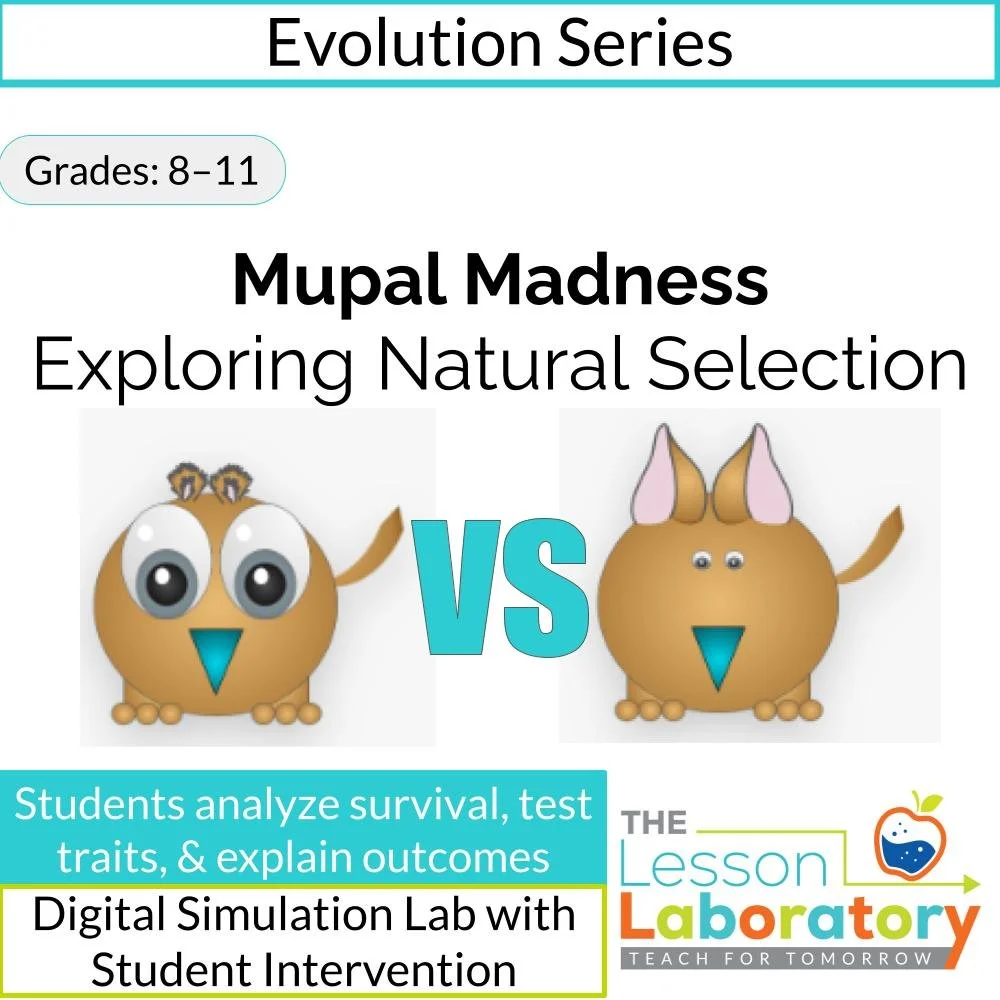
Natural Selection Simulation Lab – Evolution Activity with Data Analysis & Student Intervention (Mupal Madness)
This natural selection simulation lab moves beyond definitions and into evidence-based reasoning. Students use numerical data from an interactive simulation to analyze how traits influence survival, test an intervention, and explain outcomes in a probabilistic system.
Students often learn natural selection as a set of definitions. This lesson is designed to move beyond that.
In this simulation-based investigation, students analyze how traits influence survival under different environmental conditions. Rather than observing a fixed outcome, students work through a probabilistic system in which survival depends on both trait advantage and chance. This allows them to build a more accurate understanding of how natural selection works in real populations.
The simulation itself is free and hosted online. This resource provides the instructional structure that makes the simulation meaningful.
Students begin by activating prior knowledge about traits and survival, then design a model organism (“Mupal”) with specific physical characteristics. As they run the simulation, they collect numerical data from each matchup, including base rolls, trait modifiers, and final survival scores. They use this evidence to identify patterns in trait–environment interactions and explain how environmental conditions influence which traits are advantageous.
Midway through the lesson, students apply their understanding by modifying one trait of their organism and testing whether their intervention improves survival. This introduces an additional layer of reasoning, as students must justify their decisions and evaluate outcomes using evidence rather than assumptions.
The lesson concludes with analysis and transfer tasks that push students to generalize their understanding beyond the simulation. Students compare outcomes across multiple runs, analyze tradeoffs between traits, and apply their thinking to real organisms in different environments. An extension question explicitly addresses probabilistic outcomes, helping students understand why a “less adapted” organism may still survive in individual cases.
This is not a worksheet. It is a structured system for helping students reason from evidence about natural selection.
What’s Included
Student companion document (printable)
Structured data collection and analysis tasks
Prediction and hypothesis development
Evidence-based explanation prompts using numerical data
Student-driven intervention and evaluation
Transfer to real-world organisms
Extension question targeting probabilistic reasoning
Teacher key with:
expected conceptual understandings
clear “look-fors” for strong vs developing responses
guidance for evaluating evidence-based reasoning
How It Works
Students access the free online simulation
They design a model organism and run a tournament under specific environmental conditions
Students collect and analyze data from each matchup
They identify patterns and explain how traits affect survival
Students modify a trait and test their intervention
They evaluate results and apply their understanding to new scenarios
Why This Lesson Works
Moves beyond definitions to evidence-based reasoning
Models natural selection as a probabilistic process, not a guaranteed outcome
Requires students to use numerical data as evidence
Includes a built-in intervention task, which deepens understanding of cause and effect
Supports teachers with clear guidance for evaluating student thinking
Suggested Use
Natural selection or evolution units (middle or high school biology)
Inquiry-based or student-centered classrooms
As a core lesson, lab replacement, or enrichment experience
Access the Simulation (Free):
The interactive simulation used in this lesson is freely available online. Students can access it using the link provided in the resource.
To see a preview of this lesson, click here.
Standards Alignment
NGSS Alignment (High School):
HS-LS4-2
HS-LS4-3
NGSS Alignment (Middle School):
MS-LS4-4
MS-LS4-6
Science & Engineering Practices (SEPs):
Developing and Using Models
Analyzing and Interpreting Data
Using Mathematics and Computational Thinking
Constructing Explanations
Crosscutting Concepts (CCCs):
Cause and Effect
Patterns
Systems and System Models
Common Core (Literacy in Science):
RST.6-8.1/RST.9-10.1
RST.6-8.7/RST.9-10.7
WHST.6-8.2/WHST.9-10.2
WHST.6-8.9/WHST.9-10.9
Common Core (Mathematics) :
6.SP.B.5
7.SP.C.7
Bundle Upgrade Policy
This lesson is included in one or more bundles. To support flexible purchasing and long-term use of our curriculum, Lesson Laboratory offers a bundle upgrade policy.
If you purchase this lesson and decide at a later date that you would like to upgrade to a bundle, you may request a store credit equal to the total amount paid for duplicate items.
To request an upgrade credit, please email thelessonlaboratory@gmail.com and include:
Your username
The order numbers for both the original purchase(s) and the bundle
The names of the duplicate resources
Requests must be submitted within 30 days of the bundle purchase. Credits are issued as store credit for future Lesson Laboratory purchases and are not provided as cash refunds.
This policy applies only to purchases of resources that are later included in a Lesson Laboratory bundle and is limited to one adjustment per upgrade pathway.
Join the Lesson Laboratory & Teach for Tomorrow!
This natural selection simulation lab moves beyond definitions and into evidence-based reasoning. Students use numerical data from an interactive simulation to analyze how traits influence survival, test an intervention, and explain outcomes in a probabilistic system.
Students often learn natural selection as a set of definitions. This lesson is designed to move beyond that.
In this simulation-based investigation, students analyze how traits influence survival under different environmental conditions. Rather than observing a fixed outcome, students work through a probabilistic system in which survival depends on both trait advantage and chance. This allows them to build a more accurate understanding of how natural selection works in real populations.
The simulation itself is free and hosted online. This resource provides the instructional structure that makes the simulation meaningful.
Students begin by activating prior knowledge about traits and survival, then design a model organism (“Mupal”) with specific physical characteristics. As they run the simulation, they collect numerical data from each matchup, including base rolls, trait modifiers, and final survival scores. They use this evidence to identify patterns in trait–environment interactions and explain how environmental conditions influence which traits are advantageous.
Midway through the lesson, students apply their understanding by modifying one trait of their organism and testing whether their intervention improves survival. This introduces an additional layer of reasoning, as students must justify their decisions and evaluate outcomes using evidence rather than assumptions.
The lesson concludes with analysis and transfer tasks that push students to generalize their understanding beyond the simulation. Students compare outcomes across multiple runs, analyze tradeoffs between traits, and apply their thinking to real organisms in different environments. An extension question explicitly addresses probabilistic outcomes, helping students understand why a “less adapted” organism may still survive in individual cases.
This is not a worksheet. It is a structured system for helping students reason from evidence about natural selection.
What’s Included
Student companion document (printable)
Structured data collection and analysis tasks
Prediction and hypothesis development
Evidence-based explanation prompts using numerical data
Student-driven intervention and evaluation
Transfer to real-world organisms
Extension question targeting probabilistic reasoning
Teacher key with:
expected conceptual understandings
clear “look-fors” for strong vs developing responses
guidance for evaluating evidence-based reasoning
How It Works
Students access the free online simulation
They design a model organism and run a tournament under specific environmental conditions
Students collect and analyze data from each matchup
They identify patterns and explain how traits affect survival
Students modify a trait and test their intervention
They evaluate results and apply their understanding to new scenarios
Why This Lesson Works
Moves beyond definitions to evidence-based reasoning
Models natural selection as a probabilistic process, not a guaranteed outcome
Requires students to use numerical data as evidence
Includes a built-in intervention task, which deepens understanding of cause and effect
Supports teachers with clear guidance for evaluating student thinking
Suggested Use
Natural selection or evolution units (middle or high school biology)
Inquiry-based or student-centered classrooms
As a core lesson, lab replacement, or enrichment experience
Access the Simulation (Free):
The interactive simulation used in this lesson is freely available online. Students can access it using the link provided in the resource.
To see a preview of this lesson, click here.
Standards Alignment
NGSS Alignment (High School):
HS-LS4-2
HS-LS4-3
NGSS Alignment (Middle School):
MS-LS4-4
MS-LS4-6
Science & Engineering Practices (SEPs):
Developing and Using Models
Analyzing and Interpreting Data
Using Mathematics and Computational Thinking
Constructing Explanations
Crosscutting Concepts (CCCs):
Cause and Effect
Patterns
Systems and System Models
Common Core (Literacy in Science):
RST.6-8.1/RST.9-10.1
RST.6-8.7/RST.9-10.7
WHST.6-8.2/WHST.9-10.2
WHST.6-8.9/WHST.9-10.9
Common Core (Mathematics) :
6.SP.B.5
7.SP.C.7
Bundle Upgrade Policy
This lesson is included in one or more bundles. To support flexible purchasing and long-term use of our curriculum, Lesson Laboratory offers a bundle upgrade policy.
If you purchase this lesson and decide at a later date that you would like to upgrade to a bundle, you may request a store credit equal to the total amount paid for duplicate items.
To request an upgrade credit, please email thelessonlaboratory@gmail.com and include:
Your username
The order numbers for both the original purchase(s) and the bundle
The names of the duplicate resources
Requests must be submitted within 30 days of the bundle purchase. Credits are issued as store credit for future Lesson Laboratory purchases and are not provided as cash refunds.
This policy applies only to purchases of resources that are later included in a Lesson Laboratory bundle and is limited to one adjustment per upgrade pathway.