 Image 1 of 4
 Image 2 of 4
 Image 3 of 4
 Image 4 of 4
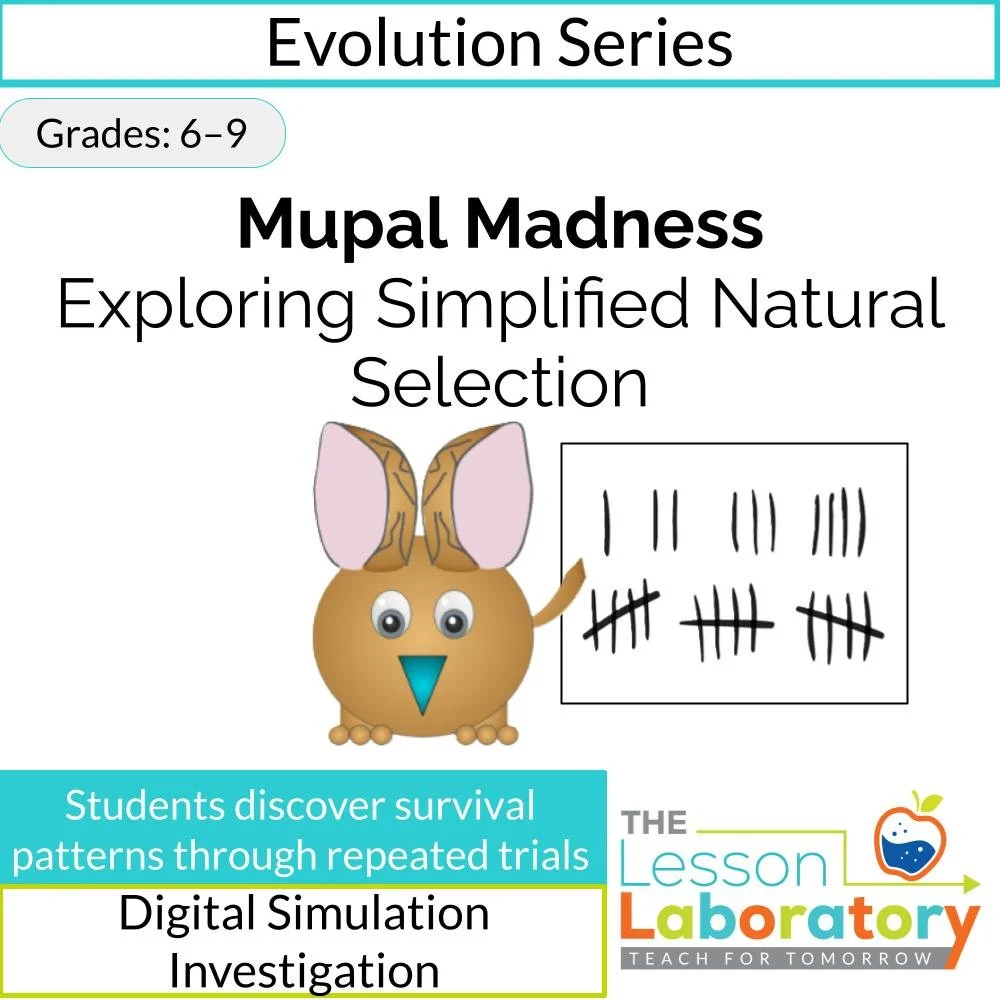
Students run repeated trials to discover how traits affect survival across environments.
Understanding natural selection requires more than definitions—it requires seeing patterns emerge over time.
This simulation-based activity gives students a structured way to explore how traits influence survival across different environments. Instead of being told what happens, students run repeated trials, collect data, and identify patterns for themselves.
Students begin by making predictions about which traits will be most successful in different environments. They then use the Mupal Madness simulation to run multiple trials, recording survival data across cold, temperate, and hot conditions. As patterns begin to emerge, students analyze their results, explain tradeoffs, and apply their understanding to real organisms.
This activity is designed to make natural selection visible, repeatable, and understandable—especially for students who benefit from clear structure and concrete patterns.
What Students Do
Make predictions about how traits affect survival in different environments
Run multiple simulation trials across cold, temperate, and hot conditions
Record and organize survival data in a structured table
Identify patterns in how traits perform across environments
Explain tradeoffs and variability in survival outcomes
Apply their understanding to real-world organisms
Synthesize patterns across all trials
What’s Included
Student companion document (structured, simulation-aligned)
Data collection table for 12 trials
Analysis questions focused on pattern recognition and explanation
Real-world application task (fennec fox vs. arctic fox)
Teacher key with sample responses
Why Teachers Use This
Clear structure without lowering rigor
Students are supported in collecting and interpreting data, while still doing the thinking.
Makes abstract ideas visible
Repeated trials allow students to see how traits influence survival over time.
No-prep implementation
Launch the simulation and begin—no setup required.
Flexible use
Works as an introduction, core lesson, or reinforcement activity.
How This Fits in Your Curriculum
This lesson is designed for Grades 6–9 and works well in units on:
Natural selection
Adaptations
Evolution
Traits and environment
It pairs especially well with lessons that introduce or follow key vocabulary and concepts, providing a concrete experience students can refer back to.
Important Note
The interactive simulation used in this lesson is freely available online.
To see a preview of this lesson, click here.
NGSS Alignment (High School):
HS-LS4-2
HS-LS4-3
NGSS Alignment (Middle School):
MS-LS4-4
MS-LS4-6
Science & Engineering Practices (SEPs):
Planning and Carrying Out Investigations
Analyzing and Interpreting Data
Constructing Explanations
Engaging in Argument from Evidence
Crosscutting Concepts (CCCs):
Patterns
Cause and Effect
Stability and Change
Common Core (Literacy in Science):
RST.6-8.3
RST.6-8.7
WHST.6-8.2
WHST.6-8.9
Bundle Upgrade Policy
This lesson is included in one or more bundles. To support flexible purchasing and long-term use of our curriculum, Lesson Laboratory offers a bundle upgrade policy.
If you purchase this lesson and decide at a later date that you would like to upgrade to a bundle, you may request a store credit equal to the total amount paid for duplicate items.
To request an upgrade credit, please email thelessonlaboratory@gmail.com and include:
Your username
The order numbers for both the original purchase(s) and the bundle
The names of the duplicate resources
Requests must be submitted within 30 days of the bundle purchase. Credits are issued as store credit for future Lesson Laboratory purchases and are not provided as cash refunds.
This policy applies only to purchases of resources that are later included in a Lesson Laboratory bundle and is limited to one adjustment per upgrade pathway.
Students run repeated trials to discover how traits affect survival across environments.
Understanding natural selection requires more than definitions—it requires seeing patterns emerge over time.
This simulation-based activity gives students a structured way to explore how traits influence survival across different environments. Instead of being told what happens, students run repeated trials, collect data, and identify patterns for themselves.
Students begin by making predictions about which traits will be most successful in different environments. They then use the Mupal Madness simulation to run multiple trials, recording survival data across cold, temperate, and hot conditions. As patterns begin to emerge, students analyze their results, explain tradeoffs, and apply their understanding to real organisms.
This activity is designed to make natural selection visible, repeatable, and understandable—especially for students who benefit from clear structure and concrete patterns.
What Students Do
Make predictions about how traits affect survival in different environments
Run multiple simulation trials across cold, temperate, and hot conditions
Record and organize survival data in a structured table
Identify patterns in how traits perform across environments
Explain tradeoffs and variability in survival outcomes
Apply their understanding to real-world organisms
Synthesize patterns across all trials
What’s Included
Student companion document (structured, simulation-aligned)
Data collection table for 12 trials
Analysis questions focused on pattern recognition and explanation
Real-world application task (fennec fox vs. arctic fox)
Teacher key with sample responses
Why Teachers Use This
Clear structure without lowering rigor
Students are supported in collecting and interpreting data, while still doing the thinking.
Makes abstract ideas visible
Repeated trials allow students to see how traits influence survival over time.
No-prep implementation
Launch the simulation and begin—no setup required.
Flexible use
Works as an introduction, core lesson, or reinforcement activity.
How This Fits in Your Curriculum
This lesson is designed for Grades 6–9 and works well in units on:
Natural selection
Adaptations
Evolution
Traits and environment
It pairs especially well with lessons that introduce or follow key vocabulary and concepts, providing a concrete experience students can refer back to.
Important Note
The interactive simulation used in this lesson is freely available online.
To see a preview of this lesson, click here.
NGSS Alignment (High School):
HS-LS4-2
HS-LS4-3
NGSS Alignment (Middle School):
MS-LS4-4
MS-LS4-6
Science & Engineering Practices (SEPs):
Planning and Carrying Out Investigations
Analyzing and Interpreting Data
Constructing Explanations
Engaging in Argument from Evidence
Crosscutting Concepts (CCCs):
Patterns
Cause and Effect
Stability and Change
Common Core (Literacy in Science):
RST.6-8.3
RST.6-8.7
WHST.6-8.2
WHST.6-8.9
Bundle Upgrade Policy
This lesson is included in one or more bundles. To support flexible purchasing and long-term use of our curriculum, Lesson Laboratory offers a bundle upgrade policy.
If you purchase this lesson and decide at a later date that you would like to upgrade to a bundle, you may request a store credit equal to the total amount paid for duplicate items.
To request an upgrade credit, please email thelessonlaboratory@gmail.com and include:
Your username
The order numbers for both the original purchase(s) and the bundle
The names of the duplicate resources
Requests must be submitted within 30 days of the bundle purchase. Credits are issued as store credit for future Lesson Laboratory purchases and are not provided as cash refunds.
This policy applies only to purchases of resources that are later included in a Lesson Laboratory bundle and is limited to one adjustment per upgrade pathway.