 Image 1 of 4
 Image 2 of 4
 Image 3 of 4
 Image 4 of 4
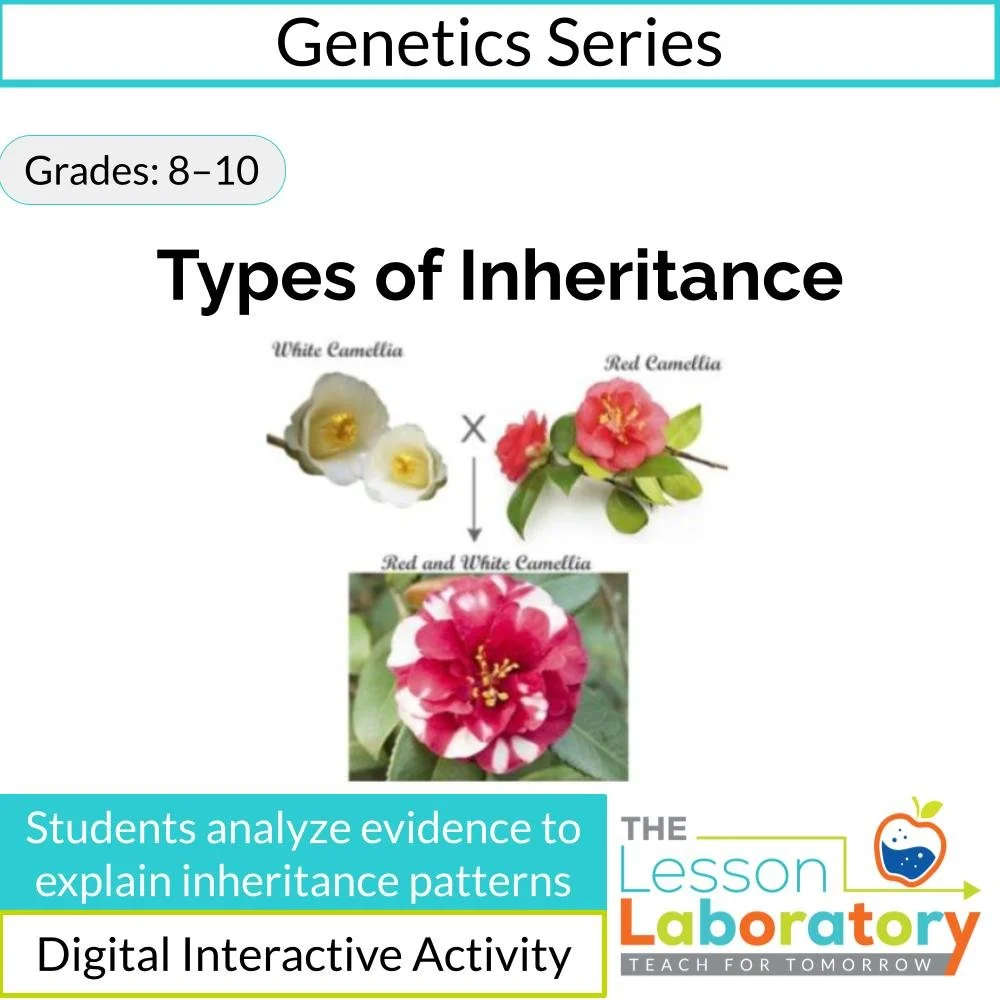
Students analyze genetic evidence to determine and compare patterns of inheritance.
Students often leave genetics units believing that all traits follow simple dominant/recessive inheritance patterns. This lesson challenges that misconception by helping students analyze real genetic evidence and compare multiple inheritance models, including codominance, incomplete dominance, sex-linked inheritance, and polygenic inheritance.
In this lesson, students move beyond memorizing vocabulary and instead use evidence to determine which inheritance pattern best explains a variety of human and animal traits. Throughout the activity, students examine real-world examples, interpret trait distributions, analyze population data, and defend conclusions using scientific reasoning.
Students investigate:
Blood type inheritance
Color blindness prevalence
Incomplete dominance in chickens
Polygenic inheritance and human skin color
Real-world genetics phenomena such as calico cats and sickle cell inheritance
This lesson emphasizes pattern recognition, evidence analysis, and conceptual understanding rather than repetitive Punnett Square practice. Students are asked to compare inheritance models, explain why certain patterns occur, and justify conclusions using evidence from the lesson.
This resource works well as:
A core non-Mendelian inheritance lesson
A transition between Mendelian genetics and molecular genetics
A reinforcement activity after Punnett Squares
A review lesson before assessments
An introductory lesson for more advanced genetics topics
Because the lesson is built around interpretation and reasoning, it works especially well for classrooms that prioritize student thinking over simple procedural practice.
What’s Included
Student lesson slides
Teacher key
Final analysis questions
Extension/challenge analysis activity
Exit ticket
Topics Covered
Mendelian vs. non-Mendelian inheritance
Codominance
Incomplete dominance
Sex-linked inheritance
Polygenic inheritance
Trait analysis and evidence interpretation
Student Experience
Students:
Analyze real genetic evidence
Compare inheritance patterns
Interpret trait distributions
Defend conclusions using evidence
Apply genetics concepts to unfamiliar examples
Grade Band
Grades 8–10 (flexible)
Suggested Placement
This lesson fits well within:
Genetics units
Heredity units
Biology courses
Introductory genetics sequences
It also pairs naturally with lessons on:
Meiosis
Punnett Squares
DNA mutations
Pedigree charts
Protein synthesis
To see a preview of this lesson, click here.
NGSS Alignment (High School):
HS-LS3-1
HS-LS3-2
NGSS Alignment (Middle School):
MS-LS3-1
MS-LS3-2
Science & Engineering Practices (SEPs):
Analyzing and Interpreting Data
Constructing Explanations
Engaging in Argument from Evidence
Obtaining, Evaluating, and Communicating Information
Crosscutting Concepts (CCCs):
Patterns
Cause and Effect
Structure and Function
Common Core (Literacy in Science):
RST.6-8.1, RST.6-8.7, RST.9-10.1, RST.9-10.7, WHST.6-8.1, WHST.6-8.2, WHST.9-10.1, WHST.9-10.2
Bundle Upgrade Policy
This lesson is included in one or more bundles. To support flexible purchasing and long-term use of our curriculum, Lesson Laboratory offers a bundle upgrade policy.
If you purchase this lesson and decide at a later date that you would like to upgrade to a bundle, you may request a store credit equal to the total amount paid for duplicate items.
To request an upgrade credit, please email thelessonlaboratory@gmail.com and include:
Your username
The order numbers for both the original purchase(s) and the bundle
The names of the duplicate resources
Requests must be submitted within 30 days of the bundle purchase. Credits are issued as store credit for future Lesson Laboratory purchases and are not provided as cash refunds.
This policy applies only to purchases of resources that are later included in a Lesson Laboratory bundle and is limited to one adjustment per upgrade pathway.
Students analyze genetic evidence to determine and compare patterns of inheritance.
Students often leave genetics units believing that all traits follow simple dominant/recessive inheritance patterns. This lesson challenges that misconception by helping students analyze real genetic evidence and compare multiple inheritance models, including codominance, incomplete dominance, sex-linked inheritance, and polygenic inheritance.
In this lesson, students move beyond memorizing vocabulary and instead use evidence to determine which inheritance pattern best explains a variety of human and animal traits. Throughout the activity, students examine real-world examples, interpret trait distributions, analyze population data, and defend conclusions using scientific reasoning.
Students investigate:
Blood type inheritance
Color blindness prevalence
Incomplete dominance in chickens
Polygenic inheritance and human skin color
Real-world genetics phenomena such as calico cats and sickle cell inheritance
This lesson emphasizes pattern recognition, evidence analysis, and conceptual understanding rather than repetitive Punnett Square practice. Students are asked to compare inheritance models, explain why certain patterns occur, and justify conclusions using evidence from the lesson.
This resource works well as:
A core non-Mendelian inheritance lesson
A transition between Mendelian genetics and molecular genetics
A reinforcement activity after Punnett Squares
A review lesson before assessments
An introductory lesson for more advanced genetics topics
Because the lesson is built around interpretation and reasoning, it works especially well for classrooms that prioritize student thinking over simple procedural practice.
What’s Included
Student lesson slides
Teacher key
Final analysis questions
Extension/challenge analysis activity
Exit ticket
Topics Covered
Mendelian vs. non-Mendelian inheritance
Codominance
Incomplete dominance
Sex-linked inheritance
Polygenic inheritance
Trait analysis and evidence interpretation
Student Experience
Students:
Analyze real genetic evidence
Compare inheritance patterns
Interpret trait distributions
Defend conclusions using evidence
Apply genetics concepts to unfamiliar examples
Grade Band
Grades 8–10 (flexible)
Suggested Placement
This lesson fits well within:
Genetics units
Heredity units
Biology courses
Introductory genetics sequences
It also pairs naturally with lessons on:
Meiosis
Punnett Squares
DNA mutations
Pedigree charts
Protein synthesis
To see a preview of this lesson, click here.
NGSS Alignment (High School):
HS-LS3-1
HS-LS3-2
NGSS Alignment (Middle School):
MS-LS3-1
MS-LS3-2
Science & Engineering Practices (SEPs):
Analyzing and Interpreting Data
Constructing Explanations
Engaging in Argument from Evidence
Obtaining, Evaluating, and Communicating Information
Crosscutting Concepts (CCCs):
Patterns
Cause and Effect
Structure and Function
Common Core (Literacy in Science):
RST.6-8.1, RST.6-8.7, RST.9-10.1, RST.9-10.7, WHST.6-8.1, WHST.6-8.2, WHST.9-10.1, WHST.9-10.2
Bundle Upgrade Policy
This lesson is included in one or more bundles. To support flexible purchasing and long-term use of our curriculum, Lesson Laboratory offers a bundle upgrade policy.
If you purchase this lesson and decide at a later date that you would like to upgrade to a bundle, you may request a store credit equal to the total amount paid for duplicate items.
To request an upgrade credit, please email thelessonlaboratory@gmail.com and include:
Your username
The order numbers for both the original purchase(s) and the bundle
The names of the duplicate resources
Requests must be submitted within 30 days of the bundle purchase. Credits are issued as store credit for future Lesson Laboratory purchases and are not provided as cash refunds.
This policy applies only to purchases of resources that are later included in a Lesson Laboratory bundle and is limited to one adjustment per upgrade pathway.