Pedigree Investigator Genetics Activity – Tracking Traits, Building Pedigrees & Analyzing Inheritance
Hands-On Pedigree Practice for Middle & High School Genetics.
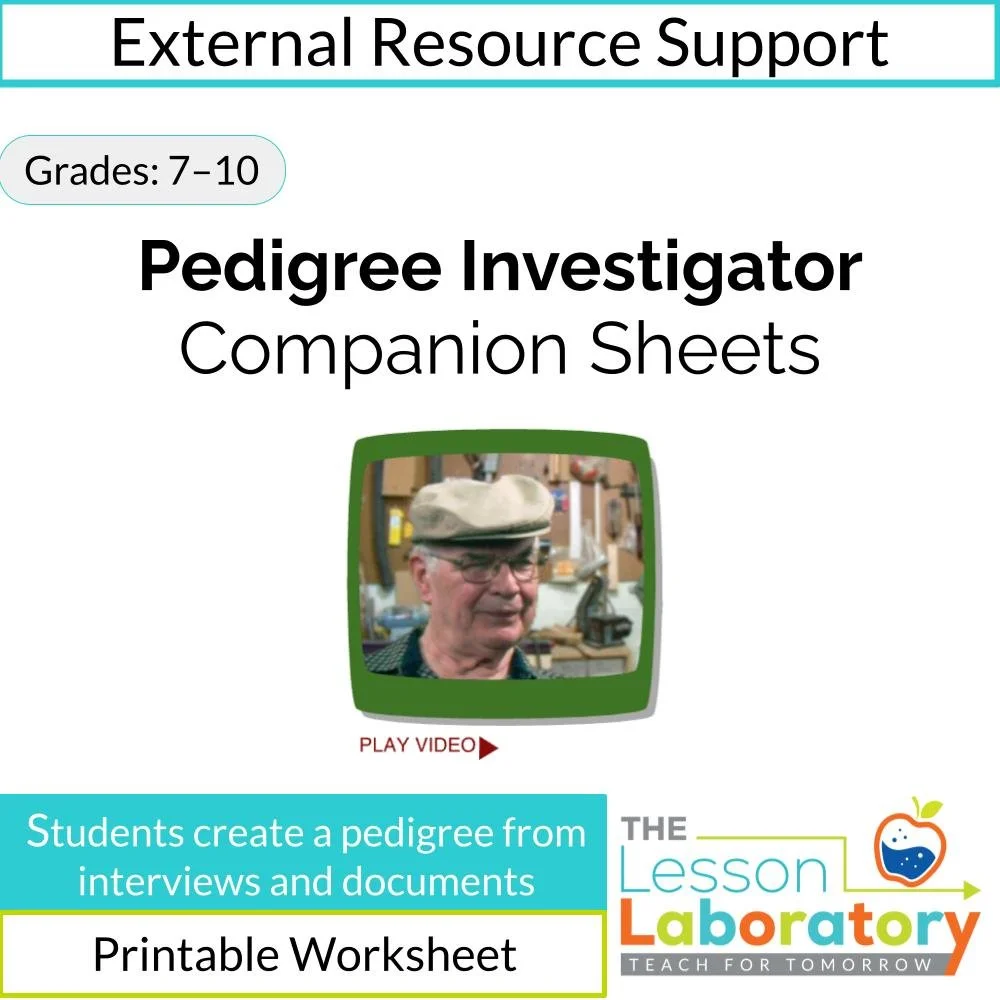
Bring the University of Utah’s popular Inheritance of Nicotine Addiction activity to life with this ready-to-use companion worksheet. Designed to give structure and depth to the lesson, this worksheet guides students step-by-step through the activity while keeping them engaged and on track.
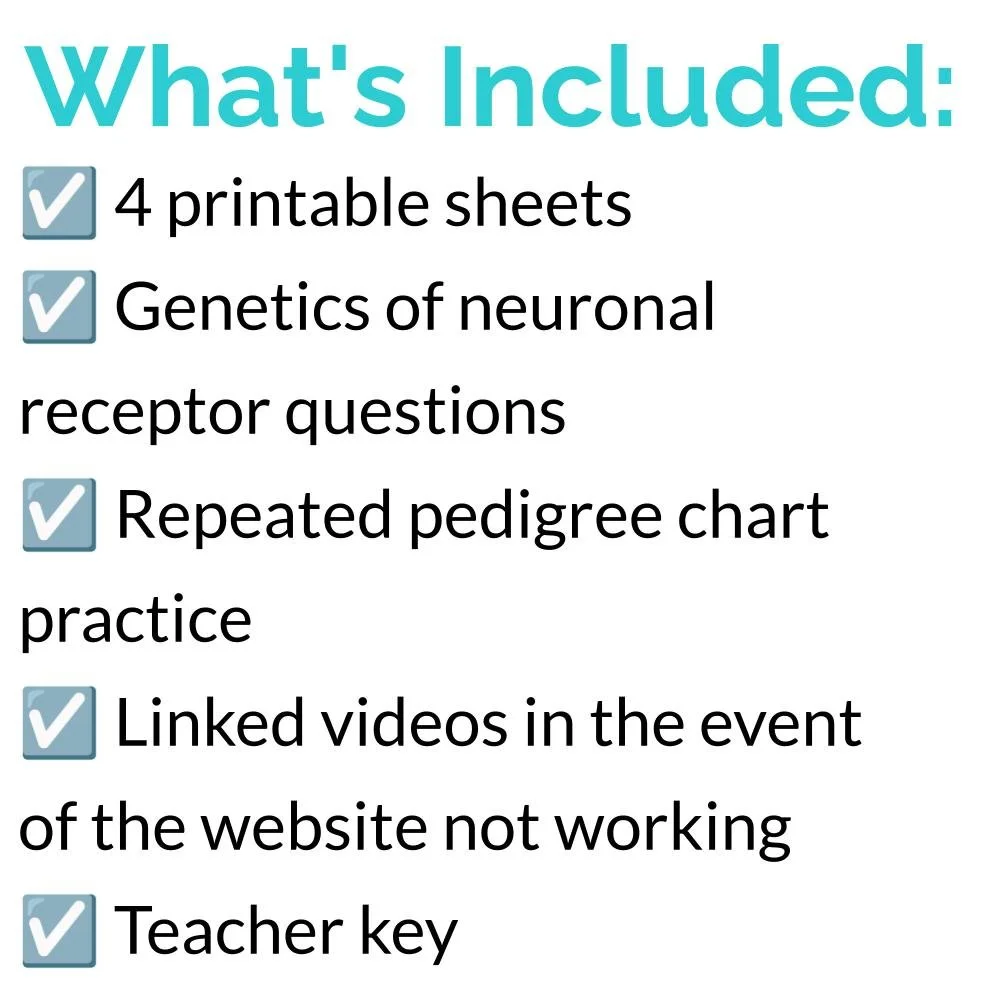
📘 What’s Included:
A skeleton framework to help students construct and analyze pedigree charts
Scaffolded questions that lead students to discover inheritance patterns
Opportunities to connect pedigree analysis to molecular biology, as students examine nicotinic acetylcholine receptors and explore how protein differences can influence addiction
Practice exercises where students build pedigree charts from family descriptions
💡 Teacher Note:
Since Pedigree Investigator has recently returned but may have some video issues, I’ve included a shared Google Doc with timestamped YouTube links to the interviews. Students can access it easily with a QR code, so the experience runs smoothly in any classroom. Everything else on the University of Utah site works as intended.
✨ Why Teachers Love It:
Saves prep time with a clear, structured worksheet
Encourages higher-order thinking by connecting genetics to real-world health issues
Perfect for reinforcing pedigree analysis skills in a meaningful, applied context
With this resource, students don’t just learn pedigree charts—they connect them to molecular genetics and human health in a way that’s memorable, relevant, and engaging.
Grade Recommendation
Best Fit:
Middle School (grades 7–8) — highly appropriate; the Utah Genetics site, pedigree interpretation, and guided analysis questions align smoothly with MS-LS3 content
High School (grades 9–10) — still appropriate, especially as reinforcement or early genetics practice
Rationale:
The tasks require reading a pedigree, interpreting genotypes, and applying inheritance rules. Students also work with real data (nicotine addiction case study) and two more advanced case studies about albinism and Huntington’s disease. These are well within MS-LS3 but still valuable for HS introductory genetics.
Cross-Curricular Connections / Extensions
Cross-Curricular
ELA:
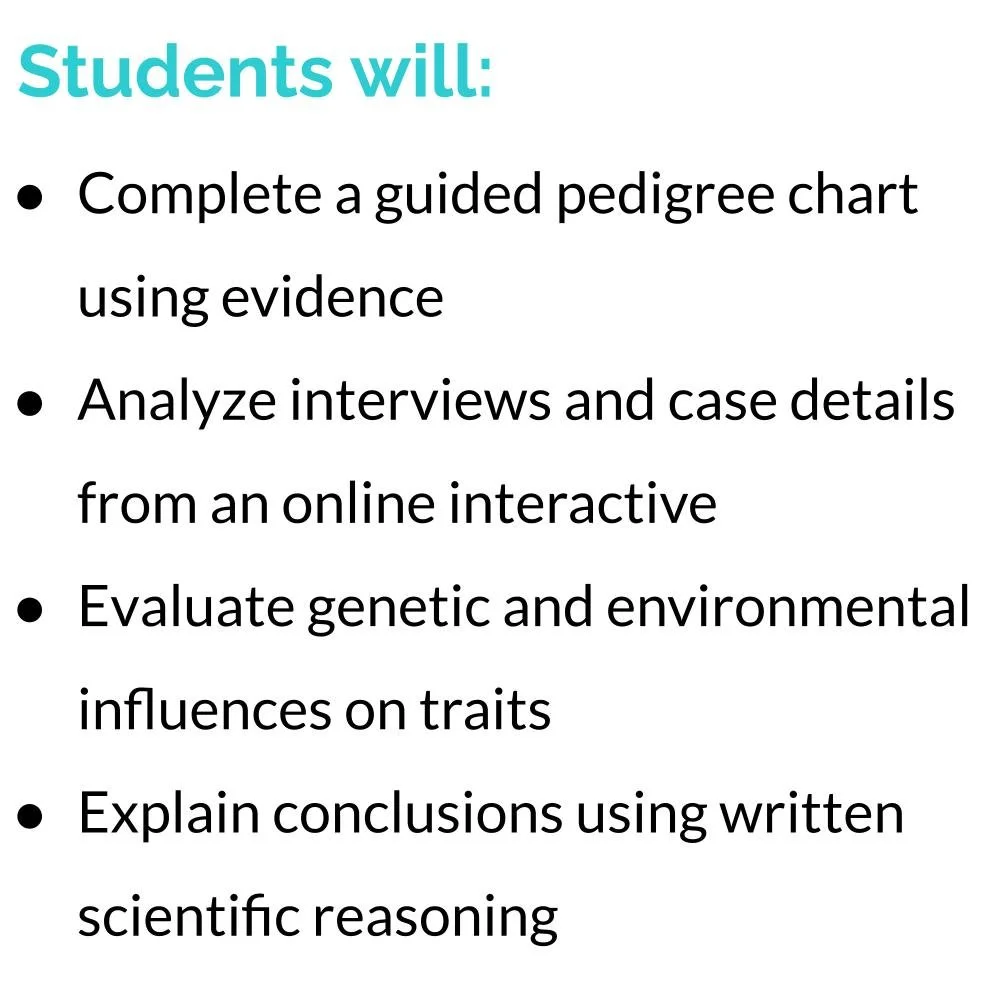
Evidence-based argumentation (questions about hereditary vs. environmental influences).
Reading scientific informational text from the Utah Genetics website.
Writing explanations using domain-specific vocabulary (allele, receptor, heteromeric, etc.).
Health Education:
Understanding nicotine addiction risk factors.
Discussing environmental influences on substance use decisions.
(This is directly tied to the addiction pedigree on pages 1–2.)
Psychology / Sociology:
Nature vs. nurture debate (explicitly referenced in questions 1–2 of the nicotine pedigree).
Possible Extensions
Bioethics discussion: Should genetic predispositions influence public health policy?
Mini-project: Students research another genetic disorder and create their own pedigree activity.
Connection to protein synthesis: The nAChR receptor analysis on page 2 links perfectly to lessons on how genes code for proteins.
Join the Lesson Laboratory and Teach for Tomorrow!
NGSS Standards (with CCCs + SEPs)
Middle School (Primary Alignment)
MS-LS3-1 — Develop and use a model to describe why structural changes to genes result in changes to proteins and organisms.
Seen when analyzing how nAChR receptor structure relates to addiction susceptibility
MS-LS3-2 — Develop and use a model to describe that genetic variations result from inherited traits.
Students track nicotine addiction inheritance & analyze case studies on albinism and Huntington’s disease
High School (Reinforcement)
HS-LS3-1 — Ask questions to clarify relationships about changes in DNA and resulting variations.
HS-LS3-2 — Make and defend claims based on evidence that inheritable genetic variations may result from allele combinations.
HS-LS3-3 — Apply concepts of probability to explain inheritance patterns.
Science & Engineering Practices
Analyzing and Interpreting Data (students build and interpret pedigrees; evaluate genetic vs. environmental factors).
Developing and Using Models (pedigree diagrams and genotype notation).
Constructing Explanations (short-answer analysis at the end of each section).
Crosscutting Concepts
Cause and Effect: Genes → proteins → traits (nAChR receptor example).
Patterns: Recognizing inheritance patterns in pedigrees.
Structure and Function: How receptor protein structure affects susceptibility.
Common Core Standards
ELA-Literacy
RST.6-8.1 / RST.9-10.1 — Cite specific evidence to support scientific analysis.
Students must justify inheritance claims using pedigree evidence.
RST.6-8.4 / RST.9-10.4 — Determine meaning of scientific terms (allele, receptor, heteromeric, etc.).
WHST.6-8.2 / WHST.9-10.2 — Write explanatory scientific texts.
WHST.6-8.1 / WHST.9-10.1 — Construct arguments using evidence.
Used in responses about genetic vs. environmental influence.
Math (light alignment)
6.SP.B / 7.SP — Informal reasoning with probability (dominant vs. recessive inheritance).
Hands-On Pedigree Practice for Middle & High School Genetics.
Bring the University of Utah’s popular Inheritance of Nicotine Addiction activity to life with this ready-to-use companion worksheet. Designed to give structure and depth to the lesson, this worksheet guides students step-by-step through the activity while keeping them engaged and on track.
📘 What’s Included:
A skeleton framework to help students construct and analyze pedigree charts
Scaffolded questions that lead students to discover inheritance patterns
Opportunities to connect pedigree analysis to molecular biology, as students examine nicotinic acetylcholine receptors and explore how protein differences can influence addiction
Practice exercises where students build pedigree charts from family descriptions
💡 Teacher Note:
Since Pedigree Investigator has recently returned but may have some video issues, I’ve included a shared Google Doc with timestamped YouTube links to the interviews. Students can access it easily with a QR code, so the experience runs smoothly in any classroom. Everything else on the University of Utah site works as intended.
✨ Why Teachers Love It:
Saves prep time with a clear, structured worksheet
Encourages higher-order thinking by connecting genetics to real-world health issues
Perfect for reinforcing pedigree analysis skills in a meaningful, applied context
With this resource, students don’t just learn pedigree charts—they connect them to molecular genetics and human health in a way that’s memorable, relevant, and engaging.
Grade Recommendation
Best Fit:
Middle School (grades 7–8) — highly appropriate; the Utah Genetics site, pedigree interpretation, and guided analysis questions align smoothly with MS-LS3 content
High School (grades 9–10) — still appropriate, especially as reinforcement or early genetics practice
Rationale:
The tasks require reading a pedigree, interpreting genotypes, and applying inheritance rules. Students also work with real data (nicotine addiction case study) and two more advanced case studies about albinism and Huntington’s disease. These are well within MS-LS3 but still valuable for HS introductory genetics.
Cross-Curricular Connections / Extensions
Cross-Curricular
ELA:
Evidence-based argumentation (questions about hereditary vs. environmental influences).
Reading scientific informational text from the Utah Genetics website.
Writing explanations using domain-specific vocabulary (allele, receptor, heteromeric, etc.).
Health Education:
Understanding nicotine addiction risk factors.
Discussing environmental influences on substance use decisions.
(This is directly tied to the addiction pedigree on pages 1–2.)
Psychology / Sociology:
Nature vs. nurture debate (explicitly referenced in questions 1–2 of the nicotine pedigree).
Possible Extensions
Bioethics discussion: Should genetic predispositions influence public health policy?
Mini-project: Students research another genetic disorder and create their own pedigree activity.
Connection to protein synthesis: The nAChR receptor analysis on page 2 links perfectly to lessons on how genes code for proteins.
Join the Lesson Laboratory and Teach for Tomorrow!
NGSS Standards (with CCCs + SEPs)
Middle School (Primary Alignment)
MS-LS3-1 — Develop and use a model to describe why structural changes to genes result in changes to proteins and organisms.
Seen when analyzing how nAChR receptor structure relates to addiction susceptibility
MS-LS3-2 — Develop and use a model to describe that genetic variations result from inherited traits.
Students track nicotine addiction inheritance & analyze case studies on albinism and Huntington’s disease
High School (Reinforcement)
HS-LS3-1 — Ask questions to clarify relationships about changes in DNA and resulting variations.
HS-LS3-2 — Make and defend claims based on evidence that inheritable genetic variations may result from allele combinations.
HS-LS3-3 — Apply concepts of probability to explain inheritance patterns.
Science & Engineering Practices
Analyzing and Interpreting Data (students build and interpret pedigrees; evaluate genetic vs. environmental factors).
Developing and Using Models (pedigree diagrams and genotype notation).
Constructing Explanations (short-answer analysis at the end of each section).
Crosscutting Concepts
Cause and Effect: Genes → proteins → traits (nAChR receptor example).
Patterns: Recognizing inheritance patterns in pedigrees.
Structure and Function: How receptor protein structure affects susceptibility.
Common Core Standards
ELA-Literacy
RST.6-8.1 / RST.9-10.1 — Cite specific evidence to support scientific analysis.
Students must justify inheritance claims using pedigree evidence.
RST.6-8.4 / RST.9-10.4 — Determine meaning of scientific terms (allele, receptor, heteromeric, etc.).
WHST.6-8.2 / WHST.9-10.2 — Write explanatory scientific texts.
WHST.6-8.1 / WHST.9-10.1 — Construct arguments using evidence.
Used in responses about genetic vs. environmental influence.
Math (light alignment)
6.SP.B / 7.SP — Informal reasoning with probability (dominant vs. recessive inheritance).