 Image 1 of 4
 Image 2 of 4
 Image 3 of 4
 Image 4 of 4
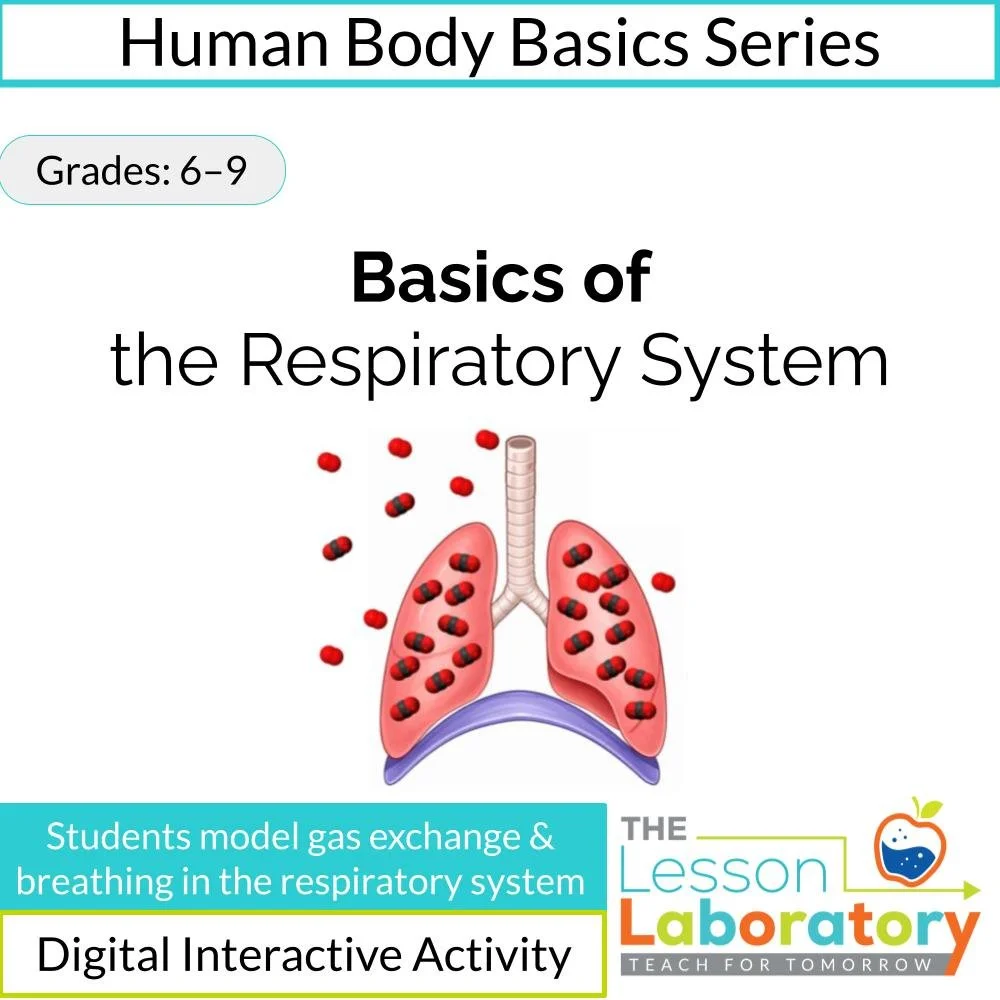
Understanding how the respiratory system works requires more than memorizing anatomy diagrams. In this lesson, students build a conceptual model of how gases move through the body and how breathing supports homeostasis.
In Basics of the Respiratory System, students investigate the structure and function of the respiratory system through guided diagrams, conceptual modeling, and applied reasoning tasks. Students begin by exploring how gases move by diffusion along a concentration gradient, then connect that principle to gas exchange in the lungs and the role of the alveoli and capillaries in transporting oxygen and carbon dioxide.
From there, students examine the major structures of the respiratory system, including the nasal cavity, trachea, bronchi, lungs, and diaphragm, and analyze how breathing mechanics change pressure inside the lungs during inhalation and exhalation.
The lesson concludes with a short investigation into respiratory diseases and homeostasis, where students analyze how disorders such as asthma, pneumonia, or pulmonary fibrosis disrupt the body’s ability to maintain stable internal conditions.
Students:
Model how gases move through diffusion and concentration gradients
Identify and label major respiratory system structures
Examine how oxygen and carbon dioxide move between alveoli and capillaries
Analyze how pressure differences drive inhalation and exhalation
Investigate respiratory diseases and their effects on homeostasis
Demonstrate understanding through a short exit ticket
Teachers appreciate this lesson because it:
Introduces respiratory physiology through conceptual reasoning rather than memorization
Uses clear diagrams and visual modeling to support struggling learners
Includes scaffolded slides and optional simplified support slides for differentiation
Connects anatomy to homeostasis and disease
Requires minimal preparation and works well for digital classrooms
Full digital lesson slides
Teacher answer key
Printable literacy-based exit ticket
Optional simplified slides to support struggling learners
Links to interactive review activities
Designed for grades 6–9 life science or introductory biology.
This lesson is especially appropriate for:
middle school life science
introductory biology courses
remedial or support biology classes
human body systems units
Respiratory system anatomy
Gas exchange and diffusion
Alveoli and capillary exchange
Pressure changes during breathing
Inhalation and exhalation mechanics
Respiratory diseases and homeostasis
To preview this lesson, click here.
NGSS Alignment (High School):
HS-LS1-2
NGSS Alignment (Middle School):
MS-LS1-3
Science & Engineering Practices (SEPs):
Developing and Using Models; Constructing Explanations
Crosscutting Concepts (CCCs):
Structure and Function; Systems and System Models; Cause and Effect
Common Core (Literacy in Science):
RST.9-10.4; RST.9-10.7
Understanding how the respiratory system works requires more than memorizing anatomy diagrams. In this lesson, students build a conceptual model of how gases move through the body and how breathing supports homeostasis.
In Basics of the Respiratory System, students investigate the structure and function of the respiratory system through guided diagrams, conceptual modeling, and applied reasoning tasks. Students begin by exploring how gases move by diffusion along a concentration gradient, then connect that principle to gas exchange in the lungs and the role of the alveoli and capillaries in transporting oxygen and carbon dioxide.
From there, students examine the major structures of the respiratory system, including the nasal cavity, trachea, bronchi, lungs, and diaphragm, and analyze how breathing mechanics change pressure inside the lungs during inhalation and exhalation.
The lesson concludes with a short investigation into respiratory diseases and homeostasis, where students analyze how disorders such as asthma, pneumonia, or pulmonary fibrosis disrupt the body’s ability to maintain stable internal conditions.
Students:
Model how gases move through diffusion and concentration gradients
Identify and label major respiratory system structures
Examine how oxygen and carbon dioxide move between alveoli and capillaries
Analyze how pressure differences drive inhalation and exhalation
Investigate respiratory diseases and their effects on homeostasis
Demonstrate understanding through a short exit ticket
Teachers appreciate this lesson because it:
Introduces respiratory physiology through conceptual reasoning rather than memorization
Uses clear diagrams and visual modeling to support struggling learners
Includes scaffolded slides and optional simplified support slides for differentiation
Connects anatomy to homeostasis and disease
Requires minimal preparation and works well for digital classrooms
Full digital lesson slides
Teacher answer key
Printable literacy-based exit ticket
Optional simplified slides to support struggling learners
Links to interactive review activities
Designed for grades 6–9 life science or introductory biology.
This lesson is especially appropriate for:
middle school life science
introductory biology courses
remedial or support biology classes
human body systems units
Respiratory system anatomy
Gas exchange and diffusion
Alveoli and capillary exchange
Pressure changes during breathing
Inhalation and exhalation mechanics
Respiratory diseases and homeostasis
To preview this lesson, click here.
NGSS Alignment (High School):
HS-LS1-2
NGSS Alignment (Middle School):
MS-LS1-3
Science & Engineering Practices (SEPs):
Developing and Using Models; Constructing Explanations
Crosscutting Concepts (CCCs):
Structure and Function; Systems and System Models; Cause and Effect
Common Core (Literacy in Science):
RST.9-10.4; RST.9-10.7