 Image 1 of 4
 Image 2 of 4
 Image 3 of 4
 Image 4 of 4
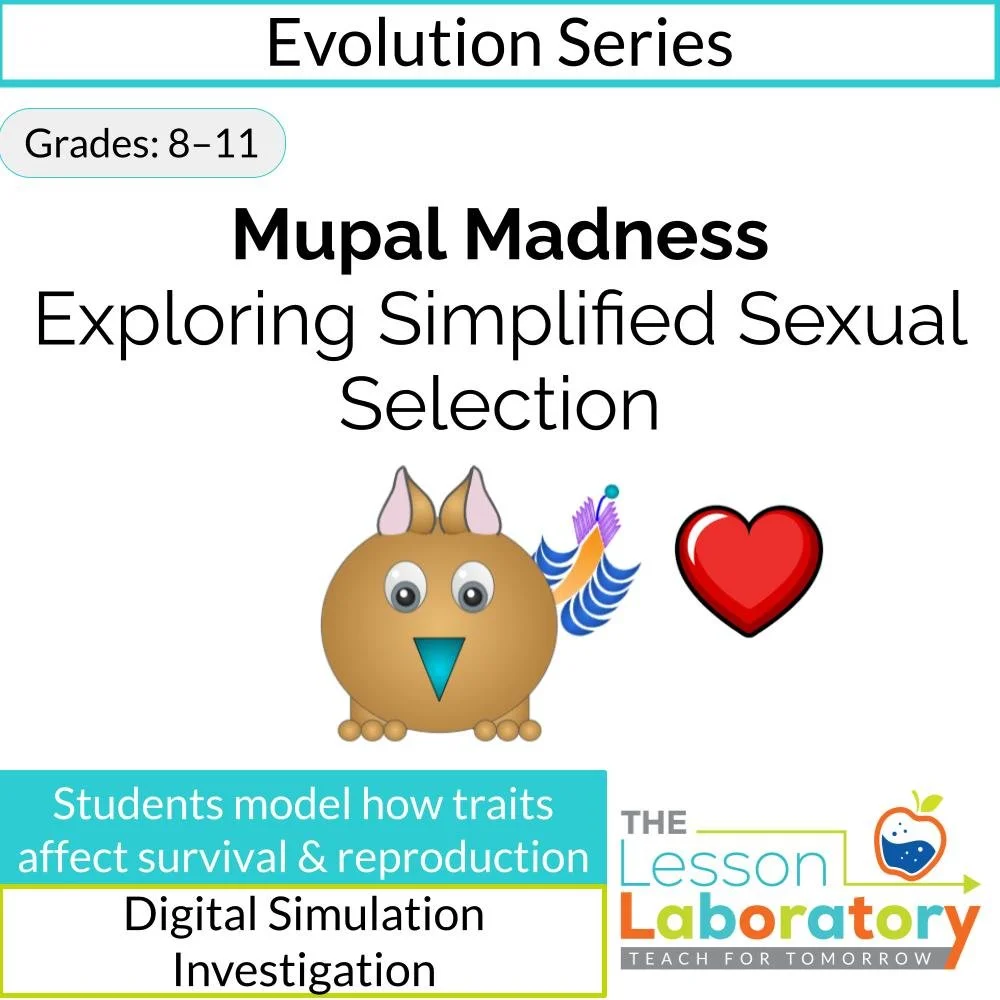
Students model evolutionary trade-offs between survival and reproductive success through an interactive simulation investigation.
This interactive evolution lesson helps students investigate one of the most important ideas in evolutionary biology: traits that improve reproductive success may also reduce survival. Through repeated simulation trials, students model how environmental pressures and mate attraction work together to shape populations across generations.
In this investigation, students use the Mupal Madness: Exploring Simplified Sexual Selection simulator to analyze how different tail traits affect both survival and reproductive success under changing predator conditions. Students make predictions, collect data, analyze population trends, and explain why certain traits become more or less common over time.
Unlike many simplified evolution activities that present traits as simply “good” or “bad,” this lesson emphasizes evolutionary trade-offs and environmental context. Students explore how a trait may be beneficial in one situation while harmful in another, helping build a more accurate understanding of natural and sexual selection.
Students will:
Investigate trade-offs between survival and reproduction
Analyze how environmental conditions affect reproductive success
Explain how sexually selected traits change across generations
Collect and interpret population data from a simulation
Recreate and analyze population trend graphs
Compare simulation patterns to real organisms
Explain how sexual selection differs from natural selection
What’s Included:
Student investigation worksheets
Structured simulation analysis activities
Population graphing/data analysis section
Real-organism comparison and transfer questions
Teacher key
Link to the free online simulation
This lesson works well for:
Evolution units
Natural selection instruction
Sexual selection instruction
NGSS-aligned biology courses
Interactive modeling activities
Inquiry-based science classrooms
Middle school advanced life science
High school biology
Grades: 8–11 (flexible)
This resource is part of the broader Mupal Madness simulation ecosystem and the Lesson Laboratory Evolution Series.
The interactive simulation used in this lesson is freely available online.
To see a preview of this lesson, click here.
NGSS Alignment (High School):
HS-LS4-2
HS-LS4-3
HS-LS4-4
NGSS Alignment (Middle School):
MS-LS4-4
MS-LS4-6
Science & Engineering Practices (SEPs):
Developing and Using Models
Analyzing and Interpreting Data
Constructing Explanations
Engaging in Argument from Evidence
Crosscutting Concepts (CCCs):
Cause and Effect
Systems and System Models
Patterns
Common Core (Literacy in Science):
RST.6-8.1
RST.6-8.7
RST.9-10.1
RST.9-10.7
WHST.6-8.1
WHST.6-8.9
WHST.9-10.1
WHST.9-10.9
Bundle Upgrade Policy
To support flexible purchasing and long-term use of our curriculum, Lesson Laboratory offers a bundle upgrade policy.
If you have previously purchased one or more individual lessons that are included in this bundle, you may request a store credit equal to the total amount paid for those duplicate items.
To request an upgrade credit, please email thelessonlaboratory@gmail.com and include:
Your username
The order numbers for both the original purchase(s) and the bundle
The names of the duplicate resources
Requests must be submitted within 30 days of the bundle purchase. Credits are issued as store credit for future Lesson Laboratory purchases and are not provided as cash refunds.
This policy applies only to purchases of resources that are later included in a Lesson Laboratory bundle and is limited to one adjustment per upgrade pathway.
Students model evolutionary trade-offs between survival and reproductive success through an interactive simulation investigation.
This interactive evolution lesson helps students investigate one of the most important ideas in evolutionary biology: traits that improve reproductive success may also reduce survival. Through repeated simulation trials, students model how environmental pressures and mate attraction work together to shape populations across generations.
In this investigation, students use the Mupal Madness: Exploring Simplified Sexual Selection simulator to analyze how different tail traits affect both survival and reproductive success under changing predator conditions. Students make predictions, collect data, analyze population trends, and explain why certain traits become more or less common over time.
Unlike many simplified evolution activities that present traits as simply “good” or “bad,” this lesson emphasizes evolutionary trade-offs and environmental context. Students explore how a trait may be beneficial in one situation while harmful in another, helping build a more accurate understanding of natural and sexual selection.
Students will:
Investigate trade-offs between survival and reproduction
Analyze how environmental conditions affect reproductive success
Explain how sexually selected traits change across generations
Collect and interpret population data from a simulation
Recreate and analyze population trend graphs
Compare simulation patterns to real organisms
Explain how sexual selection differs from natural selection
What’s Included:
Student investigation worksheets
Structured simulation analysis activities
Population graphing/data analysis section
Real-organism comparison and transfer questions
Teacher key
Link to the free online simulation
This lesson works well for:
Evolution units
Natural selection instruction
Sexual selection instruction
NGSS-aligned biology courses
Interactive modeling activities
Inquiry-based science classrooms
Middle school advanced life science
High school biology
Grades: 8–11 (flexible)
This resource is part of the broader Mupal Madness simulation ecosystem and the Lesson Laboratory Evolution Series.
The interactive simulation used in this lesson is freely available online.
To see a preview of this lesson, click here.
NGSS Alignment (High School):
HS-LS4-2
HS-LS4-3
HS-LS4-4
NGSS Alignment (Middle School):
MS-LS4-4
MS-LS4-6
Science & Engineering Practices (SEPs):
Developing and Using Models
Analyzing and Interpreting Data
Constructing Explanations
Engaging in Argument from Evidence
Crosscutting Concepts (CCCs):
Cause and Effect
Systems and System Models
Patterns
Common Core (Literacy in Science):
RST.6-8.1
RST.6-8.7
RST.9-10.1
RST.9-10.7
WHST.6-8.1
WHST.6-8.9
WHST.9-10.1
WHST.9-10.9
Bundle Upgrade Policy
To support flexible purchasing and long-term use of our curriculum, Lesson Laboratory offers a bundle upgrade policy.
If you have previously purchased one or more individual lessons that are included in this bundle, you may request a store credit equal to the total amount paid for those duplicate items.
To request an upgrade credit, please email thelessonlaboratory@gmail.com and include:
Your username
The order numbers for both the original purchase(s) and the bundle
The names of the duplicate resources
Requests must be submitted within 30 days of the bundle purchase. Credits are issued as store credit for future Lesson Laboratory purchases and are not provided as cash refunds.
This policy applies only to purchases of resources that are later included in a Lesson Laboratory bundle and is limited to one adjustment per upgrade pathway.