 Image 1 of 4
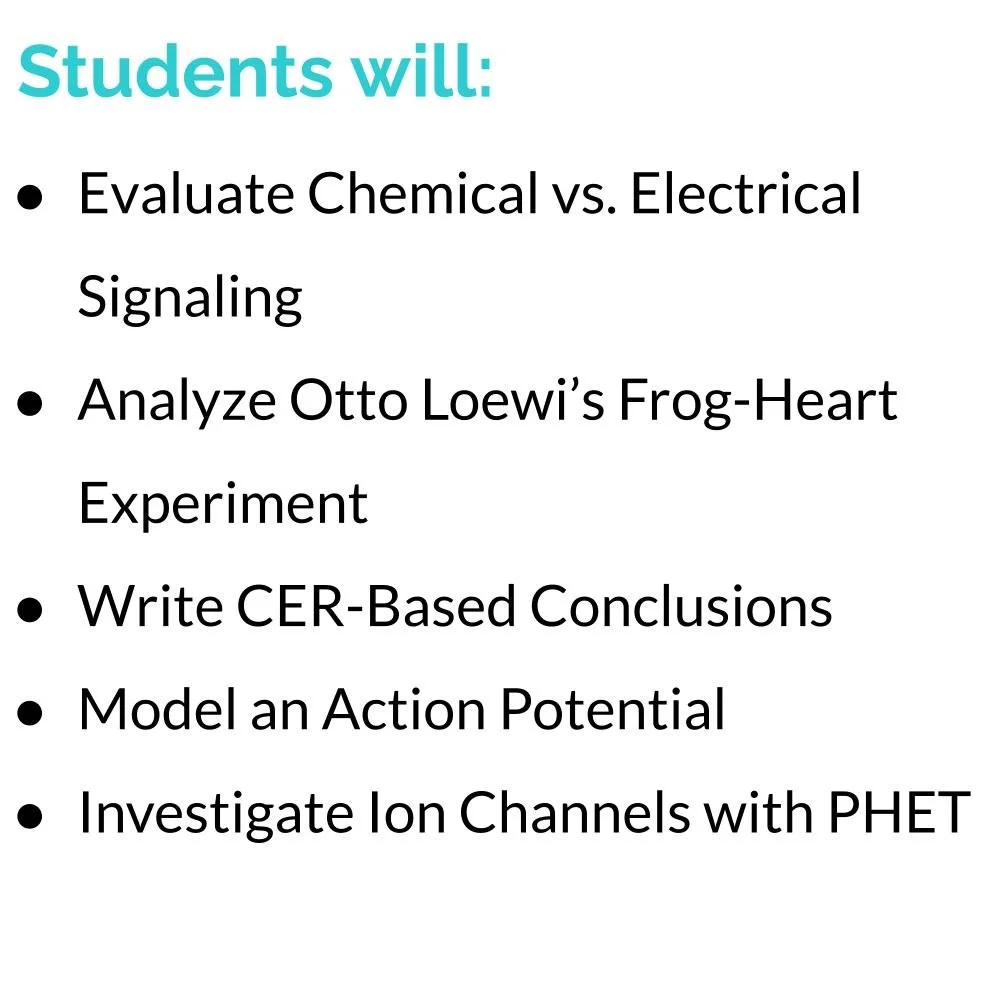 Image 2 of 4
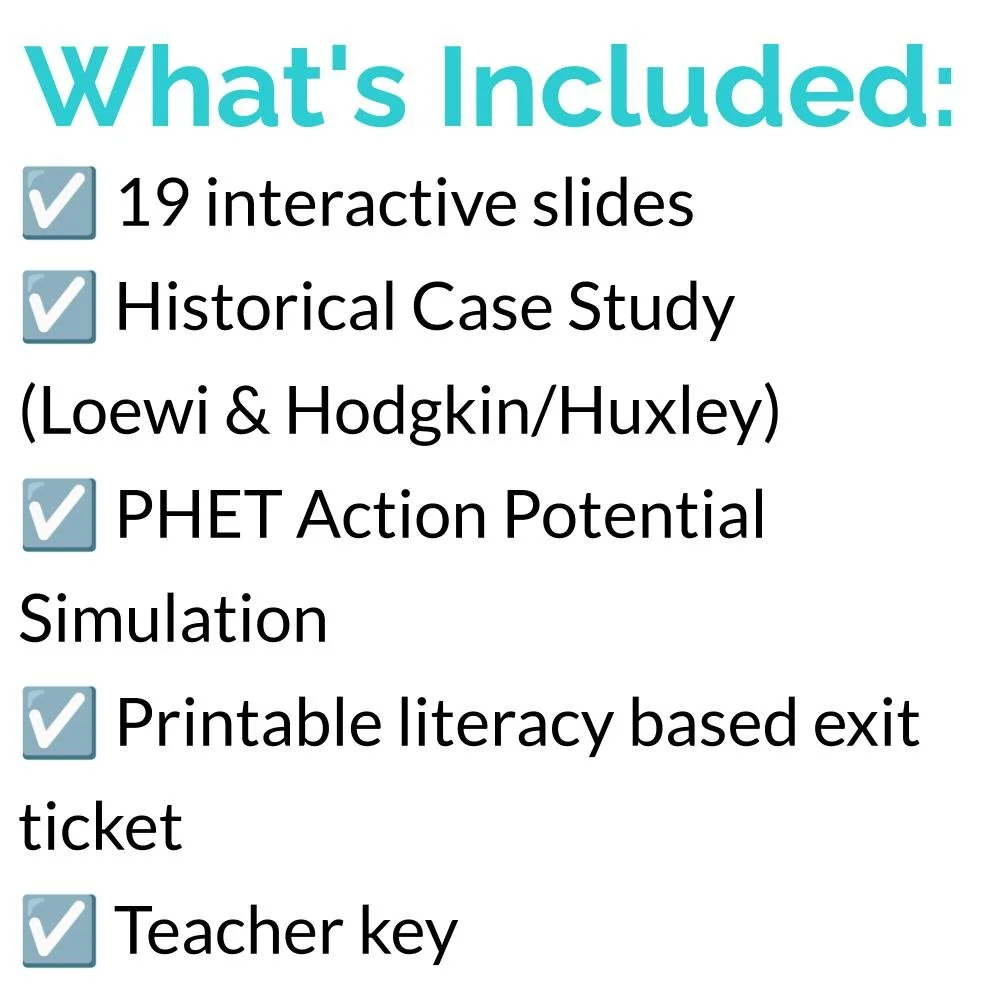 Image 3 of 4
 Image 4 of 4
Otto Loewi, Hodgkin & Huxley, and the Science of Neural Signaling | Advanced A&P | Google Slides + PHET Simulation.
This advanced digital lesson guides students through one of the most important scientific debates in neuroscience: Do neurons communicate chemically, electrically, or both?
Students examine the early 20th-century “Soups vs. Sparks” debate, analyze Otto Loewi’s landmark frog-heart experiment, and investigate how action potentials were later explained through the Nobel Prize–winning work of Hodgkin and Huxley. The lesson integrates historical case study, mechanistic modeling, CER writing, and a structured PHET simulation to build a precise understanding of neural signaling.
Rather than memorizing terminology, students evaluate evidence, interpret experimental design, and trace the sequence of events that produce an action potential.
Evaluate the Soups vs. Sparks Debate
Students analyze early experimental evidence for both chemical and electrical signaling using guided digital models.
Reconstruct Otto Loewi’s Experiment
Students examine the frog-heart experiment step by step, then complete a structured Claim–Evidence–Reasoning analysis to determine whether neurons communicate chemically.
Examine the Evolution of the Debate
Students explore later discoveries demonstrating that both chemical synapses and electrical synapses exist.
Analyze Action Potentials
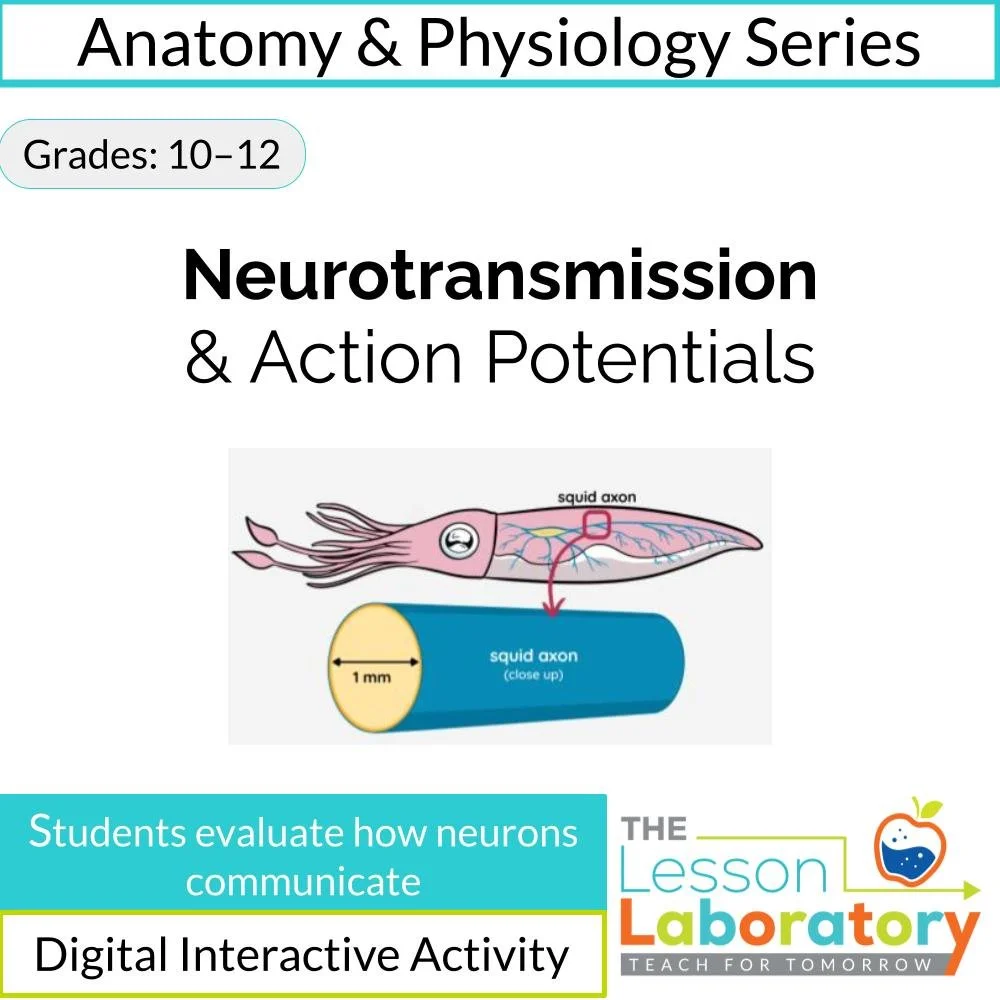
Students study Hodgkin and Huxley’s squid axon research, compare squid and human axons, and interpret simplified voltage and membrane diagrams.
Investigate Ion Channels Using a PHET Simulation
Students:
Observe resting membrane potential
Track ion movement during stimulation
Analyze leak and gated channels
Trace depolarization and repolarization
Examine the refractory period
Throughout the lesson, students connect experimental evidence to mechanistic explanation.
Structured progression from historical debate to modern model
Integrated CER writing for scientific argumentation
Visual scaffolding to support complex physiological concepts
Simulation-based inquiry with guided analysis
Fully digital, no-prep format
A complete teacher key and printable literacy-based exit ticket are included.
Anchored in authentic scientific discovery
Emphasizes mechanism over memorization
Integrates history of science with advanced physiology
Builds evidence-based reasoning skills
Appropriate for Advanced Anatomy & Physiology or upper-level biology
Ready to assign in Google Slides
To see a preview of this lesson, click here.
NGSS Alignment (High School):
HS-LS1-2; HS-LS1-3; HS-LS1-1
Science & Engineering Practices (SEPs):
Developing and Using Models
Analyzing and Interpreting Data
Constructing Explanations
Obtaining, Evaluating, and Communicating Information
Crosscutting Concepts (CCCs):
Structure and Function
Cause and Effect
Systems and System Models
Stability and Change
Common Core (Literacy in Science):
CCSS.ELA-LITERACY.RST.9-10.3; CCSS.ELA-LITERACY.RST.11-12.7; CCSS.ELA-LITERACY.WHST.9-12.2; CCSS.ELA-LITERACY.RST.9-10.9
Otto Loewi, Hodgkin & Huxley, and the Science of Neural Signaling | Advanced A&P | Google Slides + PHET Simulation.
This advanced digital lesson guides students through one of the most important scientific debates in neuroscience: Do neurons communicate chemically, electrically, or both?
Students examine the early 20th-century “Soups vs. Sparks” debate, analyze Otto Loewi’s landmark frog-heart experiment, and investigate how action potentials were later explained through the Nobel Prize–winning work of Hodgkin and Huxley. The lesson integrates historical case study, mechanistic modeling, CER writing, and a structured PHET simulation to build a precise understanding of neural signaling.
Rather than memorizing terminology, students evaluate evidence, interpret experimental design, and trace the sequence of events that produce an action potential.
Evaluate the Soups vs. Sparks Debate
Students analyze early experimental evidence for both chemical and electrical signaling using guided digital models.
Reconstruct Otto Loewi’s Experiment
Students examine the frog-heart experiment step by step, then complete a structured Claim–Evidence–Reasoning analysis to determine whether neurons communicate chemically.
Examine the Evolution of the Debate
Students explore later discoveries demonstrating that both chemical synapses and electrical synapses exist.
Analyze Action Potentials
Students study Hodgkin and Huxley’s squid axon research, compare squid and human axons, and interpret simplified voltage and membrane diagrams.
Investigate Ion Channels Using a PHET Simulation
Students:
Observe resting membrane potential
Track ion movement during stimulation
Analyze leak and gated channels
Trace depolarization and repolarization
Examine the refractory period
Throughout the lesson, students connect experimental evidence to mechanistic explanation.
Structured progression from historical debate to modern model
Integrated CER writing for scientific argumentation
Visual scaffolding to support complex physiological concepts
Simulation-based inquiry with guided analysis
Fully digital, no-prep format
A complete teacher key and printable literacy-based exit ticket are included.
Anchored in authentic scientific discovery
Emphasizes mechanism over memorization
Integrates history of science with advanced physiology
Builds evidence-based reasoning skills
Appropriate for Advanced Anatomy & Physiology or upper-level biology
Ready to assign in Google Slides
To see a preview of this lesson, click here.
NGSS Alignment (High School):
HS-LS1-2; HS-LS1-3; HS-LS1-1
Science & Engineering Practices (SEPs):
Developing and Using Models
Analyzing and Interpreting Data
Constructing Explanations
Obtaining, Evaluating, and Communicating Information
Crosscutting Concepts (CCCs):
Structure and Function
Cause and Effect
Systems and System Models
Stability and Change
Common Core (Literacy in Science):
CCSS.ELA-LITERACY.RST.9-10.3; CCSS.ELA-LITERACY.RST.11-12.7; CCSS.ELA-LITERACY.WHST.9-12.2; CCSS.ELA-LITERACY.RST.9-10.9