 Image 1 of 4
 Image 2 of 4
 Image 3 of 4
 Image 4 of 4
Interactive Notes + Meme, Infographic, or Article Task | High School Biology.
This structured digital lesson introduces students to the major components and functions of the immune system, moving from foundational barriers to adaptive immune specificity. Guided notes, visual modeling, and differentiated application tasks support both conceptual understanding and student ownership.
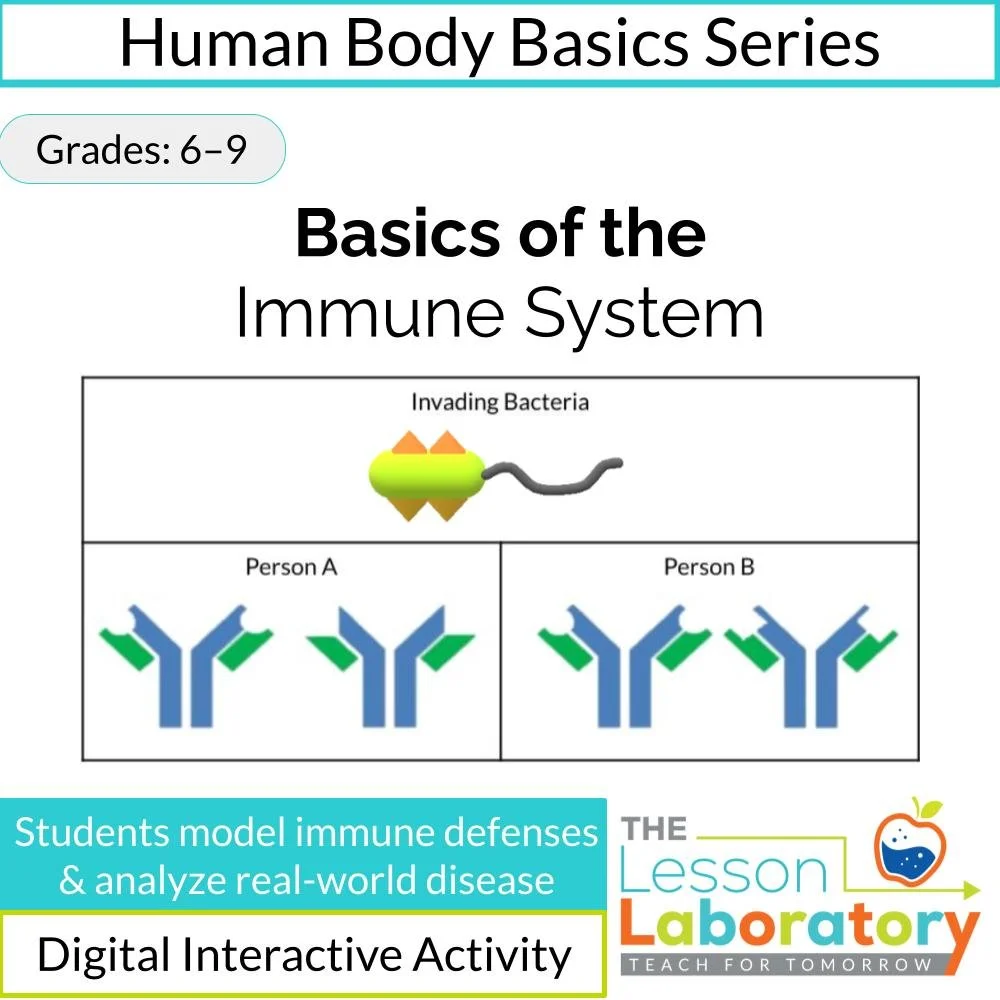
Students begin by reviewing the body’s first line of defense, including physical and chemical barriers. They then examine antigen–antibody interactions, focusing on shape specificity and immune memory. A guided modeling activity requires students to match antigens with corresponding antibodies and determine which individual would be protected from a particular pathogen based on antibody structure.
White blood cell function is revisited to reinforce internal defenses and coordinated immune responses.
After completing core instruction, students choose one of three tiered tasks to extend their understanding through media creation and analysis:
Level 1 – Allergies (Memes)
Students analyze allergy-related memes for scientific accuracy before creating an original meme that correctly explains allergic immune responses.
Level 2 – HIV & AIDS (Infographics)
Students interpret existing HIV infographics and then design their own, accurately communicating how HIV compromises immune defenses.
Level 3 – The Black Death (Short Articles)
Students examine concise readings about the bubonic plague and its long-term evolutionary impact. They summarize key ideas and compose a short article explaining how historical disease pressures shaped modern immune responses.
Each pathway requires students to translate immune system concepts into structured, evidence-based explanations.
Scaffolded notes on innate and adaptive defenses
Visual modeling of antigen–antibody specificity
Reinforcement of immune memory and pathogen response
Built-in differentiation through task choice
Integration of media literacy and scientific explanation
Teacher key and literacy-based exit ticket included
MS life science
High school general biology
Human Body Systems units
Mixed-ability classrooms requiring structured differentiation
This lesson balances direct instruction with applied analysis, allowing students to move from foundational immune concepts to real-world disease contexts in a single class period.
To preview this lesson, click here.
NGSS Alignment (High School):
HS-LS1-2; HS-LS1-3
NGSS Alignment (Middle School):
MS-LS1-3; MS-LS1-2
Science & Engineering Practices (SEPs):
Developing and Using Models
Constructing Explanations
Crosscutting Concepts (CCCs):
Cause and Effect
Systems and System Models
Common Core (Literacy in Science):
CCSS.ELA-LITERACY.RST.6-8.7 / RST.9-10.7; CCSS.ELA-LITERACY.WHST.6-8.2 / WHST.9-10.2
Interactive Notes + Meme, Infographic, or Article Task | High School Biology.
This structured digital lesson introduces students to the major components and functions of the immune system, moving from foundational barriers to adaptive immune specificity. Guided notes, visual modeling, and differentiated application tasks support both conceptual understanding and student ownership.
Students begin by reviewing the body’s first line of defense, including physical and chemical barriers. They then examine antigen–antibody interactions, focusing on shape specificity and immune memory. A guided modeling activity requires students to match antigens with corresponding antibodies and determine which individual would be protected from a particular pathogen based on antibody structure.
White blood cell function is revisited to reinforce internal defenses and coordinated immune responses.
After completing core instruction, students choose one of three tiered tasks to extend their understanding through media creation and analysis:
Level 1 – Allergies (Memes)
Students analyze allergy-related memes for scientific accuracy before creating an original meme that correctly explains allergic immune responses.
Level 2 – HIV & AIDS (Infographics)
Students interpret existing HIV infographics and then design their own, accurately communicating how HIV compromises immune defenses.
Level 3 – The Black Death (Short Articles)
Students examine concise readings about the bubonic plague and its long-term evolutionary impact. They summarize key ideas and compose a short article explaining how historical disease pressures shaped modern immune responses.
Each pathway requires students to translate immune system concepts into structured, evidence-based explanations.
Scaffolded notes on innate and adaptive defenses
Visual modeling of antigen–antibody specificity
Reinforcement of immune memory and pathogen response
Built-in differentiation through task choice
Integration of media literacy and scientific explanation
Teacher key and literacy-based exit ticket included
MS life science
High school general biology
Human Body Systems units
Mixed-ability classrooms requiring structured differentiation
This lesson balances direct instruction with applied analysis, allowing students to move from foundational immune concepts to real-world disease contexts in a single class period.
To preview this lesson, click here.
NGSS Alignment (High School):
HS-LS1-2; HS-LS1-3
NGSS Alignment (Middle School):
MS-LS1-3; MS-LS1-2
Science & Engineering Practices (SEPs):
Developing and Using Models
Constructing Explanations
Crosscutting Concepts (CCCs):
Cause and Effect
Systems and System Models
Common Core (Literacy in Science):
CCSS.ELA-LITERACY.RST.6-8.7 / RST.9-10.7; CCSS.ELA-LITERACY.WHST.6-8.2 / WHST.9-10.2