 Image 1 of 4
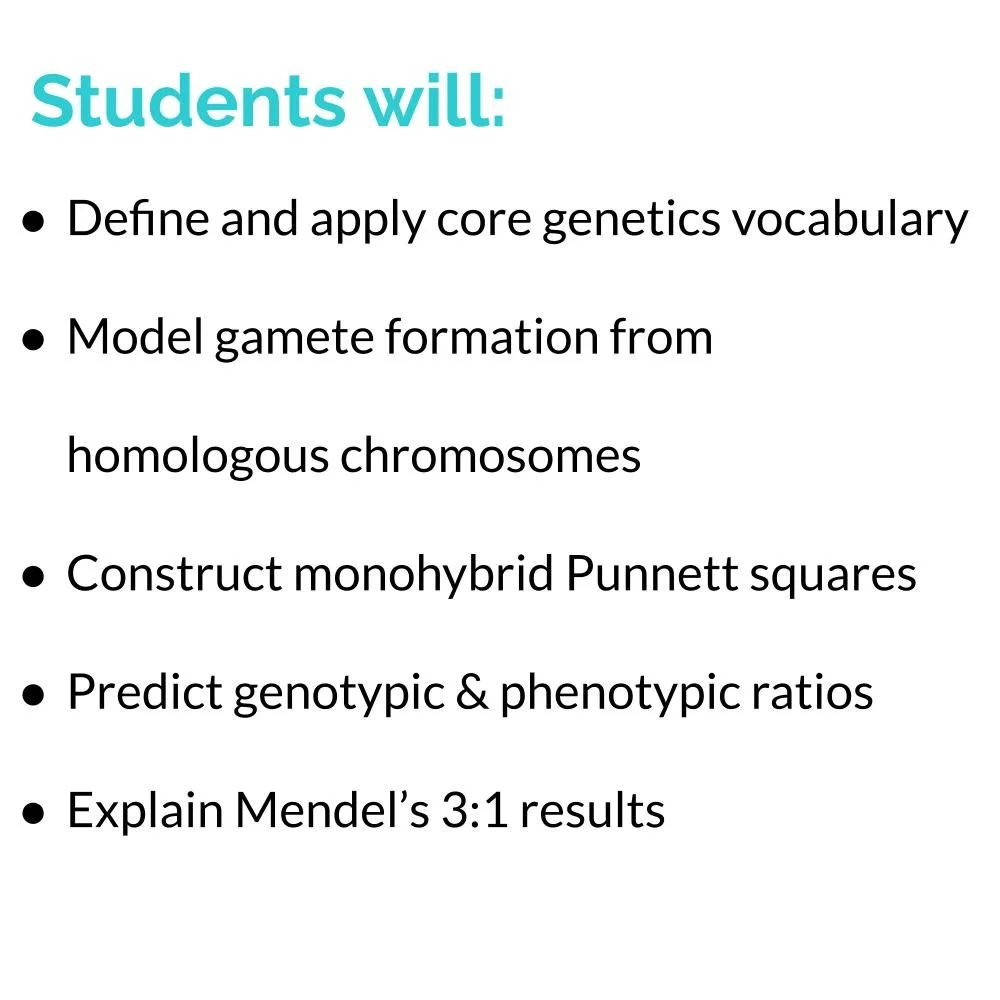 Image 2 of 4
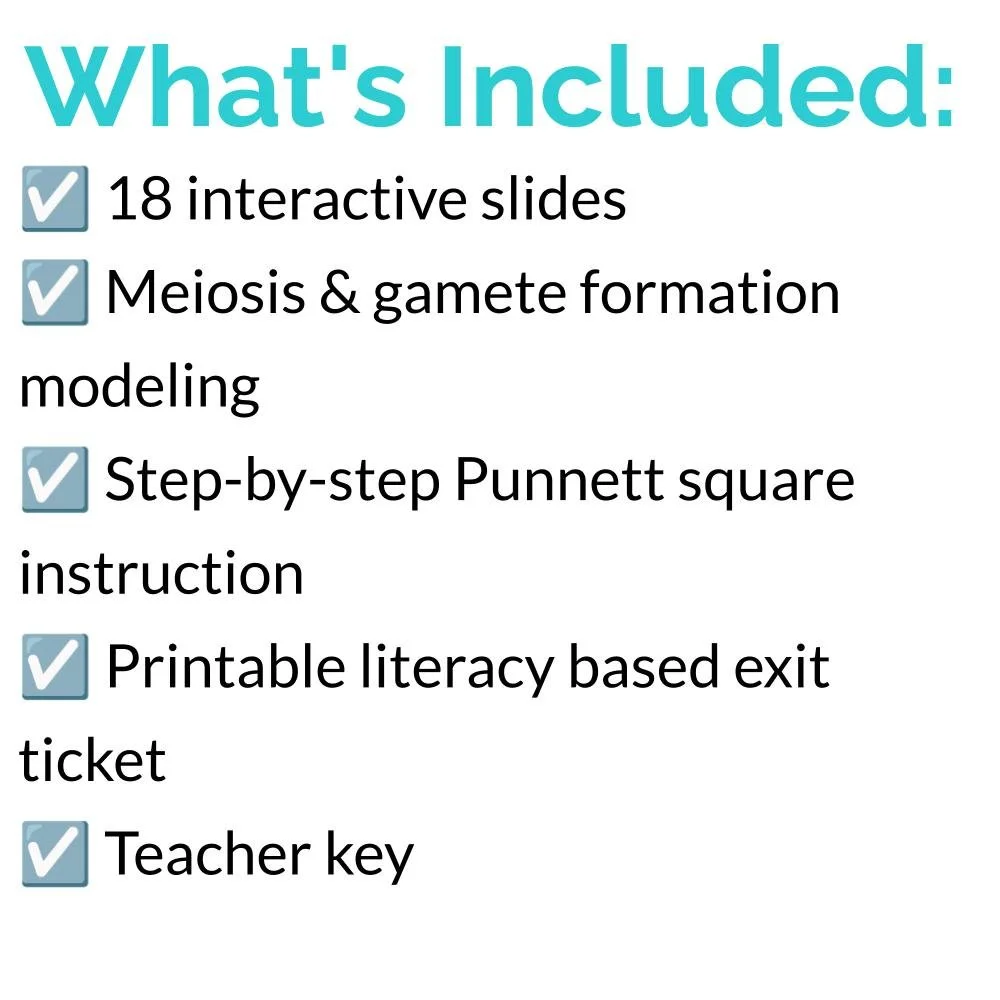 Image 3 of 4
 Image 4 of 4
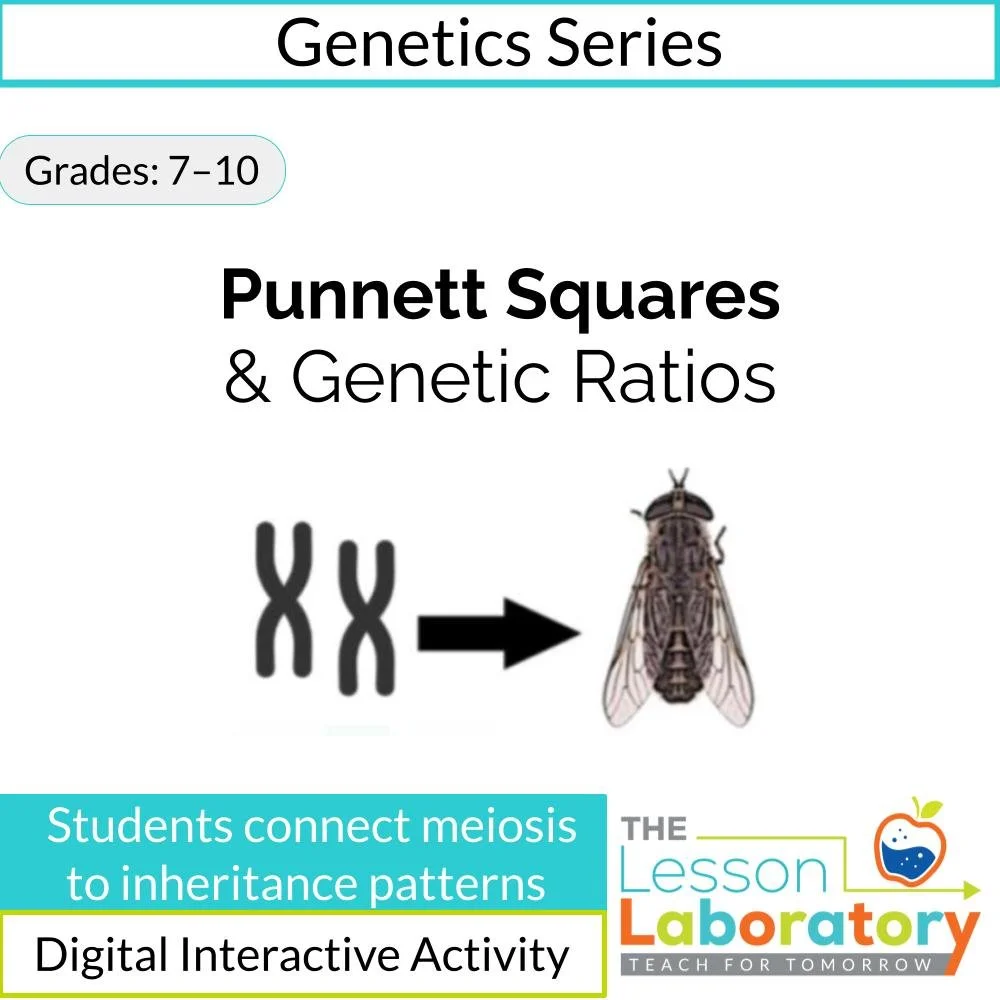
Hands-on genetics lesson with step-by-step modeling, guided practice, and real-world trait analysis.
This digital lesson introduces foundational genetics concepts and guides students through the logic of Mendelian inheritance. Students build from vocabulary precision to structured Punnett square analysis, connecting meiosis, gamete formation, and genetic probability.
The lesson begins with targeted review of essential terminology, including gene, allele, genotype, phenotype, homozygous, and heterozygous. Students then apply these concepts by identifying allele pairs, distinguishing genotype from phenotype, and classifying inheritance patterns.
From there, students model gamete formation and connect homologous chromosomes to allele segregation. This conceptual bridge supports accurate construction of monohybrid Punnett squares and prediction of genotypic and phenotypic ratios.
Students analyze Mendel’s F₁ and F₂ crosses, explain the origin of the 3:1 ratio, and examine how probability influences inheritance outcomes. A structured probability simulation reinforces the role of randomness in allele combinations. The lesson concludes with guided practice problems that require students to calculate and interpret offspring ratios.
This resource emphasizes conceptual clarity rather than isolated drill. By the end of the lesson, students understand not only how to construct a Punnett square, but why inheritance patterns occur as they do.
To see a preview of this lesson, click here.
NGSS Alignment (High School):
HS-LS3-2
NGSS Alignment (Middle School):
none- supports SEPs and CCCs
Science & Engineering Practices (SEPs):
Developing and Using Models
Analyzing and Interpreting Data
Using Mathematics and Computational Thinking
Constructing Explanations
Crosscutting Concepts (CCCs):
Cause and Effect
Systems and System Models
Patterns
Common Core (Math in Science):
CCSS.MATH.CONTENT.6.RP.A.3; CCSS.MATH.CONTENT.7.SP.C.7
Bundle Upgrade Policy
This lesson is included in one or more bundles. To support flexible purchasing and long-term use of our curriculum, Lesson Laboratory offers a bundle upgrade policy.
If you purchase this lesson and decide at a later date that you would like to upgrade to a bundle, you may request a store credit equal to the total amount paid for duplicate items.
To request an upgrade credit, please email thelessonlaboratory@gmail.com and include:
Your username
The order numbers for both the original purchase(s) and the bundle
The names of the duplicate resources
Requests must be submitted within 30 days of the bundle purchase. Credits are issued as store credit for future Lesson Laboratory purchases and are not provided as cash refunds.
This policy applies only to purchases of resources that are later included in a Lesson Laboratory bundle and is limited to one adjustment per upgrade pathway.
Hands-on genetics lesson with step-by-step modeling, guided practice, and real-world trait analysis.
This digital lesson introduces foundational genetics concepts and guides students through the logic of Mendelian inheritance. Students build from vocabulary precision to structured Punnett square analysis, connecting meiosis, gamete formation, and genetic probability.
The lesson begins with targeted review of essential terminology, including gene, allele, genotype, phenotype, homozygous, and heterozygous. Students then apply these concepts by identifying allele pairs, distinguishing genotype from phenotype, and classifying inheritance patterns.
From there, students model gamete formation and connect homologous chromosomes to allele segregation. This conceptual bridge supports accurate construction of monohybrid Punnett squares and prediction of genotypic and phenotypic ratios.
Students analyze Mendel’s F₁ and F₂ crosses, explain the origin of the 3:1 ratio, and examine how probability influences inheritance outcomes. A structured probability simulation reinforces the role of randomness in allele combinations. The lesson concludes with guided practice problems that require students to calculate and interpret offspring ratios.
This resource emphasizes conceptual clarity rather than isolated drill. By the end of the lesson, students understand not only how to construct a Punnett square, but why inheritance patterns occur as they do.
To see a preview of this lesson, click here.
NGSS Alignment (High School):
HS-LS3-2
NGSS Alignment (Middle School):
none- supports SEPs and CCCs
Science & Engineering Practices (SEPs):
Developing and Using Models
Analyzing and Interpreting Data
Using Mathematics and Computational Thinking
Constructing Explanations
Crosscutting Concepts (CCCs):
Cause and Effect
Systems and System Models
Patterns
Common Core (Math in Science):
CCSS.MATH.CONTENT.6.RP.A.3; CCSS.MATH.CONTENT.7.SP.C.7
Bundle Upgrade Policy
This lesson is included in one or more bundles. To support flexible purchasing and long-term use of our curriculum, Lesson Laboratory offers a bundle upgrade policy.
If you purchase this lesson and decide at a later date that you would like to upgrade to a bundle, you may request a store credit equal to the total amount paid for duplicate items.
To request an upgrade credit, please email thelessonlaboratory@gmail.com and include:
Your username
The order numbers for both the original purchase(s) and the bundle
The names of the duplicate resources
Requests must be submitted within 30 days of the bundle purchase. Credits are issued as store credit for future Lesson Laboratory purchases and are not provided as cash refunds.
This policy applies only to purchases of resources that are later included in a Lesson Laboratory bundle and is limited to one adjustment per upgrade pathway.